
by Joseph DeMaio, ©2026

(Nov. 16, 2026) — Introduction
Part of the dark and dreadful aftermath of the Democrat successes in the recent midterm election is a renewed examination of the National Popular Vote Interstate Compact, the “NPVIC.” As elsewhere noted here and here, the NPVIC may be – as some would claim – on course for implementing an “end-around-run” on the Constitution’s Electoral College regarding how the Republic elects its President and Vice President without amending the founding document and all but assuring that no GOP president will ever again occupy the Oval Office. Not a prudent potential.
Your humble servant normally addresses here at The P&E the topics of “birthright citizenship” and, primarily, presidential eligibility as a “natural born Citizen.” The following offering, however, will address the menace to the Republic presented by the NPVIC and why SCOTUS – and sooner rather than later – should intervene to preserve the Founders’ intent in creating the Electoral College in the first place.
Moreover, since a “deep dive” into the “pros and cons” of the Electoral College would render this offering even longer than it already is, that option will be avoided and left to interested P&E readers to explore. Instead, your servant seeks to present for examination the narrow relationship between the NPVIC and the recent (2020) SCOTUS decision in Chiafalo v. State of Washington and how that decision may stand in the way of the NPVIC becoming effective nationwide.
Interested? Read on.
Legal Analysis
Distilled to its essence, the NPVIC is a compact or agreement among several of the states of the Union under which each participating state agrees to require its presidential electors to cast their Electoral College ballots in favor of the presidential candidate (and his/her vice presidential running mate) who garnered the most popular votes nationwide rather than the popular votes garnered in that particular state. Once the total number of states with a collective total of at least 270 electoral votes – the required number to be elected President – have joined the compact, it would go into effect and control all future presidential elections…, unless otherwise invalidated or if prior member states reversed course and revoked their membership.
The ultimate effect, of course, would be to ensure election of the ticket which received a raw majority of the nationwide popular votes cast rather than as now, a majority of the electoral votes counted, to actually elect a president.
There are many arguments for and against the legality of the NPVIC, but it is generally agreed among the “experts” that SCOTUS has not yet directly addressed the compact’s purported constitutionality. The negative arguments include that the agreement would need to be approved by Congress under the Compacts Clause of the Constitution (BTW, a much easier task following the midterm election) or that it is invalid as constituting an attempt to neuter the Electoral College without a formal amendment of the Constitution.
However, it is posited that one argument that has thus far not been adequately examined is that, by requiring a particular state’s presidential electors to cast their ballots for the winner of the nationwide popular vote, rather than the winner of that state’s popular vote winner, a disenfranchisement of that state’s voters will occur. The political preferences of large populous “blue states” will overwhelm the preferences of smaller “red or purple” states, a situation the Founders specifically sought to avoid. It is one of the reasons this is properly called a “republic” rather than a “democracy,” where more often than not, “mob rule” prevails.
The NPVIC proponents ignore or dismiss this concern as fatuous: even without a formal “compact,” the individual states could themselves decide independently to abandon the current “winner take all” model for only their state and adopt the same “winner-of-the-nationwide-popular-vote-gets-all-of-our-state’s-electoral-votes” protocol consistent with the Constitution.
This is where the Chiafalo decision might present a problem.
To begin with, that decision involved three so-called “faithless electors” who each breached their Electoral College elector pledge to cast their ballots for Hillary Clinton in 2016, inconsistent with Washington law governing their obligations, and instead voted for Colin Powell (odd, since he wasn’t even in the 2016 Oval Office mix).
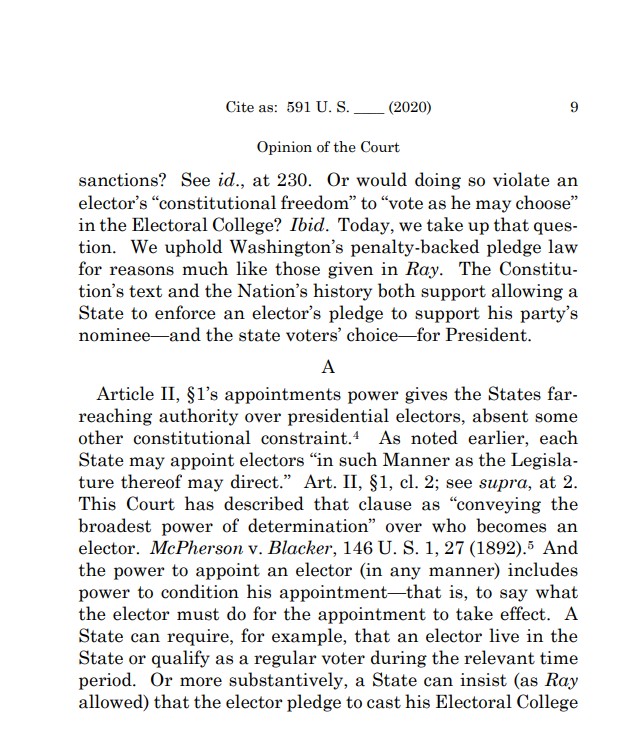
The electors were fined and their votes were voided. After unsuccessful appeals in the lower Washington courts, SCOTUS upheld the fines and voiding of their votes, thus holding that the states have the “broadest authority” to condition the way electors must vote and unanimously rejecting the argument that presidential electors are free to “vote their consciences,” even if it meant violating their pledge to vote for the candidate who won Washington’s 2016 popular vote: Hillary Clinton.
Indeed, the author of the opinion, Justice Kagan, cited in a footnote the example of a voter’s anger in 1796 to a “faithless elector’s” voting of his “conscience” as opposed to what he had pledged and was expected to do: “An irate voter reacted: ‘[W]hen I voted for the [Federalist] ticket, I voted for John Adams. . . . What! do I chuse Samuel Miles to determine for me whether John Adams or Thomas Jefferson is the fittest man for President of the United States? No—I chuse him to act, not to think.” See Gazette of the United States, Dec. 15, 1796, p. 3, col. 1 (emphasis in original).”
While the Chiafalo decision is instructive on how SCOTUS might be expected to rule in future faithless elector cases, it is the informative backdrop of its reasoning with regard to the Founders’ intent in creating the Electoral College in the first place that becomes important in addressing the “collective” nationwide aggregation of popular votes residing at the core of the NPVIC which deserves more attention.
Specifically, throughout the decision, the Court emphasizes that the Founders’ intent was to observe and preserve each of the states’ voters’ preferences for presidential aspirants as revealed in that state’s popular vote, rather than an aggregated total of all states’ preferences as revealed in a conglomeration of all states’ popular vote totals. The NPVIC disregards, in effect, the preferences of one particular state’s voters, substituting the collective preferences of all participating states nationwide.
For example, Justice Kagan notes (joined by all other Justices) (Chiafalo at 16): “Washington’s law, penalizing a pledge’s breach …, reflects a tradition more than two centuries old. In that practice, electors are not free agents; they are to vote for the candidate whom the State’s voters have chosen.” (Emphasis added).
The NPVIC disregards this language selected by Justice Kagan (and ratified by all of the other Justices). The phrase “whom the State’s voters have chosen…” is not synonymous with “whom the State’s voters have not chosen.” By permitting a state’s legislature and governor to supplant and substitute the voting preferences of a particular state’s electorate with a collective nationwide “preference” in which they have not participated is not merely unwise, it is likely unconstitutional.
Finally, as for the argument that Justice Kagan’s observations in Chiafalo constitute non-precedential side comment “dictum,” they are at minimum “judicial dictum” entitled to precedential deference by lower federal courts. Moreover, as noted in United States v. Watkins, 10 F.4th 1179, 1182 (11th Cir. 2021): “There is dicta, and then there is dicta, and then there is Supreme Court dicta.” (Emphasis added)
Thus, even if a state disregards as dicta Justice Kagan’s observation in Chiafalo and joins the NPVIC, it may be for naught: SCOTUS may need – again, sooner rather than later – to directly address the constitutionality of the NPVIC well before the 2028 General Election, particularly if states not presently signatories to the compact and possessed of enough electoral votes to reach the magic 270 vote plateau become members in time to affect the 2028 election. The NPVIC presently has 18 compact member states (and the District of Columbia) with a total of 222 electoral votes, a mere 48 votes short of 270…, and the clock is ticking.
At minimum, the issue needs to be addressed by the electorate at large, which this post hopes to incentivize. We are, after all, only proposing to alter the way in which our Presidents and Vice-Presidents are selected…, even assuming they otherwise are eligible “natural born Citizens” without even going through the motions of crafting a constitutional amendment.
And as the adage warns: “Haste makes waste.” While many would support making waste of the Republic by eliminating the Electoral College, the Founders would resist. And so should you.
Leave a Reply