
by Joseph DeMaio, ©2026
(Aug. 22, 2026) — INTRODUCTION

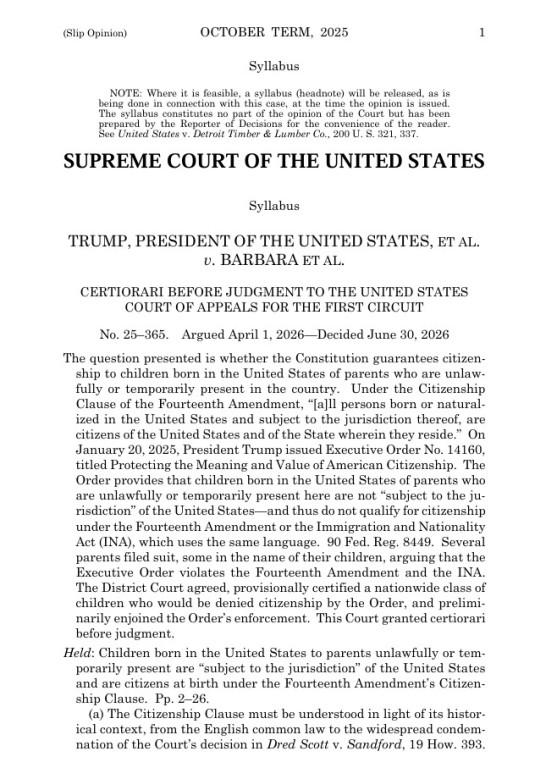
The recent SCOTUS decision in Trump v. Barbara – holding, among other things, that if born here on U.S. soil, the child of an illegal alien or a foreigner unlawfully present here is nonetheless a U.S. citizen – continues to produce fallout. While technically not radioactive, the fallout is nonetheless unhealthy to the continued wellbeing of the Republic. If you doubt that, just read the dissenting opinions of Justices Thomas and Alito and the partial dissent of Justice Kavanaugh.
Your humble servant has addressed the decision and the shortcomings of the majority opinion here. The following offering will take a slightly “deeper dive” into the potential impact of the decision on future scholarship and analysis of the relationship between a “citizen” for 14th Amendment purposes, post-Barbara, and a “natural born Citizen” (“nbC”) as understood and adopted by the Founders in Art. 2, § 1, Cl. 5 of the Constitution itself, the “Presidential Eligibility Clause.”
While the Barbara decision addresses who may constitute a U.S. “citizen” under the 14th Amendment, it is a long way from being determinative of what the Founders considered to be an “nbC” when the Constitution was drafted, adopted and ratified “back in the day.” Stated otherwise, while the 14th Amendment “citizen” and Eligibility Clause nbC issues are different, the two concepts are not totally unrelated. The Barbara majority opinion, erroneously focusing on the Court’s prior flawed decision in United States v. Wong Kim Ark (read the dissenting opinion of Chief Justice Fuller and concurring dissent of Associate Justice Harlan) ruled that the citizenship principle of jus soli (citizenship determined by the soil or place of birth) was what the Framers of the Fourteenth Amendment intended when using the phrase “subject to the jurisdiction [of the United States].” In so ruling, the Court rejected any role for the citizenship principles of jus sanguinis (citizenship by parental bloodline or descent),
The fallout from the ruling in Barbara, while facially affecting only the “citizenship” analysis for persons under the 14th Amendment, will undoubtedly be leveraged by those insisting that merely if one is a “citizen at/by/from birth” under jus soli principles, with no other qualifications, such will suffice to deem one an nbC for presidential eligibility purposes.
Respectfully, your humble servant begs to differ.
LEGAL ANALYSIS
Apart from the fact that the 14th Amendment – the sole issue before SCOTUS in its Barbara decision – was not in existence in 1787, it is beyond dispute that one of the primary – if not the sole – concerns of the Founders when drafting Art. 2, § 1, Cl. 5 of the Constitution, the nbC presidential Eligibility Clause, was to shield the office of the “Chief Magistrate,” eventually to become the Presidency, from both the actuality as well as the potential for the insinuation into it of “foreign influence.” Whether or not that remains a legitimate concern in 2026 – as opposed to 1787 – is a different question: when the Constitution was drafted, adopted and eventually ratified to become operational, that was their original concern. If that is to change, a constitutional amendment is required.
Your servant has also addressed the nbC issue in the context of a law review article published in 2015 titled “On the Meaning of Natural Born Citizen.” The article (addressed and critiqued here, here and here) was co-authored by two well-credentialed former Justice Department Solicitors General, Paul Clement (Solicitor General 2005-2008 under President George W. Bush) and Neal Katyal (Acting Solicitor General, 2010-2011 under President Obama). That article posited that an nbC was “a citizen at birth, with no need to go through a later naturalization proceeding.”
The article rejected – dismissively – any need for birth on U.S, soil, calling Senator Ted Cruz’s birth in Alberta, Calgary, Canada a purportedly irrelevant “happenstance” rather than an eligibility disqualifier. Their definition of an nbC additionally ignored dual parental U.S. citizenship altogether, claiming that the U.S. citizenship of the senator’s mother alone sufficed for nbC purposes, the senator’s father being a Cuban national at his birth. So much for the “place of birth alone” or “jus soli prevails” principle. The “dual parent” citizenship issue was disregarded, except with reference to the 1790 Naturalization Act (1 Stat. 103), which was repealed less than five years after its enactment by the 1795 Naturalization Act (1 Stat. 414).
But I digress.
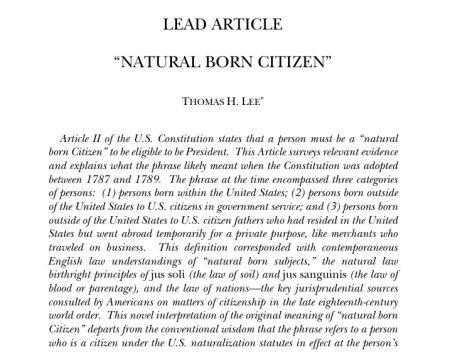
The shortcomings of the law review article by Messrs. Clement and Katyal aside, in another law review article two years later (2017) by Fordham University Law School Professor Thomas Lee, the nbC conundrum is again examined, but in that article without the advocacy overtones supporting Senator Cruz’s purported eligibility found in the Clement/Katyal article.
Interestingly, after a detailed examination of the historical backdrop of the nbC clause, Professor Lee arrives at the conclusion that the Founders relied on both the jus soli and jus sanguinis doctrines when fashioning their nbC restrictions. Indeed, he states in his conclusion: “My findings on the original meaning of the Natural Born Citizen Clause reveal that it was not grounded exclusively on jus soli or jus sanguinis, but rather incorporated both natural law principles.” (Emphasis added) The significance of Professor Lee’s conclusion lies in its recognition of the “original meaning” of the term (i.e., as understood and adopted by the Founders in 1787 rather than as postulated by well-credentialed lawyers in 2015…, or even 2026 or subsequent).
Moreover, his conclusion that the Founders likely relied on both jus soli and jus sanguinis principles when selecting the nbC barrier to foreign influence makes perfect sense, given the Founders’ desire to preclude, rather than simply impede or frustrate foreign influence. Serendipitously, that “blended” doctrinal approach to defining what the Founders (including, parenthetically, John Jay when “hinting” to George Washington that the presidency be restricted to a “natural born Citizen”) was already available in Book 1, Ch. 19, § 212 of Emer de Vattel’s treatise, The Law of Nations, a resource well-known to and relied upon by the Founders.
As articulated by Supreme Court Justice Joseph Story in his authoritative treatise “Commentaries on the Constitution of the United States” (§ 1473: “It is indispensable, too, that the president should be a natural born citizen of the United States; or a citizen [of the United States] at the [time of the] [A]doption of the constitution, and for fourteen years before his election. This permission of a naturalized citizen to become president [i.e., the “citizen-grandfather clause] is an exception from the great fundamental policy of all governments, to exclude foreign influence from their executive councils and duties. It was doubtless introduced (for it has now become by lapse of time merely nominal, and will soon become wholly extinct) out of respect to those distinguished revolutionary patriots, who were born in a foreign land, and yet had entitled themselves to high honours in their adopted country. A positive exclusion of them from the office would have been unjust to their merits, and painful to their sensibilities. But the general propriety of the exclusion of foreigners, in common cases, will scarcely be doubted by any sound statesman. It cuts off all chances for ambitious foreigners, who might otherwise be intriguing for the office; and interposes a barrier against those corrupt interferences of foreign governments in executive elections, which have inflicted the most serious evils upon the elective monarchies of Europe. Germany, Poland, and even the pontificate of Rome, are sad, but instructive examples of the enduring mischiefs arising from this source.” (Emphasis added)
Accordingly, Justice Story’s observation validates two things. First, it confirms that, at least in his view, the “Citizen at the time of the Adoption of the Constitution” exception from the nbC restriction was a “naturalized” citizen, and not a “citizen at/by/from birth.” Second, it confirms that the Founders’ intent was to “exclude” foreigners from the office, not merely “restrict them under certain undefined circumstances” or permit “some” or a “few” opportunities or chances for “ambitious foreigners” to enter or occupy the office.

.jpg)
Justice Story’s observations also mirror precisely the sentiments expressed in two of the more important documents informing the Founders’ intent in adopting the nbC restriction into the Constitution, i.e., (1) the July 25, 1787 “hint” letter written by Founder John Jay to the Chair of the Constitutional Convention, George Washington, already noted, and (2) the Mar. 12, 1788 Federalist 68 article authored by Founder Alexander Hamilton under the pseudonym “Publius.”
The “hint” letter, of course, had the goal of persuading General Washington to support and advocate to the Constitutional Convention Delegates the strongest barrier to the potential for foreign influence insinuating itself into the presidency, i.e., the “commonly understood” impediment of the nbC restriction. This happened when the Delegates rejected the Madison-Pinckney “citizen” amendment proposed on Aug. 22, 1787 and instead adopted the “natural born Citizen” substitute amendment offered and recommended by the Committee on Postponed Matters on Sept. 4, 1787. Moreover, Hamilton’s Federalist 68 article (untitled) echoed the same objective of persuading the voters of New York – and those of any other state happening to see the Federalist collection – to ratify the Constitution in order to preclude, among other things, the attempt by foreigners to “gain an improper ascendant in our councils … by raising a creature of their own to the chief magistracy of the union.” (Emphasis added) This is what the nbC Eligibility Clause seeks to prevent.
Indeed, because each and all of the first seven presidents – from Washington to Jackson – had been “born in a foreign land,” viz., in one of the Colonial States of British America prior to July 4, 1776, in the absence of the citizen-grandfather exception from the robust nbC restrictions as then intended and understood by the Founders, none of them could have constitutionally served as President.
The first “home grown” president born in the United States of America was Martin Van Buren in 1837, born to Abraham Van Buren and Maria Hoes Van Alen, both of whom were citizens of the British Colonial State of New York in 1776 when, by operation of the Declaration of Independence, they both became naturalized U.S. citizens. When Martin Van Buren was born in 1782 in Kinderhook, New York, United States of America, to U.S. citizen parents, he therefore fit precisely the nbC template created and adopted by the Founders without the need for reliance on or reference to the citizen-grandfather clause, as he was not yet born “at the time of the Adoption of [the] Constitution.”
Professor Lee’s blended “jus soli/jus sanguinis” conclusion as to the Founders’ original intent is entirely consistent with another principle espoused by E. de Vattel: § 216 of his treatise, providing in part that as to children born “at sea,” “… naturally, it is our extraction, not the place of our birth, that gives us rights.” (Emphasis added). A more succinct and direct validation of the jus sanguinis principle would be difficult to construct.
All of the foregoing points but in one direction: the Founders intended that an nbC for their purposes in their new Constitution meant a person born here to parents both of whom were already U.S. citizens. It was not enough for only one parent to be a U.S. citizen: both parents needed to be citizens.
In addition, as noted by Professor Lee in his review article, there is nothing inconsistent or internally conflicted with positing that, in seeking the highest practical barrier to foreign influence invading the presidency, the Founders selected the blended jus soli and jus sanguinis doctrines embodied in the de Vattel § 212 definition of a natural born citizen.
Stated otherwise: since the Constitution was being written, essentially, on a tabula rasa, what person or nation possessed the authority to dictate otherwise? The Congressional Research Service was not in existence in 1787; Messrs. Clement and Katyal had not yet published their “authoritative” law review article; and the decision in Trump v. Barbara was some 240 years in the future. If the “scholars” and “experts” want a different result than what the empirical historical facts confirm or by anecdotal inference establish, they should proceed with an amendment to the Constitution altering (or, as some would favor eliminating) the nbC restriction. But they err badly when they contend that “up” means “down” (unless you are in orbit or traveling in space) or that the word “penalty” actually means “tax” or that Emer de Vattel was either unknown or irrelevant to the Founders. Those contentions give new meaning to the term “fatuous.”
And finally, the contention by Messrs. Clement and Katyal that the nbC concept of the 1790 Naturalization Act has “remained constant” – presumably meaning unchanged since 1790 (“The proviso in the Naturalization Act of 1790 underscores that while the concept of ‘natural born Citizen’ has remained constant and plainly includes someone who is a citizen from birth by descent [again, so much for the “jus soli alone claim] without the need to undergo naturalization proceedings, the details of which individuals born abroad to a citizen parent qualify as citizens from birth have changed….” – is demonstrably and manifestly wrong.
First, the 1790 Act contains two provisos, neither of which relate to the issue of the need for both parents to be U.S. citizens at the time of their child’s birth, at least as the Founders understood the term to mean in 1787. Second, any “concept” that a child born outside the geographic limits of the United States, if born to U.S. citizen parents, was “considered” to be a “natural born Citizen” evaporated when the 1790 law (1 Stat. 103) was repealed by Congress in 1795 (1 Stat. 414), with the “considered as natural born Citizens” language repealed and replaced by the language “considered as citizens …,” – but not, significantly, “natural born” – neither of which provisos relate to the question of the need for birth here to two U.S. citizen parents if the higher, rather than the lower, barrier to foreign influence adopted by the Founders in the Eligibility Clause is to be observed.
CONCLUSION
At the end of the day, the question to be answered is simply this: against the backdrop of the Founders’ undisputed goal of insulating the office of the Chief Magistrate from the disfavored and feared insinuation of foreign influence into the office, why would they have selected a definition of an nbC which erected a lower and inferior barrier to such a result – the sole British common-law principle of jus soli – when a known available higher and superior barrier – the de Vattel § 212 blended definitional barrier – existed?
The answer – clear to some, but opaque to others – is that they did not adopt the inferior, lower barrier, but instead consciously and intentionally selected the superior, higher barrier. Politically-motivated or result-oriented arguments to the contrary are merely intellectual goo. If the empirically accurate result – an nbC being a person born here to parents both of whom are already U.S. citizens – needs to be changed, the only proper and constitutional way of doing it is by an Article 5 amendment, not another poorly-reasoned opinion from SCOTUS.
The Barbara decision, flawed as it may be, should not impact the reality of the Founders’ intent in enacting the nbC clause in 1787. If that is to change, a constitutional amendment is the only proper path to take …, and intellectual goo along the pathway should be avoided.
Leave a Reply