
by Sharon Rondeau

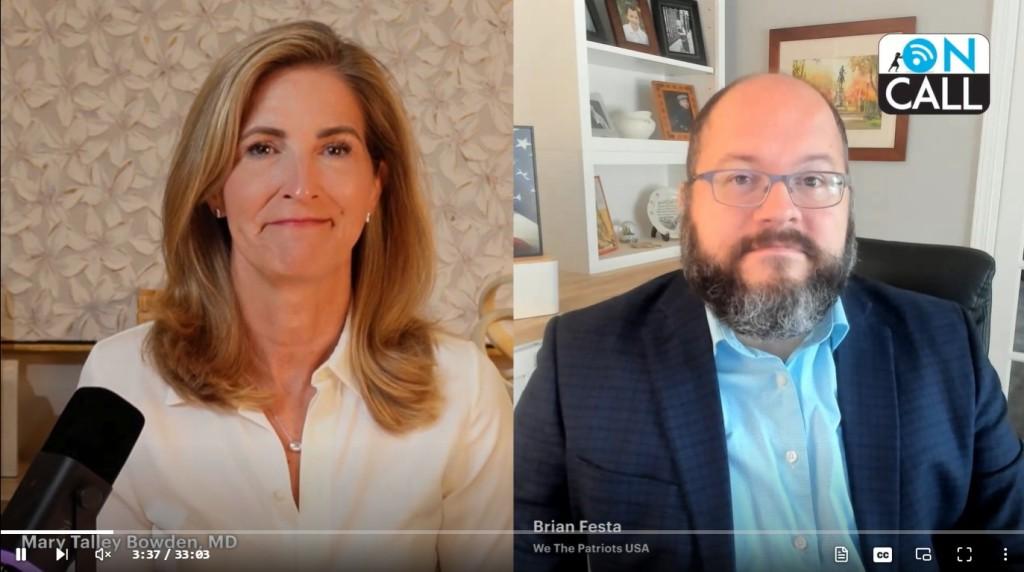
(Aug. 23, 2026) — In a recent episode of her podcast, “On Call,” Dr. Mary Talley Bowden, MD interviewed Atty. Brian Festa of We the Patriots USA, a non-profit law firm advocating for the restoration of religious exemptions to government-issued mandates for schoolchildren.
Early in the interview, Festa presented the argument that as a result of the U.S. Supreme Court’s 2025 6-3 opinion in Mahmoud v. Taylor favoring parents’ right to opt their children out of certain curricula which violate their “sincere views,” religious objections to mandated vaccinations should also be honored.
Festa is currently litigating a similar case arising in Connecticut, one of five remaining states barring religious exemptions to vaccines by school-board edict, in the case of West Virginia, or legislation in Maine, California, Connecticut and New York.
On February 6, 2026, 13 members of Congress wrote a letter to then-U.S. Attorney General Pamela Bondi and U.S. Assistant Attorney General, Civil Rights Division Harmeet Dhillon “urging” the Justice Department to “exercise its authority to investigate” the states “for potential violations of constitutionally protected rights” pertaining to religious freedom.
At the time, the states numbered four as a result of an executive order issued by West Virginia Gov. Patrick Morrissey “allowing for religious exemptions from compulsory school vaccines for K-12 public, private and parochial schools, and State-regulated child care centers.”
West Virginia maintained no law in favor of or barring religious exemptions for vaccines.
Morrissey’s order was challenged in court and later declared invalid by the West Virginia Board of Education upon a ruling favorable to the plaintiffs by the state’s supreme court.
Originating in Maryland and decided by the U.S. Supreme Court last year, the Mahmoud plaintiffs consisted of a number of parents and “other interested parties” who filed suit against the Montgomery County Board of Education for rescinding its established “opt out policy” on the basis that it “could not accommodate the growing number of opt out requests without causing significant disruptions to the classroom environment.”
The Court’s majority opinion reads, in part:
Parents challenging the Board’s introduction of the “LGBTQ+-inclusive” storybooks, along with its decision to withhold opt outs, are entitled to a preliminary injunction…
…Without an injunction, the parents will continue to suffer an unconstitutional burden on their religious exercise, and such a burden unquestionably constitutes irreparable injury.
Justices Kagan, Sotomayor and Jackson dissented, writing, in part:
“Public schools, this Court has said, are “‘at once the symbol of our democracy and the most pervasive means for promoting our common destiny.’” Edwards v. Aguillard, 482
U. S. 578, 584 (1987). They offer to children of all faiths and backgrounds an education and an opportunity to practice living in our multicultural society. That experience is
critical to our Nation’s civic vitality. Yet it will become a mere memory if children must be insulated from exposure to ideas and concepts that may conflict with their parents’ religious beliefs.
Festa referenced an adverse Second Circuit Court of Appeals opinion in a case, Miller v. McDonald, brought by Amish families and three schools against the New York State Health Commissioner and Education Commissioner claiming their First and Fourteenth Amendment rights were violated from the legislature’s 2019 repeal of a law granting religious exemptions to vaccine mandates.
The plaintiffs appealed to the U.S. Supreme Court, which reversed the Second Circuit’s finding and remanded the case for reconsideration “in light of Mahmoud v. Taylor.”
On June 30, 2026 the Second Circuit issued a second adverse ruling against the plaintiffs, concluding, in an unsigned opinion:
We have reconsidered our decision in light of Mahmoud, the parties’ supplemental briefs, and their Rule 28(j) submissions, and we adhere to our decision. We have also reconsidered Plaintiffs’ remaining arguments and find them to be without merit. For the foregoing reasons, the judgment of the district court is AFFIRMED.
During the discussion, Festa detailed the developments in both Mahmoud and Miller:
So we have two very, very important decisions from the Supreme Court very recently saying that parents have the right to opt out of things in school on religious grounds. Well, if you can opt out of curriculum, you should be able to opt out of mandatory vaccination; it seems like a no-brainer, but the Second Circuit still said “No.”
…I don’t really understand their logic…they see it as somehow less invasive of religious freedom to force parents to have their children vaccinated than to be teaching about a different worldview in the classroom…Vaccination can’t be undone, right? That’s what we argue in our case, because we have an identical case, really, to this. …You can undo bad teaching; if you’re a good parent, you can counter that with teaching at home. You can’t counter — Once you’re vaccinated, that’s it.
“Aren’t we protected by the Constitution from this?” Bowden asked.
“The Dobbs decision, which I agree with,” Festa replied, “…that overturned Roe v. Wade,… said, correctly, I believe, that there is no bodily autonomy right found in the Constitution. Previously they looked at the Fifth Amendment; they looked at some other amendments, Fourteenth Amendment, and came up, sort-of just crafted in the Roe v. Wade decision, they just sort-of invented this sovereign-bodily right that was never expressly written in or really even implied in the Constitution… In the case of abortions, obviously that’s a different issue than receiving a vaccination.
“…In this case, with vaccination, with any issue, they’ve never found — other than the abortion issue; that was the outlier which has been overturned now — there was this right to bodily autonomy found in the Constitution, because it’s not there…That’s why we go the religious freedom route, because there is an express right to opt out on religious grounds. That’s where the issue is…under the Constitution, it’s clearly unconstitutional to force someone to do something that’s violates their religious beliefs.”
Miller will be refiled with the Supreme Court, plaintiffs’ advocate Atty. Aaron Siri wrote on his Substack on July 28.
The “legal issues are the same” as those in Miller, Festa told Bowden. “Milford Christian Church…continued to allow religious exemptions, just like the Amish schools did…A Christian school should be allowed to honor their families’ religious beliefs. So even after Connecticut abolished the religious exemption in 2021, they continued to allow religious exemptions for the families. The State of Connecticut had an inspector — believe it or not, yes, that was the person’s job title (sounds like where I live in communism, right?) –…an inspector came in to inspect the vaccination records and found that…they were indeed continuing to allow religious exemptions.”
“‘You have to do one of two things,’” Festa told Bowden the state inspector told the Christian daycare and school, “‘or we’re going to shut you down: you can either force all these students to catch up on their vaccinations or you can expel all the ones that are unvaccinated. If you don’t do one of those two things, we are going to shut you down…’
“Luckily, they called We the Patriots USA, and we filed a federal lawsuit; now, this was in 2023…We are now pending a decision at the Second Circuit; we had oral argument back in April. The panel seemed to indicate that they wanted to wait until Miller was decided…Well, now that’s been decided, we expect a decision any day now. Of course, we expect it to be the same. I don’t want to speak for the judges, but I’d be shocked if they issued a different decision than another panel in the same circuit…we expect that it will be dismissed, and then we will be petitioning for review at the U.S. Supreme Court. I can’t speak for what the attorneys on the Amish case are going to do.
It’s no surprise that these cases are being dismissed; these are the same arguments that we had previously made before the same court in another case challenging Connecticut’s religious-exemption repeal when the law first was enacted, and that case ultimately was also dismissed…but this is the Second Circuit. We believe these are very incorrect decisions and these need to be looked at by the Supreme Court and overturned. And so this is our opportunity to do so; I think it’s the best opportunity we’ve ever had…they have shown a strong, strong willingness to defend and uphold religious liberty, especially when it comes to parents’ parental rights.”
“If you succeed at the Supreme Court level, does that set a precedent for the entire country?” Bowden asked.
“Yes,” Festa responded. “So if the Supreme Court says that it’s unconstitutional for a state to refuse, to honor, religious exemptions, that schools are not allowed to –…if it violates the Constitution in Connecticut and New York, then it violates the Constitution everywhere.”
“…Sometimes the Supreme Court can issue a narrow decision,” Festa said, which in this case could limit any decision favorable to the plaintiffs to religious institutions only. “Then it would only apply to all of the religious schools in the United States.”
“If it’s not narrow…then that’s going to apply to everywhere to everyone,” he said.
Leave a Reply