

by Joseph DeMaio, ©2024
(Apr. 2, 2024) — [Update, 5:58 p.m. EDT April 8, 2024: The last three paragraphs of the following initial segment of the author’s three-part analysis has been amended to reflect a discovered change in the subject article’s footnote #4.]
Introduction
In 2015, two former high officials in the Office of the Solicitor General in the U.S. Department of Justice – Messrs. Paul Clement, a Republican, and Neal Katyal, a Democrat – jointly authored an article on the Constitution’s “natural born Citizen” term (hereafter, for brevity, “nbC”). Entitled “On the Meaning of ‘Natural Born Citizen,’” the article appeared in the March 2015 edition of the Harvard Law Review Forum (128 Harv.L.Rev.F. 161), which describes itself as the “the online companion to the print journal (i.e., the Harvard Law Review) and where “[i]t hosts scholarly discussion of our print content and timely reactions to recent developments.” Even today, the article is still widely cited as an authoritative source on the nbC issue, thus now warranting a revisiting for a more detailed examination of its contents.
By way of background, Paul Clement was nominated in 2005 by President George W. Bush to be the 43rd Solicitor General of the United States. He served in that capacity – well and honorably – between 2005 and 2008. After graduating magna cum laude from Harvard Law School, he clerked (1993-1994) for Associate Supreme Court Justice Antonin Scalia, in your humble servant’s view, one of the best Supreme Court Justices of the last century.
Neal Katyal is a former Acting Solicitor General of the United States (2010-2011) and Principal Deputy Solicitor General (2011), having been appointed by President Barack Obama to replace at the Office of the Solicitor General now-Supreme Court Justice Elena Kagan. After graduation from Yale Law School, he clerked (1996) for Associate Supreme Court Justice Stephen Breyer.
Both gentlemen (hereafter, for brevity, “C&K”) now lecture at the Georgetown University Law Center and practice law in the Washington, D.C. area. Accordingly, both attorneys are, shall we say, well-educated and well-credentialed. That said, however, even well-educated and well-credentialed lawyers occasionally can arrive at questionable and even erroneous conclusions.
Although your humble servant has in the past addressed here at The P&E various aspects of their 2015 article – which concluded, among other things, that Senator Ted Cruz was an nbC under the Constitution and thus eligible to the presidency – the following critique is intended to be a “deeper dive” into the article and its many legal interstices.
Spoiler alert: it is your servant’s view that the article reaches the erroneous conclusion that if a person is merely a “citizen at birth” or a “citizen by birth,” with no need for subsequent naturalization to be a U.S. citizen, and regardless of place of birth or the U.S. citizenship status of both parents, as long as one is a U.S. citizen, that person qualifies as an nbC.
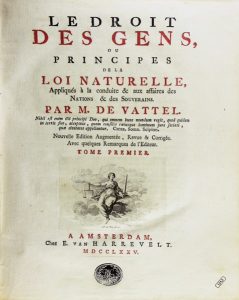
The C&K “definition” is directly at odds with § 212 of Book 1, Ch. 19 of the 1758 treatise, “Le Droit des Gens,” or “The Law of Nations” by Swiss lawyer, jurist and scholar Emer de Vattel. There, a “natural born citizen” is defined as a person born in a country where both parents are already its citizens, hereafter, for brevity, “§ 212.” Your servant has for years maintained that the § 212 definition is the one accepted and adopted by the Founders into Art. 2, § 1, Cl. 5 of the Constitution: the presidential “Eligibility Clause.”
It is left to the P&E reader – and many “de Vattel Deniers” who reject outright the argument that the Founders adopted the § 212 definition of an nbC and instead, subscribe to the conclusions of the C&K article – to debate and decide (a) if your servant is correct or (b) whether Messrs. Clement and Katyal have the better argument. Granted, your servant did not attend Hah-vahd or Yale and has never served as Solicitor General of the United States…, but he has in the past occasionally slept at a Holiday Inn Express®. Is the First Amendment great, or what?
Finally, as a formatting matter, the following original words of the subject C&K article being reviewed remain in Times New Roman font, 12-point black. Footnotes remain where they appear in the article but are reformatted and relocated as endnotes at the conclusion of the article and this post. In order to differentiate your servant’s “deep dive” comments on various statements from the C&K article, they are generally indented, bracketed, left-margin justified only and appear in Calibri font, 12-point bold. Page breaks in the original article are signaled thusly: “[161 // 162]”
Ready? Let us begin.
Deep Dive Part 1
“ON THE MEANING OF ‘NATURAL BORN CITIZEN’”
Paul Clement∗ & Neal Katyal∗∗
“We have both had the privilege of heading the Office of the Solicitor General during different administrations. We may have different ideas about the ideal candidate in the next presidential election, but we agree on one important principle: voters should be able to choose from all constitutionally eligible candidates, free from spurious [a gratuitous and unscholarly pejorative modifier] arguments that a U.S. citizen at birth is somehow not constitutionally eligible to serve as President simply because he was delivered at a hospital abroad.
[The use of the unfounded term “spurious,” coming from two former heads of the United States Solicitor General’s Office, is lamentable, particularly against the backdrop of an issue which they assert, post, is “refreshingly clear” under the terms of the Constitution itself. In this regard, C&K fail to articulate precisely where in the Constitution, as opposed to other places, the definition of the term “natural born Citizen” is found, thus bringing “clarity” and “resolution” to the issues.
[In fact, nowhere in the Constitution is the term “natural born Citizen,” (“nbC” as appearing in Art. 2, § 1, Cl. 5) defined, much less made “refreshingly clear.” That “clarity” is contended by the authors as purportedly referring to a person who is either merely a “citizen at birth” or a “citizen by birth” regardless of place of nativity or the citizenship status of both parents, as long as (a) one parent is a U.S. citizen, and (b) no further formal naturalization proceedings are required to make the person a “citizen” under the 14th Amendment.
[Recall that under a Euler diagram analysis, discussed here, while all nbC’s are by definition also 14th Amendment native-born “citizens,” not all “native-born citizens” are nbC’s. Stated otherwise, in common parlance, all Corvettes are Chevrolets, but not all Chevrolets are Corvettes.
[In legal parlance, respectfully, the theory being advanced by Messrs. Clement and Katyal is sometimes labeled as ipse dixit: “It is so because I say it is so.” That principle is a shifting, sandy foundation upon which to construct the argument that the “citizen at/by birth” theory espoused by the article’s narrative was intended by the Founders – as opposed to 21st Century academics – to “define” the criteria for an nbC as understood by the Founders in 1787.]
“The Constitution directly addresses the minimum qualifications [sic: the better term is “eligibility restrictions”] necessary to serve as President. In addition to requiring thirty-five years of age and fourteen years of residency, the Constitution limits the presidency to “a natural born Citizen.”1 All the sources routinely used to interpret the Constitution….
[Regarding the “sources routinely used to interpret the Constitution…,” the C&K article omits any reference at all – even if only to distinguish or marginalize its significance – to the Supreme Court’s unanimous decision in Minor v. Happersett, 88 U.S. 162 (1875). The fact that the decision was “abrogated” in 1920 – 45 years after its appearance – by passage of the 19th Amendment has no effect on its continued presence “on the books.” The other portions of the decision regarding the Court’s statements on the nbC issue, unrelated to the core issue of women’s’ suffrage in the case, still exist because the Supreme Court has never itself “overruled” the decision.
[In Minor, a unanimous Supreme Court observed that the Founders understood and accepted – without any doubt – that a natural born citizen was a person born on U.S. soil to two parents who were already at that time, U.S. citizens, whether themselves “natural born” or naturalized. Without specifically referencing § 212, that definition as understood by the Founders is precisely what the de Vattel principle articulates.
[On the other hand, as to the purported nbC status of persons born here to aliens, the Court in Minor acknowledged that while some authorities contended that foreign parentage did not matter, the Court specifically noted that there had been “doubts” as to those persons’ purported nbC status, but then specifically added that no such doubts ever existed as to the first category, i.e., those born here to a mother and father who were already U.S. citizens.
[The omission of any reference to the Minor decision and any discussion distinguishing it merely underscores the “result-orientation” of the article’s narrative. Moreover, as to “sources routinely used to interpret the Constitution…,” (emphasis added), the C&K article completely ignores the 1758 treatise The Law of Nations. To repeat, in § 212 of the tome, de Vattel defines a natural born citizen as being a person born on the soil of a country to parents (in the plural) who are already its citizens.
[The U.S. Supreme Court has noted that “[t]he international jurist most widely cited in the first 50 years after the Revolution was Emmerich de Vattel…” and, quoting Benjamin Franklin, that his treatise “has been continually in the hands of the members of our [Continental] Congress now sitting.” U.S. Steel Corp. V. Multistate Tax Commission, 434 U.S. 452, 462 n. 12.]
[The omission by C&K to even consider the import and impact of de Vattel and the principles articulated in his treatise – particularly § 212 regarding its definition of a “natural born citizen” – is regrettable, but assumed to be unintentional.]
…. confirm that the phrase “natural born Citizen” has a specific meaning: namely, someone who was a U.S. citizen at birth [and born here to two citizen parents] with no need to go through a naturalization proceeding at some later time.
[The manufactured definition by the authors, viz., “namely, someone who was a U.S. citizen at birth with no need to go through a naturalization proceeding at some later time…” (Emphasis added) is unobjectionable insofar as it purports to apply to those persons who, in addition, are born here to two U.S. citizen parents.
[The problem with the C&K definition, however, is that it conflates and thus improperly equates the Founders’ understanding of the term “citizen” with the definition of an nbC as posited was adopted by the Founders. It also ignores the Euler diagram analysis that while all nbC’s are “citizens,” not all 14th Amendment citizens are nbC’s.
[These facts render the article’s definition in diametric opposition to the § 212 definition, if for no reason other than that the former C&K definition interposes a far lower barrier to the potential for the insinuation of “foreign influence” into the presidency than does the higher barrier afforded by § 212.]
…. And Congress has made equally clear from the time of the framing of the Constitution to the current day that, subject to certain residency requirements on the parents, someone born to a U.S. citizen parent generally becomes a U.S. citizen [but not necessarily an nbC] without regard to whether the birth takes place in Canada, the Canal Zone, or the continental United States.2
[Footnote 2 of the C&K article references 8 U.S.C. § 1401(g), which provides:
“The following shall be nationals and citizens of the United States at birth:
. . .
“(g) a person born outside the geographical limits of the United States and its outlying possessions of parents one of whom is an alien, and the other a citizen of the United States who, prior to the birth of such person, was physically present in the United States or its outlying possessions for a period or periods totaling not less than five years, at least two of which were after attaining the age of fourteen years: Provided, That any periods of honorable service in the Armed Forces of the United States, or periods of employment with the United States Government or with an international organization as that term is defined in section 288 of title 22 by such citizen parent, or any periods during which such citizen parent is physically present abroad as the dependent unmarried son or daughter and a member of the household of a person (A) honorably serving with the Armed Forces of the United States, or (B) employed by the United States Government or an international organization as defined in section 288 of title 22, may be included in order to satisfy the physical-presence requirement of this paragraph. This proviso shall be applicable to persons born on or after December 24, 1952, to the same extent as if it had become effective in its present form on that date….”
[The term “national” included in this statute is elsewhere defined (8 U.S.C. § 1101(a)(21) thusly: “The term “national” means a person owing permanent allegiance to a state.”
[While these two statutes, read together, establish that if a child is born abroad, only one of the parents needs to be a U.S. citizen in order for the child to be also a “national and citizen,” that still does not satisfy the nbC criteria of § 212.
[Only if both parents are U.S. citizens will that conclusion obtain. Moreover, the fact that the child will be actually (not just “considered”) a “national and citizen,” as a “national,” the child will also have “permanent allegiance.” The term “permanent” is defined in 8 U.S.C. § 1101(a)(31) as “a relationship of continuing or lasting nature, as distinguished from temporary, but a relationship may be permanent even though it is one that may be dissolved eventually at the instance either of the United States or of the individual, in accordance with law.”
[However, none of that verbiage addresses the other component of § 212 and the equally-pressing concern of the Founders that the person who would be eligible as an nbC possess in addition to simple “allegiance,” an allegiance which was sole and exclusive to the United States. A child born into a union of a citizen and an alien, or into a dual citizen union, by definition cannot possess “sole and exclusive” allegiance and fidelity to the United States.
[Without the “sole and exclusive fidelity” characteristic, while a person born abroad may be under 8 U.S.C. § 1401 both a “national” and a “citizen,” he/she will not automatically possess the § 212 definitional characteristic of “sole and exclusive” allegiance provided by restricting nbC status to persons born to two parents, both of whom are at the time and place of the birth in the country and already its citizens.
[The Founders were not only concerned about “allegiance” to the United States, but were in addition concerned that such allegiance be “sole and exclusive” to the United States, and the United States alone. Simultaneous split or dual allegiances to foreign nations were anathema to the Founders. This is yet another reason supporting inclusion of the “citizen grandfather” exception clause from the nbC restriction.]
“While some constitutional issues are truly difficult, with framing era sources either nonexistent or contradictory, here, the relevant materials clearly indicate that a “natural born Citizen” means a citizen from birth with no need to go through naturalization proceedings.
[Again, this contention is classic ipse dixit. The C&K article fashions the theory that the Founders purportedly intended to adopt a definition of a “natural born citizen” directly contrary to that articulated in § 212 and one providing a lower barrier to the potential for the insinuation of foreign influence than the higher one under § 212.
[The C&K definition – a person who is a “citizen at birth” or a “citizen by birth,” regardless of place of birth or U.S. citizenship of both parents – advocates a much lower barrier to the potential for the insinuation of “foreign influence” into the presidency than does the higher barrier provided by the § 212 definition.
[It is counter-intuitive to conclude that the Founders would have consciously selected the lower barrier over the known and available higher barrier provided by § 212. This conclusion is ratified and fortified when viewed against the backdrop of the Supreme Court’s observation that, in the nomenclature of the Founders’ era, there had been “doubts” as to the nbC status of persons born here to other than parents who were both U.S. citizens at the time of birth.
[And yet the illogical conclusion that the Founders intended to adopt a definition of an nbC (a) as to which they had “doubts” and (b) which created a lower barrier to the potential for insinuation of foreign influence into the presidency than the one presented by the § 212 definition is offered by C&K as the reality articulated in the Constitution. That conclusion being offered is inconsistent with the Founders’ intent.]
The Supreme Court has long recognized that two particularly useful sources in understanding constitutional terms are British common law3 and enactments of the First Congress.4 Both confirm that the original meaning of the phrase “natural born Citizen” includes persons born abroad who are citizens from birth based on the citizenship of a parent.
[As to the “useful” provisions of British common law, the C&K offering ignores the statement by Founder George Mason at the June 19, 1788 Virginia ratification debates that “[t]he common law of England is not the common law of these States.”
[The C&K offering also fails to mention the observation of Sir William Blackstone that “the common law of England, as such, has no allowance or authority…’ in what he labeled as “our American plantations there.” See Blackstone’s Commentaries on the Laws of England, Introduction, Ch. 1, § IV at 105. So much for the “usefulness” of the article’s citations to the “common law” of England.
[Footnote 3 in the article also cites to the Supreme Court decision in Smith v. Alabama, 124 U.S. 465, 478 (1888). That case is repeatedly cited by adherents to the “British-common-law-governs-nbC-analyses” theory for its statement that “[t]he interpretation of the Constitution of the United States is necessarily influenced by the fact that its provisions are framed in the language of the English common law, and are to be read in the light of its history.” This statement requires additional review.
[First, the underlying opinion of the Court concluded, as Blackstone conceded and George Mason admonished: “there is no ‘common law’ of the United States” as emanating from British common law. The “interpretation of the Constitution” language in the decision, adverting to British common law as “influencing” its interpretation, was stated as an exception to the underlying general ruling.
[Second, Justice Mathews’ opinion specifically qualifies its remarks by noting that although British common law may “influence” the Court’s interpretations of the Constitution, British common law plainly does not “govern” or “control” the Court’s interpretation.
[Justice Mathews specified that “[t]he code of constitutional and statutory construction which therefore is gradually formed by the judgments of this Court, in the application of the Constitution and the laws and treaties made in pursuance thereof, has for its basis so much of the common law as may be implied in the subject….” (Emphasis added)
[The natural result flowing from this language is that the Court’s statement in Minor regarding the Founders’ understanding of the nbC term as coinciding with the § 212 definition supplied by de Vattel, whether by “implication” or otherwise, cannot or at minimum should not be ignored. To do so constitutes a form of intellectual indifference.
[The fact that some states in British America, prior to the events of 1776, had adopted in their own jurisdictions elements of the English “common law” is also immaterial. The reality is that, after 1776, when the United States was born – and in particular, after 1787 when the Constitution was executed – the “common law” and the “principles” of the laws of Great Britain were largely jettisoned.
[Significantly, no longer was the relationship between the people and the nation’s rulers one of “subject/liege.” Instead, the relationship was between “citizens” and the “republic” they – rather than royal lineage – had created.
[Parenthetically, in addition to citing in footnote 4 a Supreme Court case – State of Wisconsin v. Pelican Ins. Co. – for the proposition that laws passed by the First Congress carry “great weight” in analyzing their meaning under the Constitution because many members of the First Congress were also delegates at the Constitutional Convention, the C&K article omits disclosure that the Pelican case was overruled by the Supreme Court itself in 1935, albeit on other grounds.
[Moreover, the original C&K article appearing in 2015 – in periodical form – contained, immediately following the footnote 4 citation to the Pelican case, an additional citation to itself in support of the “great weight” proposition. This is yet another example of ipse dixit in action.
[Apparently later recognizing the bad form inherent in citing itself as authority for the proposition being asserted, the self-citation was deleted at some point after the original publication and no longer appears in footnote 4 as it did before its removal. This can be confirmed by accessing the review article on the Internet now. That self-citation is included, however – as copied verbatim while it was still there and for reference and historical purposes only – in the reformatted footnote section at the end of this post.]
═══════════════════════════════════════════════════════════
FOOTNOTES:
∗ Distinguished Lecturer in Law, Georgetown University; Partner, Bancroft PLLC. ∗∗ Paul and Patricia Saunders Professor of Law, Georgetown University.
1 U.S. CONST. art. II, § 1, cl. 5.
2 See, e.g., 8 U.S.C. § 1401(g) (2012); Immigration and Nationality Act of 1952, Pub. L. No. 82-414, § 303, 66 Stat. 163, 236–37; Act of May 24, 1934, Pub. L. No. 73-250, 48 Stat. 797.
3 See Smith v. Alabama, 124 U.S. 465, 478 (1888).
4 See Wisconsin v. Pelican Ins. Co., 127 U.S. 265, 297 (1888). 162 HARVARD LAW REVIEW FORUM [Vol. 128:161
To be continued.
See Part III here: https://www.thepostemail.com/2024/04/08/a-critique-of-on-the-meaning-of-natural-born-citizen-part-iii/
Comments
9 responses to “A Critique of “On the Meaning of ‘Natural Born Citizen’””
Arrogance often succeeds where Ignorance alone has failed. – JD Mooers
So, We the People now know, AG MERRICK GARLAND IS A LIAR: https://www.youtube.com/watch?v=lr0HVZkVdqo
Today’s DISINTEGRATAING “legal profession” is overly-infested with LIARS-FOR-HIRE and PIMPS OF LADY JUSTICE: https://www.licensedtolie.com/
Today’s “legal profession” is so prostituted that it has cancelled bar exams in Washington state as if to satisfy “mind-indoctrination D.E.I. = body-intoxication DUI ” over public safety competency: https://www.usatoday.com/story/news/factcheck/2024/03/28/washington-lawyer-bar-exam-alternatives/73124835007/
So, it is refreshing to see several licensed attorneys since 08-28-08 (Sidney Powell, Joseph DeMaio, Orly Taitz, former Mario Apuzzo, et al) who will unabashedly dissent from their own licensed legal profession’s “stampede of stupidity” relative to a factual and precedential presidential interpretation of “natural born Citizen”:
https://www.scribd.com/doc/48856102/All-U-S-Presidents-Eligibility-Grandfather-Clause-Natural-Born-Citizen-Clause-or-Seated-by-Fraud >>>
http://tesibria.typepad.com/whats_your_evidence/birther%20case%20list.pdf [= 100% nationally syndicated “stampede of stupidity”, OR ELSE, RETALIATION!]
ACCEPT THIS AS FACT: Paul Clement & Neal Katyal and Jack Maskell are LIARS.
https://sgp.fas.org/crs/misc/R42097.pdf
Only serious sober senior U.S. adults, each having earned a PhD in Life Experiences and each being acceptable enough for jury duty to determine the life sentence of accused defendants, can now declare as LIARS, and discard, those state-licensed attorneys who have ever pontificated that Obama, Ted Cruz, Nimarata Nikki Randhawa-Haley, et al, are each a John Jay “natural born [sole-U.S.] Citizen” 1787- Today in order to profitably “legalize” immoral civil wrongs (nbC-usurpation, sanctuary cities, lawfare-for-lawfear, infanticide after delivery, non-citizen voters, Defund Police, etc.) into “civil rights”!
As I recall, in 1949, China’s reformation curiously outlawed “the legal profession” on the same day it outlawed “the oldest profession [prostitution]”: file:///C:/Users/Jonathan/Downloads/SSRN-id4516547.pdf
This is a well researched, thoroughly reasoned and explained article.
Someday someone may come across notes from the Convention that does a better job. But until then, this is the
best (Comprehensive, Thorough) explanation that I have read regarding NBC.
Outstandingly researched and composed.
ELmo
What really disturbs me is the apparent fact that VERY FEW OF US CARE ANYMORE WHAT OUR CONSTITUTION SAYS OR MEANS (citizens of various types, government officials, politicians, justices of our Supreme Court, the CIA, NWO, and, of course, usurpers and others who will, by precedent, be usurpers in the future, etc, etc). Anyway, do not include me in this anti-American, fascist group (some even refer to it as the “fourth Reich”). I have more, but for now am choosing not to “muddy up the waters” or peddle any of what some might call “disinformation” in an election year.
See more comments and discussion about this newest article by the constitutional scholar Joseph DeMaio about Paul Clement & Neal Katyal’s 2015 paper at Free Republic at this link: https://freerepublic.com/focus/f-news/4228832/posts
CDR Charles Kerchner (Ret)
Author: Natural Born Citizen
http://www.kerchner.com/books/naturalborncitizen.htm
Looks like they pulled my sharing attempt to post an excerpt and link back to here of Joe DeMaio newest article about the C&K 2015 paper that gave Ted Cruz a pass to be considered an nbC.
My first attempt at FreeRepublic was in the major political discussion section of FreeRepublic where I usually post articles about political issues like I did regarding the lack of eligibility of Vivek Ramaswamy, etc. When they pulled my post they only gave the reason of “Try again”. I did not know if that was a snide remark or a positive feedback suggestion from the moderator for that section of Free Republic. ;-)
So, I waited awhile and then “tried again” and posted an excerpt and link to Joe DeMaio’s latest article in another less obviously major political discussion section of the FreeRepublic site, i.e., Chit/Chat, etc., along with a very brief comment, sans my Euler nbC Diagram image this time. And this time it was allowed to stay up BUT — with a tag put into the key words search field by the moderator, i.e., “birther”.
So you can read the post and comments and discussion there now at this 2nd try link to spread the word about Joe DeMaio’s outstanding new article about the Clements and Katyal’s 2015 paper that stretched any sense of sound logic to try and prove that Ted Cruz who was born in Canada to a Cuban national father was constitutionally eligible to serve at President and Commander in Chief. See: https://freerepublic.com/focus/f-chat/4228850/posts
CDR Charles Kerchner (Ret)
Author: Natural Born Citizen
http://www.kerchner.com/books/naturalborncitizen.htm
Yes Teddy boy Cruz got two of his Harvard lawyer friends to make him a NBC even tho Teddy Boy Cruz was born in Canada to a father who was a Cuban citizen at the time of Teddy Boy Cruz’s birth in Canada ! The only evidence of Ted Cruz’s citizen ship is a Canadian Birth Certificate . The question should be when did Senator Ted Cruz Naturalize as a US Citizen since he father did not become a US Citizen until 2005 ! It is part of congressional record that several in the US Congress tried to change Article ll Section 1 Clause 5 and NBC no less then eight times between 2002 and 2008 without success ! Does anyone still believe the US Congress did not not know Berry Soetoro aka Barack Hussein Obama was and is a FRAUD !
Could Rafael E. (Ted) Cruz be an undocumented alien? In my book he is until he releases all of his immigration documentation to the public.
Courts and election agencies have made rulings consistent with Clement and Katyal; none have expressed disagreement with them. Regardless, Clement and Katyal were discussing a possible nominee not born in the United States (Cruz), and every presumptive presidential or vice-presidential candidate for the upcoming presidential election was born in the United States.
All persons born under the “citizen at birth” explanation of C&K are lumped together as both STATUTORY citizens and natural born Citizens. Yet in reality, a natural born Citizen can never be a statutory citizen and a statutory citizen can never be a natural born Citizen. Only once did the term “natural born Citizen” appear in U.S. law – the Naturalization Act of 1790. That Naturalization Act of 1790 was repealed in 1795 and that term has never again appeared in U.S. law, because the Constitutionally-approved legislators who have the authority to naturalize citizens do not have the authority to deem or make anyone a natural born Citizen, on the same basis that no one can apply for nor receive a patent for something that appears naturally in God’s nature.
Neither current U.S.A. law nor any Constitutional Amendment exists that specifically declares that anyone is a natural born Citizen. Why? Because Congress cannot make or deem an event (citizen at birth) through positive man-made law that which is natural, as in natural born Citizen – the natural act of being born in the country to two (2) parents who already are citizens of that country. Congress can only make or deem STATUTORY (through positive man-made laws) U.S. citizens. A STATUTORY U.S. citizen is not a natural born Citizen. The majority of people of the U.S.A. are natural born Citizens. E.g. Former President Donald Trump is a natural born Citizen because both of his parents were U.S. citizens when he was born in the U.S.A.; but, his three children with wife Ivana are not natural born Citizens, because Ivana was not a U.S. citizen when all three of these children were born in the U.S.A. These three children are STATUTORY U.S. citizens and ineligible for Article II jobs.
Natural Born Citizen dissected.
A. Natural: adjective
1. existing in or formed by nature (opposed to artificial): e.g. The river was spanned by a natural rock bridge.
2. based on the state or behavior of things in nature; constituted by nature: e.g. Growth is a natural process.
B. Born: adjective
1. Brought into life by birth. e.g. Ted Cruz’s mother gave birth to him in Canada.
2. Brought into existence; created. e.g. A new nation was born with the revolution.
C. Citizen: noun
1. A person owing loyalty to and entitled by birth or naturalization to the protection of a state or nation.
2. A resident of a city or town, especially one entitled to vote and enjoy other privileges there.