
by Sharon Rondeau

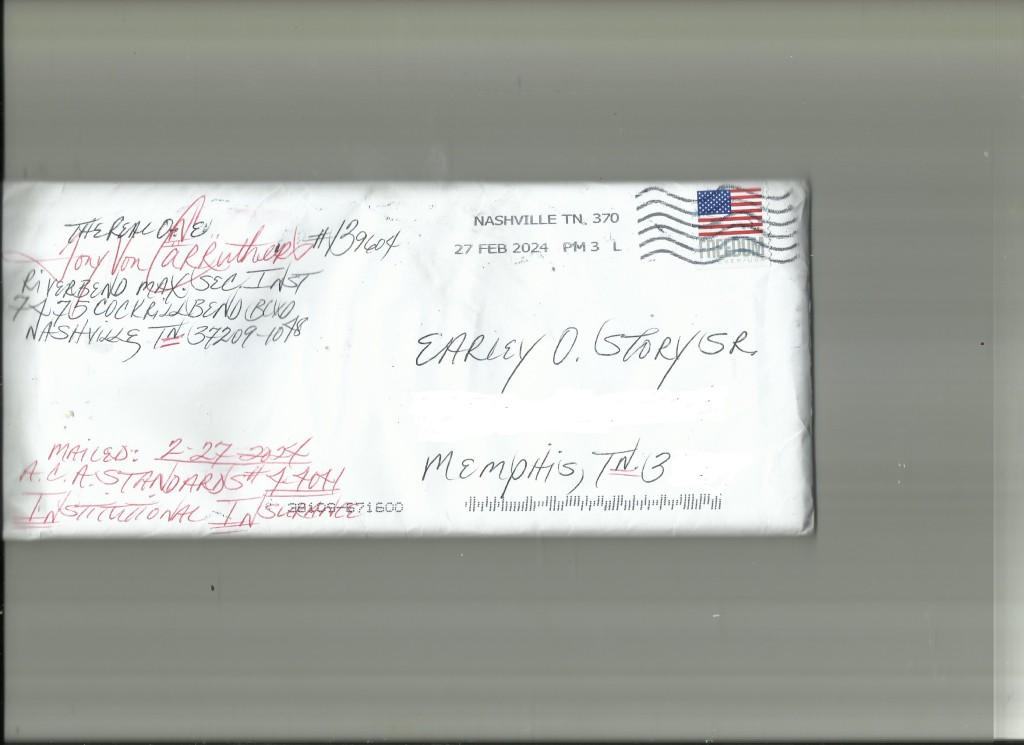
(Apr. 11, 2024) — In late February, former Shelby County, TN Sheriff’s Office Sgt. Earley Story received an unexpected envelope from Tony Carruthers, a Tennessee inmate relegated to death row after a conviction for allegedly murdering three Memphis residents in 1994.
In September 2019, then-Tennessee Atty. Gen. Herbert H. Slatery filed a motion with the Tennessee Supreme Court to advance Carruthers and eight others to execution. In the filing, Slatery recounted the history of Carruthers’s case and convictions; his appeals, including to the U.S. Supreme Court; a post-conviction petition and writ of habeas corpus, all of which were denied.
At the time, The Post & Email contacted Slatery’s office to suggest that because the main witness testifying against Carruthers recanted his testimony, Slatery might have recommended the execution of “an innocent man.”
Shaw’s contradiction of his testimony against Carruthers was aired by a local news station in 1996.
In 2016, Carruthers’s co-defendant, James Montgomery, was released from prison “with time served,” and Carruthers was reported to be “knocking on freedom’s door.”

In February 2020, The Appeal reported extensively on Carruthers’s case in an article titled, “Tennessee Man Could Be The First Person In Nearly A Century To Be Executed After Being Forced To Represent Himself At Trial.”
Most notably, the outlet reported Carruthers was “forced” to defend himself at trial, resulting in his own death sentence and Montgomery’s release:
In April 1996, Tony Carruthers, charged with kidnapping and murder, stood in a Tennessee courtroom. Despite the severity of the case against him—he was charged with three counts of first-degree murder and faced the death penalty—he did not have an attorney by his side. Carruthers represented himself.
Two years earlier, Carruthers and James Montgomery were arrested in Memphis, accused of killing Marcellos Anderson, his mother Delois, and Anderson’s friend Frederick Tucker. The three disappeared on the night of Feb. 24, 1994, and their bodies were found seven days later, buried beneath a casket in a local cemetery.
By the time his trial began in 1996, Carruthers had gone through six attorneys. He asked to have another attorney appointed to him, but the judge refused. He was convinced that Carruthers was trying to delay his trial and forced him to proceed pro se, or arguing on his own behalf.
Carruthers’s self-representation in a triple murder case was made all the more perilous by the fact that the state’s case against him relied heavily on the grand jury testimony from a career informant, Alfredo Shaw. The Center on Wrongful Convictions at Northwestern University’s law school issued a report finding that over 45 percent of all wrongful convictions in death penalty cases stem from lying by criminal informants, making “snitching the leading cause of wrongful convictions in U.S. capital cases.”
Shaw’s story was deeply flawed; he said Carruthers confessed to him in a jail law library but later admitted he had not seen Carruthers since 1988. In a statement to local media before the trial, Shaw recanted his story.
Prosecutors branded Shaw a liar and decided not to use him as a trial witness. But serving as his own attorney, Carruthers went forward with Shaw as a witness and, in a bumbling cross examination, mistakenly led Shaw to repeat his previously recanted testimony implicating him in the murders.
On April 26, 1996, Carruthers was convicted and sentenced to death even though there was no forensic evidence linking him to the triple homicide. “The end of Mr. Carruthers pro se cross-exam of Alfredo Shaw is one of the most singularly inept, ineffective and disastrous cross-examinations, possible, one that seemed designed to secure not only a guilty verdict, but a death sentence,” Carruthers’s attorneys wrote in a post-conviction filing.
Carruthers’s act of representing himself was so damaging that it eventually led to his co-defendant James Montgomery’s release. An appeals court granted him a new trial due to the prejudicial impact of being tried alongside a pro se defendant. In 2000, Montgomery agreed to a guilty plea to lesser charges of second-degree murder and was released in 2015.
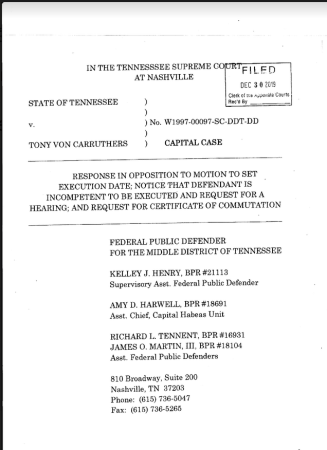
Nearly 24 years after the two were convicted, Tennessee Attorney General Herbert Slatery requested that the state Supreme Court set execution dates for nine men, including Carruthers. In a Dec. 30 filing in opposition to the state’s motion to set an execution date for Carruthers, his attorneys with the Federal Public Defender for the Middle District of Tennessee wrote that by representing himself in court, he “did more to get himself convicted and sentenced to death than did the prosecution.” They also argued that Carruthers was incompetent to stand trial because he is seriously mentally ill “and that the manifestations of this serious mental illness include paranoid delusions, distorted thought processes, conspiratorial misapprehension of fact, a gross inability to make prudent decisions, and a complete inability to rationally perceive or understand the world around him. He also has significant brain damage which exacerbates the debilitating effects of his serious mental illness.”
Carruthers’s case would be historic: If executed, he would be the first person in nearly a century to be put to death after being forced to represent himself at trial.
As The Appeal reported, on December 30, 2019 the Federal Public Defender for the Middle District of Tennessee filed a motion opposing the establishing of an execution date for Carruthers, stating him to be “incompetent to be executed” and requesting a Certificate of Commutation.
Carruthers’s case and that of Earley Story intersect via Shaw, who as a CI reported to the Shelby County Sheriff’s Office that Story attempted to sell him marijuana, as the time a felony in the state, on three different occasions.
The charges and Story’s January 31, 1997 arrest occurred after he reported crimes and horrendous conditions within the Shelby County jail, including a 1995 sexual assault of an inmate and the unwarranted death of another.
Following his arrest, Story professed his innocence and proceeded to trial. On April 3, 1997, the late Judge Ann Pugh dismissed all three charges for lack of probable cause.
A pro se lawsuit Story filed against the SCSO resulted in a judge’s order that he be reinstated, which never occurred, Story told us.
The SCSO fired Story and refiled the charges in August 1997, ultimately prevailing on convicting him in December 1999 on one count of selling marijuana to the undercover agent.
In addition to losing his livelihood and career, Story was precluded from voting. In 2011, he said, he regained that right after filing a complaint with the court clerk. “The clerk’s office found out that no felony record was present and that I had no State ID, which all felony offenders must have on the record from the time of conviction,” Story told us.
Story later discovered Shaw to have been a “fugitive from justice” and said Shaw was threatened into making the claim against him. “Alfredo Shaw’s life was threatened if he would not give false testimony in case #97-08560,” he told The Post & Email, referring to the first set of charges which were dismissed. “As stated, no affidavit of arrest has ever existed for the 8/8/1997 arrest, booking #97040006,” he added, referencing the second arrest. “The Shelby County Courts and law enforcement created all this confusion and corruption and they need to clean it up.”
A 2001 U.S. Justice Department investigation of conditions in the Shelby County jail supported Story’s reports to the NAACP, FBI and federal courts of a dangerous environment plagued with gang activity, brutality, and lack of proper medical care.
Throughout the years, Story has attempted to clear his name via a post-conviction petition, appeals through the Tennessee courts and federal court and communications with the U.S. Justice Department.
Despite a recommendation from the National Police Defense Foundation (NPDF) and request for assistance in clearing Story’s name, neither Congressman Steve Cohen nor the FBI, whose Memphis office received Story’s reports of inmate abuse three decades ago, took action.
As The Post & Email reported, in December 2017, Carruthers sent Story a copy of the log maintained by the SCSO demonstrating that on the three dates he was accused of attempting to sell marijuana to Shaw, no transactions were noted to have taken place.
In October 2018, Story filed a Writ of Error Coram Nobis with the Shelby County Criminal Court to present the new evidence. On June 21, 2019, Judge Chris Craft, who in 2004 had sentenced Story to ten days in jail for “contempt of court” stemming from an appeal hearing, dismissed Story’s claim.
In 2005, Story was told his entire criminal record was “destroyed,” prompting him to ask how the 1999 conviction could have been properly documented and recently used as a defense by the Shelby County Retirement System Board of Administration and Trust in response to Story’s request for and the SCSO’s denial of his pension.
Story is now attempting to garner a favorable ruling against the Board in Chancery Court, where he is presenting his case that Pugh’s order was illegally altered to show the 1999 conviction over which she did not preside.
Story had not communicated with nor heard from Carruthers since receiving the evidence log in December 2017. As we related last month, Story has been seeking a neutral third party to open Carruthers’s recent letter, preferably in his presence, then dispatch it to Carruthers’s attorney.
Placing it in an exterior envelope, on March 5 Story sent the letter to the office of Tennessee Attorney General Jonathan Skrmetti, which returned it on March 26 unopened. “The sealed letter that I mailed to the Tennessee Atty. General was mailed back to me,” Story told us in an email. “It’s not in the USP envelope that I paid for the delivery. I guess I will now have to find a lawyer, or some other official to open this information from Carruthers.”
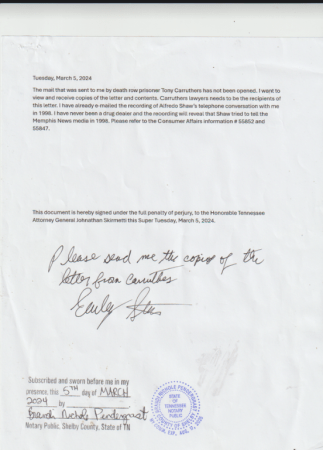

“I just believe that transparency with this letter from death row should not be opened without an officer of the court recorded as a witness,” Story said.