

by Sharon Rondeau

(Mar. 6, 2024) — On Monday morning, former Shelby County, TN Sheriff’s Office deputy Earley Story went to court for the first time in regard to his bid to obtain the pension he would have received had he not been terminated from his position as a sheriff’s office sergeant following a false arrest in 1997.
Last year, Story told The Post & Email, he filed for retirement benefits with the SCSO and was denied. He therefore appealed to the Shelby County Retirement System Board of Administration and Trust, which held a hearing in October, allotting Story 15 minutes to plead his case.
The Board ultimately upheld the SCSO’s denial, prompting Story to file a claim in Chancery (civil) Court, the Honorable Melanie Taylor Jefferson presiding. Assigned case #CH-22-1538I, Story is hopeful that in the course of considering his pension claim, the wrongdoing on the part of the Shelby County Sheriff’s Office and District Attorney General’s office will prompt an investigation into the underlying events leading to his arrest, subsequent firing and the cover-up which has unfolded since his December 1999 false conviction.
The nearly-three-decade-old case against Story for allegedly selling marijuana, a felony in Tennessee at the time, to an undercover agent arose after he reported heinous conditions within the Shelby County jail to federal authorities on multiple occasions. His claims were later borne out by three lawsuits and a U.S. Justice Department investigation into the facility.
One of the cases was Little v. Shelby County, filed in 1996 and settled in 2005 based on the Justice Department’s 2000 findings, which included “that certain conditions at the SCJ violate the constitutional rights of inmates. We find that persons confined in the SCJ risk serious injury from deficiencies in the following areas: security and protection from harm, mental health and medical care, and environmental health and safety. Crowding in the facility exacerbates these deficiencies.”
Despite the lawsuits and directives from the federal government to rectify jail conditions on a plethora of constitutional violations and safety concerns, inmate abuse, injury and death persisted. A 2001 Salon investigation corroborated Story’s description of facility conditions, stating, “The jail, the largest in Tennessee, is the focus of more than a dozen ongoing local lawsuits and an active U.S. Department of Justice investigation. Four men have died while being held in the Shelby County Jail; the families of three of those men have filed a $15 million wrongful death suit against the man who runs the jail, Sheriff A.C. Gilless, and other authorities. Just last week, on Jan. 17, Gilless and other penal authorities were also slapped with a $22 million lawsuit by 16 Shelby County Jail guards, who claim they were severely traumatized after Gilless and others authorized a phony takeover of the jail’s control room last June.”
Story was hired by the SCSO in 1981 and assigned to the Shelby County jail. In 1989, he reported several inmate assaults by staff; in 1995, he reported an inmate rape and a wrongful death to the Memphis chapter of the NAACP, the Memphis FBI and the U.S. District Court for the Western District of Tennessee.
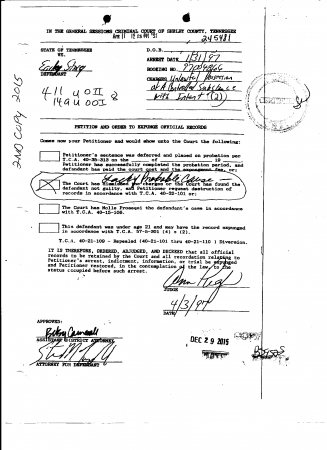
On January 31, 1997, Story was arrested for allegedly trying to sell marijuana on three occasions to SCSO confidential informant Alfredo Shaw. From the beginning, Story has denied the allegations and pointed out that the late Judge Ann Pugh dismissed all three charges on April 3, 1997 for “lack of probable cause,” additionally ordering his record expunged.
Shaw, who Story discovered was a fugitive from justice, later recanted his testimony against Story (first recording below).
Rather than observing Pugh’s dismissal of the fabricated charges, in August 1997 the SCSO again arrested Story for the same crime, this time on one count of selling marijuana to Shaw. Without an affidavit of complaint or grand-jury record, the 30th Judicial District prosecutor’s office, which encompasses Shelby County and has been the focus of numerous corruption allegations and findings of unethical behavior, obtained a conviction at trial in December 1999.
Shaw was the same informant who testified against death-row inmate Tony Carruthers who was found responsible, along with a co-defendant, for a grisly triple murder in 1994. In an interview with a local news station, Shaw also recanted his testimony against Carruthers.
The other defendant, James Montgomery, was released from prison in late 2015 “with no parole and no probation” nor any notification to the families of the deceased.
Since his conviction, Story has attempted to clear his name via the U.S. Justice Department, the media, state and federal elected officials, and appeals to state and federal courts.
In late 2018, Story received unexpected documentation from Carruthers, generated by the Shelby County Sheriff’s Office, indicating no interactions between drug dealers and any confidential informant on the dates Story allegedly committed the crimes. The discovery prompted him to file a Writ of Error Coram Nobis with the Shelby County Criminal Court to reopen his case.
The June 2019 proceedings were held by Judge Chris Craft, who presided over Story’s appeal, initially refusing Story an attorney and jailing him for ten days for alleged contempt of court. Craft promptly denied Story’s claim of new information by stating, according to an eyewitness, “Shaw is not the one who made the buy. The State is saying that Agent Butler made the buy, not Shaw. Carruthers’ evidence would not make a difference to your trial. We will hear the State’s motion to dismiss.”
Unsurprisingly, Craft granted the State’s motion, though according to the same eyewitness, no transcript of Story’s 20-year-old trial was produced to affirm Craft’s claim as to “Agent Butler.”
After attempting to obtain a copy of his file in 2022, Story told The Post & Email, the court claimed it was destroyed in 2005, though documents Story has never seen have mysteriously appeared from time to time, including the SCSO’s claim that Pugh dismissed two charges, not three.
In March 2019, the National Police Defense Foundation (NPDF) not only endorsed Story’s claim of innocence, but also called upon the Memphis FBI “to investigate newly-discovered evidence that should vindicate Shelby County Sheriff Deputy Sgt. Earley Story.”
The same year, then-Tennessee Attorney General ordered nine executions of longstanding death-row prisoners, Carruthers among them. However, approximately ten days ago Story received another letter from Carruthers proving that he was, at the time the letter was written, very much alive.
There was no communication between them, Story said, since his receipt of Carruthers’s pages from the SCSO 1997 evidence log.
Story has not opened the letter, he said. Rather, he told The Post & Email, he will seek a judge, attorney or other court official to open it in his presence and dispatch it to Carruthers’s attorney.
On Monday Story told the Chancery Court that the Shelby County Attorney’s Office committed forgery of Pugh’s order and therefore “fraud upon the court.” “They said at my preliminary hearing two counts were dismissed,” he said. “Not only did Judge Ann Pugh dismiss three counts; I have the recording of the hearings. They changed Judge Ann Pugh’s order, and that’s what I’m hoping to prove to the court, because they used that to deny my retirement.”
“They didn’t expect it to go this long, so everywhere I turn, they’re lying,” Story added.
On Wednesday morning Story shared with this writer that he fears “imminent” retribution for persisting in his efforts to expose the corruption which denied him a living, voting rights for a time, retirement benefits, an intact reputation, and peace of mind for the last 27 years.