
by Joseph DeMaio, ©2026
(Jan. 26, 2026) — INTRODUCTION
As dedicated P&E readers are well aware, there is now pending in the Supreme Court the case of Trump v. Barbara. The case involves a challenge to President Trump’s Executive Order 14160 regarding the meaning of “birthright citizenship” under the 14th Amendment. Following a post by the intrepid P&E Editor here, your humble servant addressed the issue here.
The Supreme Court granted certiorari review as to one of the two cases where President Trump had petitioned for review on Dec. 5, 2025. Now, the matter is proceeding before the Court through briefing of the merits and culminating in oral arguments, likely in early 2027.
Solicitor General John Sauer’s Opening Brief (“OB”) on the merits is – with but one minor editorial comment discussed in epilogue later – beyond merely persuasive: it is compelling. Moreover, that is a conclusion which the Supreme Court – assuming that a majority of its members will find the backbone to adhere to judicial principle – should confirm in its ultimate decision. As a side-note, and to its credit as well, the OB refers to “undocumented immigrants” by their true names: “illegal aliens.”
But do not take your humble servant’s word for it, as he may be seen as somewhat biased. Read the brief (linked above) yourself. That exercise will reveal and document that the authors of the 14th Amendment intended that it operate to confer U.S. citizenship on emancipated African slaves, and not to bestow such citizenship upon illegal aliens or, for example the offspring of such illegal aliens who have invaded this nation from Mexico, Guatemala, China or Somalia…, or, for that matter, from Sweden, France, Australia or Ireland.
ANALYSIS
The point of your servant’s interest in Solicitor Sauer’s Opening Brief, however, lies in its specific citation to and reliance for its conclusions, in significant part, on the same person who for many years your servant has posited was the source for the Founders’ understanding and definition of a “natural born Citizen” (“nbC”) as used in the Constitution’s presidential eligibility restriction, i.e., Art. 2, § 1, Cl. 5. That individual, of course, is Swiss attorney, jurist and legal scholar Emer de Vattel.
The Constitution’s eligibility restriction, of course, states: “No person except a natural born Citizen, or a Citizen of the United States, at the time of the Adoption of this Constitution, shall be eligible to the office of President….”
Stated otherwise, by acknowledging the gravitas, authority and influence of de Vattel with regard to the 14th Amendment’s “birthright citizenship” issue – as intended and understood by those who authored it in 1868 – a similar and parallel if not conceptually identical recognition and acknowledgment of his impact and influence on the nbC issue – as intended and understood by the Founders in 1787 – would seem clearly to be consistent with Solicitor General Sauer’s thinking in the OB and, by extension, perhaps even with that of President Trump.
That understanding, of course, as consistently posited by your servant, is that an nbC as intended by the Founders is a person born within the geographic boundaries of the United States to a mother and father both of whom are already U.S. citizens.
Solicitor General Sauer first addresses the 14th Amendment issue by analyzing the amendment’s pre-ratification history, stating (OB at 21): “Before the Fourteenth Amendment, citizenship depended on the “general principles of the law of nations,” as understood in the United States. Shanks v. Dupont, 3 Pet. 242, 248 (1830) (Story, J.) ….”
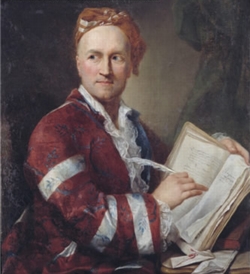

Significantly, the OB then adds: “Emerich de Vattel – “the founding era’s foremost expert on the law of nations,” [(Emphasis added)], Franchise Tax Board v. Hyatt, 587 U.S. 230, 239 (2019) – recognized that a child’s citizenship status depends on his parents’ political status. Vattel wrote that “natives, or natural born citizens, are those born in a country, of parents who are citizens.” [(Emphasis added)] Emerich de Vattel, The Law of Nations [Book 1, Ch. 19,] § 212, at 101 (1797 ed.).” This recognition by Solicitor General Sauer in support of his conclusions on the “birthright citizenship” issue has even greater relevance and materiality to the separate, but closely related nbC issue. It is precisely the definition which historical evidence strongly suggests, if not compels, was adopted by the Founders when crafting the Eligibility Clause.
The OB then acknowledges (at 22) that de Vattel noted that if a person “fixe[s] his abode” in another country, he becomes ‘a member of [that] society, at least as a perpetual inhabitant; and his children will be members of it also.’ Id. § 215, at 102. But where ‘the father has not entirely quitted his country in order to settle elsewhere,’ the child is a citizen of the father’s home country rather than the country where he was born, consistent with the principle that “children follow the condition of their fathers.” [(Emphasis added)] Ibid.”
This acknowledgment in the OB, if superimposed over the nbC issue, directly undercuts the purported nbC status of, among others, Barack Hussein Obama, Kamala Devi Harris and, yes, Senator Ted Cruz.
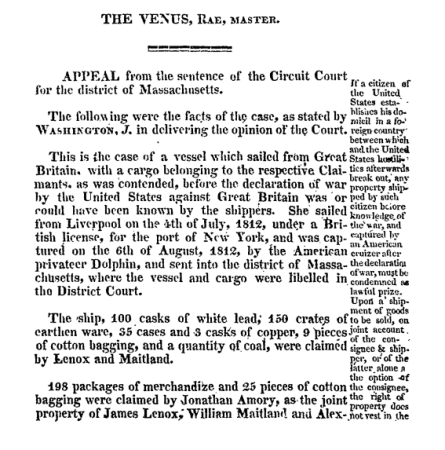
In addition, while not directly mentioning de Vattel by name, the OB cites (OB at 19) in support of its conclusions the Supreme Court’s decision in The Venus, where Justice Bushrod Washington (a nephew of George Washington) also specifically refers to de Vattel and § 212, as discussed in more detail here.
The OB also cites in support of its 14th Amendment conclusions the Supreme Court’s decision in Minor v. Happersett, quoting from it the precise language which your servant has consistently posited confirms the de Vattel § 212 definition of a natural born citizen as being the one intended, understood and adopted by the Founders in Art. 2, § 1, Cl. 5.
There is no principled reason to differentiate between the Court’s language in Minor with respect to the 14th Amendment “birthright citizenship” issue and the nbC issue under the Constitution’s Eligibility Clause, Art. 2, § 1. Cl. 5. And the presence of the “Citizen-grandfather” exception in the root clause merely fortifies this conclusion.
Apart from and in addition to the OB reliance on the principles articulated by Emer de Vattel, the OB includes useful general scholarship and precedent on the nbC issue. This is particularly evident against the backdrop of contemporary commentators who espouse and advocate an nbC definition inconsistent with that recognized in the Minor decision, that “evolved” or “modernized” definition being merely a “citizen at birth” or a “citizen by birth,” regardless of both parents’ U.S. citizen status. This is the definition advocated by former U.S. Solicitors General Paul Clement and Neal Katyal, addressed (and dissected) here, here and here.
It is undisputed that the Founders sought to erect the highest available barrier against the potential for “dual allegiance” or “foreign influence” insinuating itself into the presidency. They crafted the Eligibility Clause with that precise objective in mind.
Solicitor General Sauer advances the identical arguments with regard to “birthright citizenship.” The OB states (p. 45): “The United States has long recognized the general undesirability of dual allegiances. Savorgnan v. United States, 338 U.S. 491, 500 (1950). A child with two nationalities is often ‘reared’ ‘in an atmosphere of divided loyalty.’ Rogers v. Bellei, 401 U.S. 815, 832 (1971). ‘One who has a dual nationality will be subject to claims from both nations, claims which at times may be competing or conflicting.’ Kawakita v. United States, 401 U.S. 815, 733 (1952). ‘Circumstances may compel one who has a dual nationality to do acts which otherwise would not be compatible with the obligations of American citizenship.’” Id. at 736.
These are the identical concerns which motivated the Founders to select the higher definitional barrier to foreign influence and dual allegiances afforded by § 212. Contemporary woke prognostications that they adopted the inferior definition of an nbC as being merely a “citizen at birth” or a “citizen by birth,” regardless of parental citizenship, are both counterintuitive and historically unsupportable.

Pertinently, the OB correctly states (at 43): “Courts should interpret constitutional provisions in accordance with the meaning that ‘they were understood to have when the people adopted them.’ [(Emphasis added)] District of Columbia v. Heller, 554 U.S. 570, 634-635 (2008). Evidence from the time of ratification outweighs later evidence, [(Emphasis added)], see Powell v. McCormack, 395 U.S. 486, 541-547 (1969)”
Accordingly, flawed analyses performed two hundred years after the drafting of the Constitution’s nbC clause, utilizing flawed and even factually erroneous “contemporaneous” predicates in an attempt to fortify defective answers, is not the preferred way to arrive at legal conclusions designed to guide the Republic into the future. In fact, while it might be the “easy” or “woke” way to proceed, it is the wrong way to proceed.
The OB insightfully notes at the outset (at 5): “Constitutional rights are enshrined with the scope they were understood to have when the people adopted them” [(Emphasis added)]; they do not expand or contract because later generations misinterpret them. District of Columbia v. Heller, 554 U.S. 570, 634-635 (2008). This Court should uphold the Citizenship Order and restore the Citizenship Clause’s original meaning.”
Again, there is no principled reason why a different rule should be followed when addressing and analyzing the intent and understanding of the Founders in 1787 as to the Eligibility Clause … they being, after all, “the people who understood and adopted” the nbC restriction.
EPILOGUE
Finally, and with great deference and respect, your servant notes a minor, arguably inconsequential anomaly in the OB, yet one that the opposition lawyers might try to exploit. This anomaly is noted only for the record (and to alert the Solicitor General of its existence in the event he, or one of his lawyers, reads The P&E).
On p. 47 of the OB, it is stated: “For centuries, countries, including the United States, have extended citizenship to the foreign born children of their citizens. See Miller v. Albright, 523 U.S. 420, 477 (1998) (Breyer, J., dissenting); Act of Mar. 26, 1790, ch. 3, 1 Stat. 104.”
The reference to “1 Stat. 104” [sic] comes from Justice Breyer’s dissenting opinion in the Miller case in 1998, and not from Solicitor General Sauer in 2026. In his dissent, Justice Breyer (or his law clerks) may have overlooked or forgotten that Congress repealed altogether 1 Stat. 103 when it enacted 1 Stat. 414 in 1795 to, among other things, eliminate the “natural born” modifier of the term “citizens.” However, the OB, by including it in the quote, could be read to erroneously suggest that Solicitor General Sauer was relying on a statute long ago repealed by Congress, which would be wrong.

As discussed here, the naturalization act of Mar. 26, 1790, codified as 1 Stat. 103, was repealed in its entirety by 1 Stat. 414 in 1795. While Congress reenacted and retained the “citizen” status of children born “beyond sea” to U.S. citizen parents, they were no longer to be “considered” natural born citizens, but only “citizens” of the United States.
While this minor anomaly might have little or no relevance to the Solicitor General’s 14th Amendment “birthright citizenship” arguments now, it could have greater materiality at some future time if and/or when the Court directly addresses the nbC issue and the impact of “Gray’s Anomaly” on the issue. Perhaps at oral argument, “Gray’s Anomaly” in the United States v. Wong Kim Ark case could be noted and corrected.
Other than that, Solicitor Sauer’s OB is masterful, at least in the opinion of your humble servant. Now if only a majority of the Supreme Court Justices would agree.
Comments
7 responses to “Revisiting the Birthright Citizenship and nbC Issues”
In keeping with the theme of the title of this article on the topic of natural born Citizen (nbC), I wish to revisit the citizen status of one US Senator Rafael E. (Ted) Cruz from Texas.
The below YouTube video is from an unidentified and charged-up individual who covers a variety of topics other than Riots Worldwide. Of interest to me was narrator’s assertion that US Senator Cruz is a Canadian citizen. Jump to YouTube video timeline at the nine-minute mark for that claim.
https://beforeitsnews.com/survival/2026/01/riots-world-wide-prepare-to-survive-2801871.html
This commenter’s open request to US Senator Cruz: “Show us your naturalization papers as a bone fide US citizen.”
I am not an attorney, proudly; I am a licensed professional engineer (PE) in three states. As such, I am more comfortable and respectful of the forever non-negotiable laws of Nature over the contemporary capricious laws of man.
So, let’s remove the attorneys from these two citizenship discussions to nowhere and observe natural observations of history-reality:
How did previous generations of U.S. citizens evidently interpret “natural born Citizen” (nbC) and 14th Amendment citizen (14Ac) long before today’s generation of lofty lawyers injected their own agendized interpretations of same?
ANSWER:
nbC was evidently interpreted by the selection and election of U.S. Presidents and Vice Presidents from 1824 (nbC-VP John C. Calhoun) to 08-27-08 (President George W. Bush and VP Richard Cheney) to evidently mean, one who is born within the sole jurisdiction of USA to sole-U.S.-citizen-parents who have no foreign allegiances. In other words, for a continuous period of 184 years, all of today’s humanity can see on the Internet that 34 U.S. Vice President-to-Presidents and 29 U.S. VPs were all born inside USA to their 126 publicly-disclosed sole-U.S.-citizen-parents (Chester Arthur’s father was the one exception as he was a non-publicly-disclosed secret Irish citizen who domiciled in Canada and USA). In summary, these 189 persons over 184 continuous years evidently prove what previous U.S. citizens originally interpreted nbC to mean before 08-28-08 when Insider Traitor Nancy Pelosi fraudulently forged two nomination papers of narrative-presIDent Obama
>>> https://www.thepostemail.com/2025/08/28/natural-observations-of-obama-id-narrative-reality-08-28-08-to-08-28-25/ >>> https://www.scribd.com/doc/48856102/All-U-S-Presidents-Eligibility-Grandfather-Clause-Natural-Born-Citizen-Clause-or-Seated-by-Fraud
14Ac see above recent submission of Trump’s briefs that reveal what previous U.S. citizen’s evidently interpreted 14Ac to mean, up until attorney-criminals prostituted 14Ac to fraudulently “legitimize” anchor babies and chain migration insanity to satisfy various political agendas.
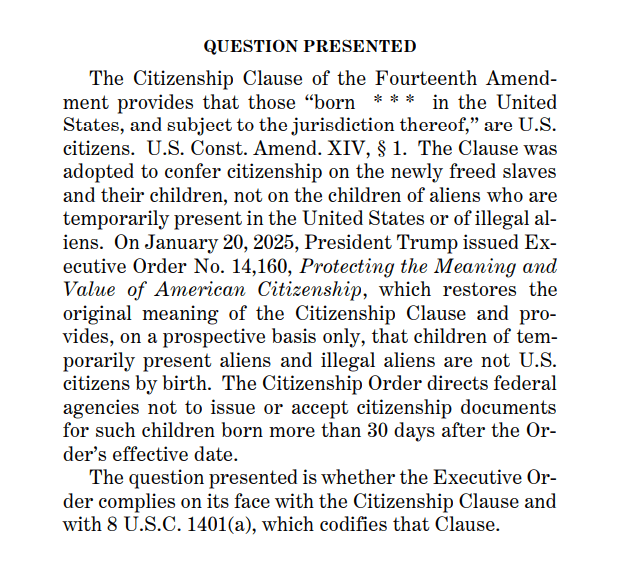
QUESTION PRESENTED
The Citizenship Clause of the Fourteenth Amendment does not provide that those “born * * * in the United States, and subject to the jurisdiction thereof,” are citizens of the United States.
According to the present liberal view, the Citizenship Clause of the Fourteenth Amendment provides that those “born * * * in the United States, and subject to the jurisdiction thereof,” are Art. 2, §1, Cl.5 natural born citizens of the United States.
From the author:
———————–
Recalling that a natural born Citizen (“nbC”), as intended by the Founders, is also completely “subject to the jurisdiction of the United States” by virtue of and as a direct consequence of both parents already being U.S. citizens at the time of birth, the fact that he/she may be deemed to be a “citizen” under the 14th Amendment is separate and apart from his/her status as an nbC under Art. 2, § 1, Cl. 5. Plainly, a “natural born Citizen” is also a “citizen.”
The 14th Amendment creates “citizens,” but it does not – nor can it – create by statutory enactment, an nbC of a differing definition from that in and as contemplated by the Founders under the Constitution’s Eligibility Clause. That is likely why Congress repealed 1 Stat. 103 in 1795 when it enacted 1 Stat. 414.
Thus interpreted, the 14th Amendment complements and dovetails, but does not supplant, Art. 2, § 1, Cl. 5.
This looks like a mistake:
Accordingly, flawed analyses performed two millennia after the drafting of the Constitution’s nbC clause, utilizing flawed and even factually erroneous “contemporaneous” predicates in an attempt to fortify defective answers, is not the preferred way to arrive at legal conclusions designed to guide the Republic into the future.
Two millenia is two thousand years. I believe it should instead say “two hundred years”.
Corrected; thank you!
Cross posted an excerpt here: https://cdrkerchner.wordpress.com/2026/01/26/revisiting-the-birthright-citizenship-and-nbc-natural-born-citizen-issues/ and here: https://freerepublic.com/focus/f-news/4364115/posts
CDR Charles Kerchner (Ret)
http://www.ProtectOurLiberty.org