
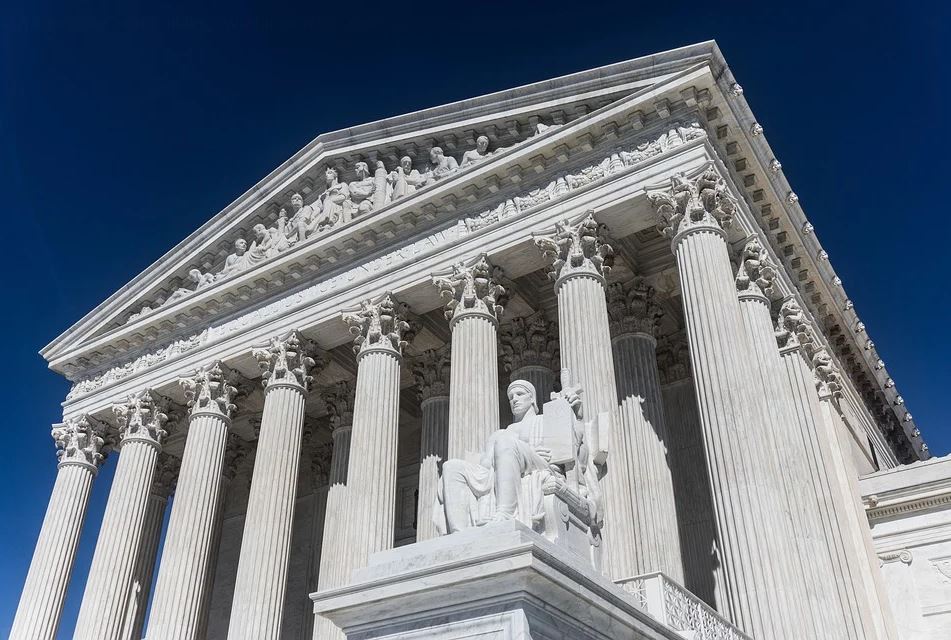
by Joseph DeMaio, ©2025

(Jun. 5, 2025) — As the Republic awaits a decision from the Supreme Court on the 14th Amendment “birthright citizenship” issue, where President Trump seeks a stay on several “nationwide injunctions” entered by lower district court trial judges (USSC Docket Nos. 24A884; 24A885 and 24A886) – said injunctions, in your humble servant’s view, being an outrage under the Constitution’s separation of powers principles as addressed here, – a revisiting of “Gray’s Anomaly” may be prudent. While the anomaly has more materiality to the larger “natural born Citizen” (“nbC”) issue, the birthright citizenship issue is also related and relevant.
Indeed, by the time you are reading this, the Court may have already handed down a decision, including potentially one or more “opinions relating to orders” concurring or dissenting from the almost certainly “split” decision, so intellectually fractured is today’s “Roberts” Court.
On the assumption that faithful P&E readers are already familiar with the blunder, i.e., the “anomaly” committed by Associate Justice Horace Gray and addressed here when composing his majority opinion in United States v. Wong Kim Ark, (“WKA”), it should be noted that Justice Gray had previously opined in Elk v. Wilkins (1884) that the “subject to the jurisdiction” element of the 14th Amendment (1868) meant subject to the complete political and substantive jurisdiction of the United States, not simply a “partial” procedural jurisdiction.
Significantly, and in support of that conclusion, he also asserted (112 U.S. at 101) that a “natural born Citizen” was someone subject to the complete political jurisdiction of the United States as a matter of sole and undivided “allegiance” to the same as demanded by the Founders in the Constitution’s Eligibility Clause, Art. 2, § 1, Cl. 5.
That being the case, Justice Gray likely also surmised that if Congress had declared in 1 Stat. 103 that a child born to citizen parents “beyond sea” was to be “considered” as being an nbC despite not being born here, as long as the child’s allegiance as declared by Congress in 1 Stat. 103 (1790) as derived from his/her citizen parents was considered to be that of an nbC, there was no logical reason to believe that Congress intended that a person actually born here, but not to citizen parents, was to be treated differently for purposes of his/her status as a “citizen” under the 14th Amendment. Stated otherwise, Gray recognized that a “natural born citizen” was still a “native born citizen.”
This conclusion would find support in and flow naturally from a mistaken belief (such as later set out in Gray’s Anomaly in WKA) that Congress (purportedly) in 1 Stat. 414 (1795) “reenacted in the same words” the “natural born” modifier of the term “citizens” it had mistakenly included in 1 Stat. 103, the 1790 Naturalization Act. Gray’s mistaken belief that Congress intended to preserve the modifier may well have been the result of his unexamined reliance on the words of Chief Justice Morrison Waite in Minor v. Happersett (“Minor”), where Justice Waite erroneously asserted (88 U.S. at 168) (as did Gray in WKA, 169 U.S. at 673), that in enacting 1 Stat. 414, and in all statutes enacted between then and 1874, when Minor was decided, Congress intended that “[t]hese provisions [including the provision that children born beyond sea to U.S. citizen parents were to be “considered” or “deemed” to be nbc’s] thus enacted have in substance been retained in all the naturalization laws adopted since.” (Emphasis added)
Thus, it would appear that both Supreme Court Justices erred in claiming that the “natural born citizen” modifier of 1 Stat. 103 survived its repeal when 1 Stat. 414 was enacted. Although the “substance” of certain provisions of 1 Stat. 103 was retained in 1 Stat. 414, the one provision regarding the “considered as natural born citizens” verbiage was not retained. To the contrary, it was specifically deleted and repealed – rather than “dropped” as a non-substantive “stylistic/grammatical decision” – as suggested by the Nov. 11, 2016 Report of the Congressional Research Service (“CRS”) (Report at 20, n. 96), never again to be included by Congress in any subsequent statute relating to its power to prescribe the laws governing naturalization.
This historical fact alone fortifies the conclusion that Congress realized its error in the 1790 Act and corrected that mistake in the 1795 Act, a circumstance completely overlooked by both Chief Justice Waite in Minor and Associate Justice Gray in WKA.
In enacting 1 Stat. 414, Congress neither “retained in substance” as suggested by Chief Justice Waite nor “reenacted in the same words” as asserted by Associate Justice Gray the “natural born” modifier. Instead, it repealed and deleted it. That which Congress did enact in 1 Stat. 414 was the verbiage requiring children born out of the limits and jurisdiction of the United States to be born to “citizens of the United States” in order to themselves be “considered as citizens of the United States.”
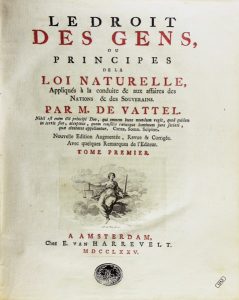
That language as to the parents of such children was expressed by Congress as the plural term “citizens,” rather than the singular “a citizen,” which singular term Congress could have, but did not, use. Moreover, although not directly related to the 14th Amendment “birthright citizenship” issue, the verbiage of both 1 Stat. 103 and 1 Stat. 414, referring to the citizenship status of the parents of such children in the plural, is entirely consistent with § 216, Book 1, Ch. 19 of The Law of Nations (1758) (hereinafter “§ 216”) by Swiss attorney, jurist and scholar Emer de Vattel, addressing the status of children born at sea, i.e.: “… naturally, it is our extraction [i.e., parental lineage], not the place of our birth, that gives us rights.” (Emphasis added)
Against the foregoing factual backdrop, the legal bases and intellectual credibility of Senate Resolution 511, purporting to confirm and ratify Senator John McCain’s nbC bona fides, as well as the assertions of the Clement/Katyal Harvard Law Review Forum article, are directly implicated. Sen. Res. 511 seemingly relies directly, and erroneously, on Gray’s Anomaly for its claim that 1 Stat. 103 continues to be in effect today and that it defines the term “natural born citizen.” In fact it does nothing of the sort, even if it were now still in effect instead of having been repealed in 1795.
As for the Clement/Katyal article, frequently cited in tandem with the flawed decision in WKA as the “be-all-end-all” of the debate – because it is also seemingly premised on the same mistaken assumption that under the 1790 Act — 1 Stat. 103 — the “concept of ‘natural born Citizen’ [sic] has remained constant…,” (Emphasis added) (see “On the Meaning of Natural Born Citizen,” 168 Harv. L. Rev. at 162), it is clear that even two esteemed and well-credentialed former Solicitors General of the United States Department of Justice are seemingly unaware that the natural born citizen “concept” of 1 Stat. 103 has not only not remained constant, it existed “on the books” for a scant 58 months before it was repealed by the same Congress which enacted it upon the realization that it had originally blundered in enacting it in the first place.
Parenthetically, the bracketed “[sic]” in the preceding paragraph is necessitated in order to signal that, while Messrs. Clement and Katyal in their article capitalize the “C” in the word “citizens” while purporting to quote 1 Stat. 103, as originally enacted by Congress the “c” was not capitalized. The only place where the “c” is capitalized in connection with the “natural born” restriction is in Art. 2, § 1, Cl. 5 of the Constitution, the presidential Eligibility Clause.
By casually capitalizing the “c” in a passage being represented to the reader in a Harvard Law Review Forum article as a “quote” of the statute as enacted by Congress, the article becomes subject to the interpretation that Congress was equating the term “citizens” used by Congress in the statute with the capitalized term “Citizen” used by the Founders in the Constitution. Sub rosa linguistic ledgerdemain such as that might be “par for the course” in CRS “products,” but it should not infect the works of former Solicitors General, particularly when appearing in prestigious law review articles.
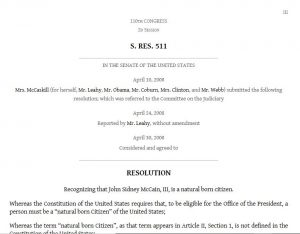
Problematically as well, Sen. Res. 511 makes the same mistake by purporting to quote 1 Stat. 103 as having capitalized the “c” in “citizens,” which it did not. Those who drafted, sponsored and initially voted out of the Senate Judiciary Committee the language of the resolution (including co-sponsoring Senators Barack Obama and Hillary Clinton) might have more closely researched the actual language of 1 Stat. 103 before misquoting it in Sen. Res. 511.
Of greater significance, moreover, is the fact that even under the Clement/Katyal article’s flawed contention that the nbC “concept” of 1 Stat. 103 has purportedly “remained constant,” it is clear that under that 1790 law, Congress “conceptually” required that the person born “beyond sea” had to be born to two U.S. citizen parents – in the plural – both of whom were already U.S. citizens. More specifically, this contention is grounded in a recognition that the nbC status, consistent with de Vattel’s § 216, arises by operation of the principles of jus sanguinis (law of the blood or lineage), rather than jus soli (law of the soil, or place of birth).
Even Messrs. Clement and Katyal concede this legal reality when they refer to 1 Stat. 103 as including “someone who is a citizen from birth by descent without the need to undergo naturalization proceedings….” (Emphasis added) Their inclusion of the term “by descent” constitutes a clear acknowledgment of the operation of jus sanguinis principles and runs directly contrary to the narrative peddled by the CRS in all of its “products” purporting to confirm and “resolve” the Founders’ intent that jus soli alone guided their understanding of who an nbC would be. Thus, even under the flawed claim that the “concept” of an nbC under 1 Stat. 103 has remained constant, that “concept” supports a de Vattel § 212 nbC analysis and not a Clement/Katyal or CRS analysis.
Accordingly, even under the Clement/Katyal “citizen at birth” or “citizen by birth” theory as coupled to 1 Stat. 103, it is a person’s parental lineage (jus sanguinis), rather than exclusively the mere place of birth (jus soli) as contended by the CRS, which is determinative. Indeed, there is nothing inconsistent with the conclusion that the Founders’ intent in fashioning the highest barrier to “foreign influence” infiltrating the presidency lay in adopting the de Vattel § 212 definition of a natural born citizen, which blends both the jus soli and jus sanguinis elements, as corroborated by the Founders’ simultaneous adoption of the time-limited, narrow “Citizen-grandfather” exception to the highly rigorous § 212 restriction. It is that simple.
Indeed, reliance on the jus soli principle exclusively to define one’s citizenship – let alone to define an nbC for purposes of the Constitution – is not unlike treating people like crops: they come into existence on the soil of a nation, grow and mature in the soil, and in due course can be harvested from the soil and consumed or sold. This is hardly an enlightened protocol when dealing with human beings as opposed to, for example, wheat. Yet it is analogous to the confused argument advanced by the CRS throughout its “analyses” of the nbC definition.
As noted by de Vattel in § 216: “It is our extraction, not the place of our birth, that gives us rights.” Insofar as the Constitution’s Art.2 § 1, Cl. 5 inclusion of the additional jus soli shield fortifying the jus sanguinis element – as articulated in § 212 by de Vattel – the only consequence is a strengthening of the nbC restriction. The CRS approach, as well as the Clement/Katyal “citizen at birth”/“citizen by birth” theory, both produce a lowering and weakening of the restrictive barrier as intended by the Founders. It is counterintuitive, even fatuous, to contend that the Founders intended to select an nbC definition that produced a lower, less restrictive barrier to foreign influence when the higher, more robust de Vattel § 212 definition existed.
Again, it is that simple.
Comments
One response to “Additional Thoughts on Gray’s Anomaly”
Sir: Since 2008 I have researched and written over a dozen research memos on natural born and birthright citizenship. My latest post analyzing the violation of jurisprudence in WKA is at my WordPress blog under the name ‘paraleaglenm.’
Analysis of WKA results in the average person’s attention tuning out into static, and it is amazing how many professional attorneys (especially Heritage Foundation contributor and now Assoc. Appellate Justice David C. Ho) produce opinions that are in complete error.
Birthright Citizenship is jus feudalis, feudal law resurrected by Horace Gray in conflict with existing statute, two sections of the constitution, and treaty. Feudal law, in English common law and random judges in cases lacking subject matter jurisdiction, recognized the principle of jus soli, or ‘place of birth’ contributing to allegiance and subjection.
However, even Gray, in his WKA opinion, cited the historical facts that England and France both abandoned jus soli in favor of jus sanguinis, the inheritance of the father’s national allegiance and rights through blood. This is supported in the 1772 British Nationality Act, and the U.S. followed suit in the First Uniform Nationality Act of 1790. Gray also cites the change in French law from jus soli to jus sanguinis in 1807!
Yet, Gray so romanticized English common law that he insisted its absence from U.S. law and the constitution was an omission that the court was bound to correct, even if in conflict with and violation of congressional plenary power in ArtISec8 over naturalization law.
The creation of birthright citizenship for Wong was also in conflict with treaty (Burlingame–Seward Treaty of 1868) which guaranteed the Emperor of China unending and perpetual allegiance and subjection of Chinese nationals, barring them from renouncing said allegiance to naturalize as U.S. citizens.
Those of us familiar with Article II recall how Alexander Hamilton proposed that presidents must be ‘native born citizens,’ but John Jay, in his letter to George Washington, opposed ‘native’ as being vague, suggesting ‘natural born citizen’ as being a more precise definition of allegiance at birth. Indeed, ‘native born’ was never an element of citizenship in statute, until Wong Kim Ark created it.
Horace Gray knew that ‘born in the United States’ did not apply to Wong Kim Ark, as the 14th Amendment addressed only those ‘native born’ who did not have citizenship. Freed slaves only inherited a stateless condition from their fathers, and Native Americans not associated with sovereign tribes on reservations were deprived citizenship as well.
Wong Kim Ark was born, under statute, natural law, and treaty, a Chinese national.
Finally, Gray in violation of multiple levels of jurisprudence–in violation of existing U.S. law, not following constitutional law, and by violating treaty–reached back into loose language, dicta, of an 1824 case in which the judge called a citizen ‘native born,’ and thus created precedent for birthright citizenship.