

by Joseph DeMaio, ©2025

(May 9, 2025) — Introduction
In the continuing saga of the impact (or, for anomaly-deniers) the purported immateriality of Associate Supreme Court Justice Horace Gray’s “Anomaly,” addressed here, a few fathoms in a deeper dive into the issue may help. This dive may have more relevance to the “natural born Citizen” (“nbC”) issue under Art. 2, § 1, Cl. 5 of the Constitution – the presidential Eligibility Clause – than to the “birthright citizenship” issue under the 14th Amendment, addressed here, but because analyses of both issues depends on similar principles and Supreme Court decisions, the discussion is warranted.
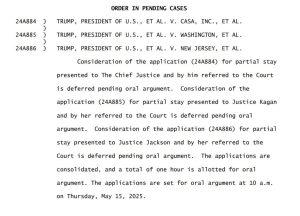
Moreover, because of the upcoming (May 15, 2025) oral arguments in the Supreme Court (USSC Docket Nos. 24A884; 24A885 and 24A886) regarding President Trump’s applications for stays on “nationwide injunctions” affecting his Executive Order 14160 challenging the currently-accepted narrative of “birthright citizenship,” this dive may prove timely.
SCUBA gear checked and operational? Pressure regulator OK? Ready? Let us take the plunge.
Discussion and analysis
As your humble servant has noted – originally over four years ago here; then here; and most recently here – the continued vitality and precedential value of the Supreme Court decision in United States v. Wong Kim Ark, 169 U.S. 649 (1898) (“WKA”) may be severely – and potentially fatally – compromised and undermined.
The basis for that potential lies in the fact that Associate Justice Gray’s majority opinion is premised, at least in significant part, on a manifest factual blunder. Blunders that are legal in nature are problematic, but usually explainable. Factual blunders, on the other hand – particularly indisputable and manifest ones – are more difficult to overcome or explain away.

The WKA blunder, of course, your servant has labeled as “Gray’s Anomaly,” where he asserts, erroneously, that the “natural born” modifier of the word “citizens” in one of Congress’s first naturalization statutes, enacted in 1790, 1 Stat. 103, was in 1795 purportedly “reenacted in the same words….” (Emphasis added), – despite being clearly deleted and repealed by 1 Stat. 414 in that year.
The verbiage was not inadvertently or accidentally “dropped” by Congress as merely a “stylistic or grammatical decision,” as suggested by the Congressional Research Service (“CRS”) back in 2016 here (see 11/11/2016 CRS Report at 20, n. 96, but was instead specifically “repealed,” as 1 Stat. 414 announced in clear and plain English.

legislink/pdf/stat/1/STATUTE-1-Pg414a.pdf
Even a cursory review of the two laws – a task apparently not performed by Justice Gray or one of his law clerks (or, indeed, by any of the other Associate Justices who joined in the majority opinion) – unambiguously confirms that Congress did not “reenact in the same words” or casually “drop” the 1790 law’s modifier term “natural born” prior to the term “citizens” in 1 Stat. 414. Indeed, Congress did just the opposite: it specifically deleted and repealed that “natural born” verbiage, such that the 1795 act thereafter declared children born “beyond sea” to U.S. citizen parents (in the plural) to be “citizens,” but no longer “natural born” citizens.

With this indisputable factual as a backdrop, one might further ask: So what? Are there any other indicators in Justice Gray’s WKA majority opinion (Chief Justice Fuller’s dissent, and Justice Harlan’s concurrence therein aside) supporting the theory that Gray’s Anomaly (aka, “blunder”) may have influenced or guided his flawed thinking regarding the “birthright citizenship” issue presented by Mr. Wong Kim Ark? And in any event, is the anomaly material?
Particularly in a split 6-2-recuse case like WKA, glad you asked.
1-Fathom Depth Discussion
First, prior to committing the blunder, Justice Gray deemed it necessary to first refer to and cite with approval, among other sources, the New York Chancery Court decision of Vice-Chancellor Lewis Sandford in Lynch v. Clarke, 1 Sand. 583 (1844). Apart from the fact that the New York Chancery Court was a jurisdictionally-restricted court of equity rather than general jurisdiction, the Lynch case involved only the “citizenship” status of one Julia Lynch, born in New York, and had nothing to do with whether she was in addition an nbC.

In addressing the “birthright citizenship” question – and quoted by Justice Gray in his WKA opinion – Vice-Chancellor Sandford in Lynch stated hypothetically, 1 Sand. at 656: “Suppose a person should be elected president who was native born, but of alien parents, could there be any reasonable doubt that he was eligible under the Constitution? I think not.” (Emphasis added) It is this passage from the Lynch case most often seized upon by supporters of the theory that a 14th Amendment “citizen” is synonymous with an nbC as “proving” presidential eligibility in the children of aliens who happen to be born here, even though the decision came years before the ratification and adoption of the 14th Amendment.
With due respect, Vice-Chancellor Sandford was wrong in Lynch and Justice Gray was “mistaken” in citing Lynch in support of his position. And as for Vice-Chancellor Sandford’s assertion that there was no “reasonable doubt” that a person born here to alien parents was an nbC eligible to the presidency, his claim was nonsense in 1844 when Lynch was decided; it was nonsense in 1898 when WKA was decided; and it remained nonsense in 2021, when your humble servant first stumbled over “Gray’s Anomaly.” His “no reasonable doubt” comment is diametrically at odds with § 212 of Book 1, Ch. 19 of The Law of Nations (“§ 212) by Swiss attorney, jurist and international law scholar Emer de Vattel, defining an nbC as a person born in a country to parents both of whom are already citizens of that country. Oddly, Vice Chancellor Sandford specifically cited with approval § 212 (see 1 Sand. at 676), yet ignored its definition of a natural born citizen when making his comment, at minimum, a patently inconsistent fact.
Additionally, the “no reasonable doubt” comment about the nbC status of persons born here to alien parents was, is, and will remain into the future: obiter dictum, having nothing to do with the status of Julia Lynch as a (New York) “native-born” U.S. “citizen.” As noted by the Supreme Court in Jama v. Immigration and Customs Enforcement, 543 U.S. 335, 351, n. 12 (2005): “Dictum settles nothing, even in the court that utters it.”
Finally, corroborating the likelihood that Congress repealed 1 Stat. 103 because it realized in 1795 that it had erroneously claimed that children born “beyond sea” to U.S. citizen parents were “natural born,” Vice Chancellor Sandford confirmed (1 Sand. at 643) that the “1790” law (i.e., 1 Stat. 103) was a statute restricted to making a uniform law of “naturalization” (Emphasis added). A statute restricted to making laws relating to naturalization cannot make a law relating to or altering the nbC Eligibility Clause in the Constitution.

2-Fathoms Deep Discussion
Second, Justice Gray deemed it necessary in his 14th Amendment birthright citizenship analysis to discuss the writings of one Horace Binney, a Philadelphia lawyer and essayist. Justice Gray cited and quoted Mr. Binney thusly, 169 U.S. at 665-66:
“Mr. Binney, in the second edition of a paper on the Alienigenae of the United States, printed in pamphlet at Philadelphia, with a preface bearing his signature and the date of December 1, 1853, said [at pp. 19-22]:
“The common law principle of allegiance was the law of all the States at the time of the Revolution and at the adoption of the Constitution, and, by that principle, the citizens of the United States are, with the exceptions before mentioned, (namely, foreign-born children of citizens, under statutes to be presently referred to) ‘such only as are either born or made so, born within the limits and under the jurisdiction of the United States or naturalized by the authority of law, either in one of the States before the Constitution or, since that time, by virtue of an act of the Congress of the United States.’ [P. 20]
“The right of citizenship never descends in the legal sense, either by the common law or under the common naturalization acts. It is incident to birth in the country, or it is given personally by statute. The child of an alien, if born in the country, is as much a citizen as the natural born child of a citizen. (Emphasis added by DeMaio) [P. 22].
“This paper, without Mr. Binney’s name and with the note in a less complete form and not containing the passage last cited, was published (perhaps from the first edition) in the American Law Register for February, 1854. 2 Amer.Law Reg.193, 203, 204.”
Against this backdrop, it would again seem clear that Justice Gray was quoting Binney for the proposition that a child born here to an alien mother was a “citizen,” just as was a child born here to citizen parents a “natural born citizen,” but not him/herself an nbC. This is nothing more than recognition of the “Euler Diagram” eligibility protocol: “While all natural born Citizens are also 14th Amendment ‘citizens,’ not all native-born citizens are nbC’s.”
Accordingly, if under Mr. Binney’s reasoning that were true, then, ipso facto, Justice Gray might well have concluded that the inverse should also be true: if someone is a “citizen at birth” or a “citizen by birth,” they must be both a “citizen” as well as an nbC. In order to bolster and fortify that conclusion, he likely then turned to the language of 1 Stat. 103 and its “natural born citizens” characterization of children born “beyond sea” to U.S. citizen parents.
The balance of his WKA opinion is entirely consistent with the theory that, if in 1790 Congress believed that children born abroad to citizen parents were “natural born citizens,” and thus also 14th Amendment “citizens,” there should be no reason to believe that such children born after 1 Stat. 414 was enacted in 1795 would not be citizens as well. This construct flows naturally from his erroneous belief that the “natural born” modifier of “citizens” Congress had included in 1 Stat. 103 remained in 1 Stat. 414, and in fact, had been “reenacted” in the same words.” That belief, of course, was wrong, further undermining the rationale of his conclusion that Wong Kim Ark was a 14th Amendment “native born” citizen.
3-Fathoms Deep Discussion


At this point, however, it bears repeating that Justice Gray may not have been the first or only Supreme Court Justice to have mistakenly believed that the 1795 statute – 1 Stat. 414 – had retained the “natural born” modifier of “citizens” present in 1 Stat. 103. As noted here, and to preempt reader complaints of “misinformation,” an original suggestion that Congress retained, rather than discarded, the “natural born” modifier of “citizens” was posited, – although not in as categorical terms as “in the same words” used by Justice Gray in WKA – by Chief Justice Morrison Waite in the unanimous opinion in Minor v. Happersett, 88 U.S. 162 (1874) (“Minor”).
Specifically, in Chief Justice Waite’s Minor opinion, after reciting and partially paraphrasing the language of the 1790 Act, 1 Stat. 103, – which included a reference to children born “beyond sea” to U.S. citizen “parents” as being “considered as natural-born citizens…,” – he states: “These provisions thus enacted have, in substance, been retained in all the naturalization laws adopted since.” (Emphasis added). Respectfully…, incorrect: the 1795 Act, 1 Stat. 414, did not retain “in substance” the “natural born” language modifying the term “citizens.” To reiterate, Congress deleted and repealed that verbiage when it enacted 1 Stat. 414.
As noted with regard to “Gray’s Anomaly” in WKA, the error committed in Minor by Chief Justice Waite occurred when he asserted that “these provisions” – presumably including reference to the “natural born” modifier of 1 Stat. 103 – “… have been retained in all the naturalization laws adopted since.” To differentiate it from “Gray’s Anomaly,” let us for discussion purposes refer to it as “Waite’s Irregularity.”
In fact, 1 Stat. 103 was the solitary law passed by Congress in the history of the Republic to use the term “natural born” to modify the term “citizens,” and that erroneous use was seemingly recognized by Congress and corrected with the passage in 1795 of 1 Stat. 414. Moreover, adding to the materiality and severity of Justice Gray’s “error,” he claimed that in 1 Stat. 414, Congress purportedly “reenacted in the same words” (Emphasis added) verbiage that it had plainly and irrefutably repealed, never thereafter in statute repeating the mistake.
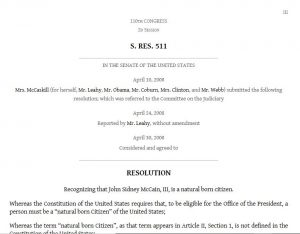
Parenthetically, Congress may have never thereafter repeated the mistake of 1790 in statute, but the Senate came close to repeating the crux and “meat” of the mistake in 2008, when on April 30, 2008, it adopted, by unanimous consent, Senate Resolution 511. There, the Senate resolved that Senator John McCain III was (purportedly) an nbC eligible to the presidency. The not insubstantial problems and defects of that resolution and its faulty conclusion are identified and discussed here.
4-Fathoms Deep Discussion
Finally, does either “Gray’s Anomaly” in WKA or Chief Justice Waite’s mistaken “in substance” statement (“Waite’s Irregularity”) in Minor matter? Stated otherwise, do either of these “aberrations” have any significance, relevance or materiality to the analysis of who may constitute either a 14th Amendment “citizen” or an Art. 2, § 1, Cl. 5 “natural born Citizen” under the Constitution? The answer to that question, of course, cannot be supplied by your humble servant. Only the Supreme Court would have the jurisdiction (and discretion) to respond. And thus far, the Court has shown little interest in traveling that rocky path.
On the other hand, there are several indicators that persons, organizations, and legislating bodies may, indeed, have been influenced by one or both of the aberrations.
For example, the 2008 Harvard Law Review Forum article by former Solicitor General Paul Clement and former Acting Solicitor General Neal Katyal, “On The Meaning of ‘Natural Born Citizen” cites the decision in WKA in support of its conclusions. After citing the case, the authors claim that
“… eight of the eleven members of the committee that proposed the natural born eligibility requirement to the Convention served in the First Congress and none objected to a definition of “natural born Citizen” that included persons born abroad to citizen parents.
The proviso in the Naturalization Act of 1790 [i.e., 1 Stat. 103] underscores that while the concept of “natural born Citizen” has remained constant… [other provisions have changed].” (Emphasis added)
To begin with, the fact that none of the members of the Convention’s “Committee on Postponed Matters” who were thereafter in Congress when 1 Stat. 103 was enacted objected simply means that, as legislators rather than Founders, they may not have been paying close enough attention to the verbiage being proposed in a naturalization statute which held the potential for being successfully voided as a prohibited “end-around-run” on the Constitution. Moreover, 1 Stat. 103 did not “define” what constituted an nbC, but only classified certain people born “beyond sea” to U.S. citizen parents as being nbC’s.
Most significantly, the “concept” of what an nbC was – and as claimed by Messrs. Clement and Katyal existed under 1 Stat. 103 – “remained constant” for only 58 months, between its enactment on March 26, 1790 and its repeal on January 29, 1795. After that date –including through today – whatever “concept,” “rationale,” “protocol” or “fantasy” believed to have been operative in 1 Stat. 103 regarding the term “natural born”… evaporated.
While Messrs. Clement and Katyal may be relying on a source other than “Gray’s Anomaly” (or, even, “Waite’s Irregularity”) for the claim that the “concept” of the natural born citizen articulated in 1 Stat. 103 survived its repeal a mere 58 months after it was enacted, it is not apparent from their article. In fact, a persuasive argument can be made that their conclusion regarding the operational vitality of the “natural born” term in 1 Stat. 103 well after its repeal, up to and including 2015, the date of their article, is entirely consistent with either or both “Gray’s Anomaly” and “Waite’s Irregularity.”
As yet another example of how the two “aberrations” may have had deleterious effects on the proper analysis of the issues, one need look no farther than Senate Resolution 511, where the Senate specifically referenced (erroneously) the phantom “definition” of a natural born Citizen which the Senators believed could be found in “… the First Congress’s own statute defining the term “natural born Citizen.” Again, the only statute to have ever used the term “natural born” – but without defining it – was 1 Stat. 103…, and that statute only categorized children born beyond sea to U.S. citizen parents as “natural born.”
Unlike the definition of a “natural born citizen” found in § 212, Sen. Res. 511 seems clearly to be relying on either or both of “Gray’s Anomaly” or “Waite’s Irregularity” as the source for that claim. At minimum, the resolution’s fourth “[w]hereas” clause is entirely consistent with that conclusion, making the resolution itself suspect.
Finally, in at least two of the amicus curiae briefs filed in the “birthright citizen” challenges in the Supreme Court make statements which are consistent with a conclusion that the WKA opinion, including “Gray’s Anomaly,” influenced the assertions of the brief. The most obvious one involves the “Biazzo” amicus brief, already discussed here, and thus omitted from further discussion in this offering.
The other amicus brief seemingly relying on the faulty claims of Justice Gray’s WKA opinion is that of “Professors Chin, Lee and Finkelman.” That amicus brief focuses primarily on the provision of the “1790” Act which denied citizenship to immigrants of Asian descent rather than on the issues of “birthright citizenship” and nbC eligibility. The potential of its erroneous reliance on Justice Gray’s mistake lies in its statement (at 14) that, between 1917 and 1935, “…the Naturalization Acts of 1790 and 1870 remained in effect and continued to make Asian immigrants ineligible for citizenship.” While in the context of the racial issue being raised by the amici, to the extent that they believe that 1 Stat. 103 “remained in effect” and was “reenacted, in the same words” by 1 Stat. 414 after its repeal in 1795, it is in error.
Conclusion
Much of the foregoing may be seen as, once again, “going over a ploughed field.” Yet even a ploughed field may sometimes unearth something too long buried or unnoticed. Your servant posits that in matters involving the correct interpretation of the Constitution and its Amendments, all things discovered as the plow traverses the field should be examined.
As frequently repeated here at The P&E in the past, unless and until the Supreme Court directly addresses the “birthright citizen” and nbC issues, they will persist as unanswered questions. And because one of the “elements” needed for the issuance of the lower District Court’s “nationwide injunctions” was a “showing” by the Respondents in the cases now pending before the Court of a “likelihood of success on the merits,” only a rebuttable presumption now exists that those persons and organizations opposing President Trump and Executive Order 14160 are likely to win, and President Trump will lose. That would be unfortunate.
Rebuttable presumptions were made…, to be rebutted. “Gray’s Anomaly” and “Waite’s Irregularity” are items found in the ploughed field which might – and, it is posited should – rebut any presumption that the Respondents will prevail on the merits and that President Trump is wrong and will lose. Your servant awaits with interest what the Court says on May 15.
Comments
2 responses to “Does Gray’s Anomaly Matter?”
Mr. DeMaio may I suggest you include all your writings of this subject in a book with the title simply nbC. Maybe it would find its way to an interested justice. I would buy it.
Excellent! Joseph DeMaio hits a home run once again.
CDR Kerchner (Ret)
ProtectOurLiberty.org