

by Joseph DeMaio, ©2025

(Apr. 23, 2025) — Introduction
Following President Trump’s issuance of Executive Order 14160 challenging the generally-accepted current “birthright citizenship” narrative under the Fourteenth Amendment, several individuals and a number of States, unsurprisingly, filed suit challenging the constitutionality of the order. Thereafter, various district and Circuit Courts of Appeal either entered (or on appeal, affirmed) preliminary injunctions and/or temporary restraining orders barring the operation of the order. The Trump Administration, in turn, responded by seeking, as to each of the separate injunctions, emergency partial stays pausing the injunctions.
Those three stay applications are presently pending at the Supreme Court under Docket Nos. 24A884; 24A885 and 24A886. Significantly, on Thursday, Apr. 17, 2025, the Court consolidated the three applications and set them for oral argument on May 15, 2025 at 10 a.m., allocating a total of one hour for the arguments.
And on Tuesday, April 22, 2025, the Court also ordered that any additional amicus curiae briefs would have to be filed on or before April 29, 2025. Because of the significance of the issues presented, look for an amicus tsunami in the next six days.
Discussion and Analysis
The Trump partial stay applications in each of the cases; the various parties’ responses; the Trump reply briefs and the several amicus curiae briefs thus far filed all acknowledge that one Supreme Court decision in particular may (or may not) play an important role in the proper analysis of the birthright citizenship issue. That 6-2 decision (Justice McKenna not participating) is United States v. Wong Kim Ark, 169 U.S. 649 (1898) (“WKA”).
The oral argument next month should be very interesting, not only because of the substantive issues being addressed – including the “subject to the jurisdiction” sub-issue embedded in the Fourteenth Amendment – but potentially also with regard to the closely-related issue of that which constitutes a “citizen at birth” or a “citizen by birth” for purposes of the “natural born Citizen” (“nbC”) restriction in Art. 2, § 1, Cl. 5, the Constitution’s “Eligibility Clause.”
Fair warning: much of what follows will seem to be “old news” to P&E readers, as the “anomaly” flaw issue was addressed several years ago here. But in light of the upcoming oral arguments, a brief refresher course on what the WKA opinion states…, doesn’t state…, and also mis-states…, may prove useful.
The birthright citizenship and nbC issues are closely related, if not actually intertwined. Thus, depending on whether by May 15, 2025, any of the Justices may have discovered the spine to tackle not just the 14th Amendment issues, but the related nbC issues, some useful clarification on both issues may result. In fact, the nbC issue has been indirectly injected into the cases by way of certain amicus curiae briefs submitted after the Court’s order setting the cases for oral argument. So maybe some long-overdue confirmation or clarification of the nbC definition by SCOTUS – might be forthcoming. The oral arguments may give a “hint” of what the ultimate decision by the Court might be on both issues.
Clearly, the opportunity to address the nbC question will be there. But whether any Justice will dare to broach it – as it was understood and intended by the Founders in 1787 as opposed to today’s “experts” – is an entirely different question. Stated otherwise, the nbC “can” could be easily kicked down the road once again, with the Court continuing to “evade” a decision on it. So…, stay tuned.

In the WKA split decision, the majority opinion – authored by Associate Justice Horace Gray – held that a person born in San Francisco to Chinese citizen parents legally-domiciled, permanently residing and doing business in that city was, himself, a U.S. citizen, the allegiance of his parents to the Emperor of China notwithstanding. Importantly, and contrary to the claims of many “experts” today, the case decided nothing…, as in zero… with regard to anything other than Wong Kim Ark’s status as a “citizen” under the 14th Amendment, including any issue as to whether he – or people similarly-situated to him – were in addition nbC’s under the Constitution.
In reaching his “birthright citizenship” conclusion, Justice Gray relied for his ultimate opinion upon, among other historical sources, the enactment by the First Congress of 1 Stat. 103, the “Naturalization Act of 1790.” That Act provided, among other things, that “the children of citizens of the United States, that may be born beyond sea, or out of the limits of the United States, shall be considered as natural born citizens….”
However, arguably realizing only five years later that the “children born beyond sea” being “considered” to be natural born citizens provision which had previously been set out in 1 Stat. 103, a “naturalization” law, could be mistakenly interpreted as creating a prohibited statutory attempt to amend or contravene the “natural born Citizen” restrictions of the Constitution itself, in 1795 Congress, likely in order to correct its 1790 oversight, repealed 1 Stat. 103 in its entirety and enacted in its place 1 Stat. 414, the “Naturalization Act of 1795.” (See Christina Lohman, “Presidential Eligibility: The Meaning of the Natural-Born Citizen Clause,” 36 Gonzaga L. Rev. 349 (2000/01) at 372-73 Lohman1.pdf)

The 1795 Act deleted the “natural born” modifier of “citizens” in the prior law, and substituted the unmodified term “citizens,” thus declaring children born beyond sea to U.S. citizen parents themselves “citizens,” but no longer to be “considered” as “natural born citizens.” Thus, the 1795 naturalization law could no longer be portrayed as constituting an “end-around run” on the Eligibility Clause as was the case with 1 Stat. 103.
Problematically and erroneously, however, Justice Gray claimed in his majority opinion (169 U.S. at 672-73) that in 1795, the provisions of 1 Stat. 103, including the “children considered as natural born citizens” verbiage was, along with other unrelated language, “… re-enacted in the same words…” (Emphasis added) In fact, 1 Stat. 103 was instead repealed in toto, with 1 Stat. 414 replacing it. Stated otherwise, the “considered as natural born citizens” verbiage was not reenacted “in the same words” in 1 Stat. 414, but was instead altogether repealed, never again to be found in a federal immigration or naturalization statute.
And whether the deletion and repeal of the verbiage was motivated by concern over the potential for interpretations that it amounted to a prohibited statutory attempt to amend the Constitution, the fact remains that the language was deleted and repealed, rather than “re-enacted in the same words,” as claimed by Justice Gray. This is what your servant labels as “Gray’s Anomaly.” As noted, this “anomaly” was addressed several years ago by your humble servant here at The P&E, but, as far as is known, it has not been identified or corrected in any research paper or law review article. And it certainly has not been addressed or corrected by SCOTUS itself. Do not poke the sleeping dog…, move along…, nothing to see here….
Plainly, a cursory or casual reading of Justice Gray’s claim, without examining its underlying veracity, could easily lead one to believe that Congress intended to preserve, rather than to jettison, the “natural born” modifier when enacting 1 Stat. 414, which conclusion, it is posited, would be wrong. While it is clear that Congress repealed 1 Stat. 103, unless one actually reads 1 Stat. 414 and confirms the opposite of what Justice Gray stated, the anomaly will go undetected. Justice Gray or one of his law clerks, seemingly, did not read 1 Stat. 414, or at minimum, did not read it closely enough.
The foregoing aside, Justice Gray’s misstatement regarding the repeal of the “natural born” modifier may (or may not) have application to the analysis of either the concept of “birthright citizenship” or the “subject to the jurisdiction” condition of the 14th Amendment. Nonetheless, Justice Gray saw fit to reference both 1 Stat. 103 and 1 Stat. 414 in his analysis of the sole question presented in WKA, i.e., whether Wong Kim Ark was (or was not) a U.S. “citizen” under the Fourteenth Amendment. The question of whether he was also a natural born Citizen for presidential eligibility purposes was never before the Court, despite the contrary contentions of many “experts,” including some of the amici curiae in the cases now at issue.
As far as can be discerned, none of the parties in the present Supreme Court matters have identified the anomaly. That said, apart from the fact that the parties, even if otherwise aware of the error, might have concluded that as to the central “birthright citizenship” question, the error is immaterial or “harmless error,” the fact remains that he seemingly felt it necessary to include discussion of the two acts together as part of his 14th Amendment reasoning as to Wong Kim Ark, particularly with regard to congressional intent under the words of the Amendment.
The question of congressional intent is, of course, central to the resolution of the birthright citizenship issue as well as to the “nbC” issue, the latter matter, as noted, presently not directly before the Court. On the other hand, if overlooked and uncorrected, the anomaly might well be seen as playing a misinforming role in related matters, including congressional actions, scholarly research and even amicus curiae briefs filed in the Supreme Court.
For example, in 2008, the Senate unanimously approved Senate Resolution 511 purporting to confirm the nbC bona fides of then-Senator John McCain. In the fourth “[w]hereas” clause in the resolution, it is stated: “Whereas such [nbC] limitations [on the children of U.S. military personnel born abroad] would be inconsistent with the purpose and intent of the ‘natural born Citizen’ clause of the Constitution of the United States, as evidenced by the First Congress’s own statute defining the term ‘natural born [c]itizen’” (Emphasis added)…
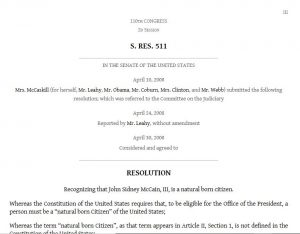
There are two problems thus presented. First, this “whereas” statement in 2008 plainly is referencing 1 Stat. 103, but without acknowledging that its “natural born citizens” provision was repealed in 1795, 213 years prior to 2008. It is bad form to rely on a repealed statute as authority for one’s position, including as to U.S. Senators in their “resolutions” addressing “weighty” matters. Second, 1 Stat. 103 did not “define” the nbC term, but only categorized certain people born “beyond sea” as being “considered” to be members of that class. These issues were addressed several years ago by your servant here.
Significantly, but parenthetically – since it relates more to the nbC issue than the pending birthright citizenship issue – in President Trump’s Applications for Partial Stay Memoranda in each case now before the Court – at pp. 7-8 thereof – the applications cite § 212 of Book 1, Ch. 19 (“§ 212”) of the seminal treatise The Law of Nations [1758, Paris] by Swiss jurist, attorney and scholar Emer de Vattel, an authority recognized and relied upon by the Framers. There, a “natural born citizen” is defined as a person born in a country to parents who are already then citizens of that country.
Your servant will not bore P&E readers with multiple citations to the numerous past articles here at the P&E addressing the § 212 definition issue and positing that his definition was the one selected by the Founders for insertion into the Constitution, but only notes that the Solicitor General’s citation to de Vattel – and in particular § 212 – is cause for optimism that at least the current Solicitor General of the United States is not only aware of that authority, but has cited him in support of his position in briefs to the Court.
But again, I digress. In addition to the problems flowing from Justice Gray’s anomaly, the WKA 14th Amendment ruling has been explained by contemporary constitutional scholars as purportedly corroborating the view that if one is merely a “citizen at birth” or a “citizen by birth,” regardless of place of birth or both parents’ U.S. citizenship, that person would qualify as an nbC eligible to the presidency. As P&E readers will recall, your servant disagrees…, and can back up that disagreement with “receipts” discussed in the aforesaid numerous nbC P&E posts.
Specifically, two highly respected and well-credentialed former U.S. Solicitors General – Paul Clement and Neal Katyal – have discussed the nbC issue in their 2015 Harvard Law Review Forum Journal article “On the Meaning of Natural Born Citizen.” That article addresses the 2008 nbC bona fides of former Senator John McCain and, as to his potential candidacy in 2016, current Senator Ted Cruz, but fails to even reference de Vattel or try to distinguish § 212.
With due respect, but at the risk of challenging various widely-held assumptions in that article, the anomaly in the WKA majority opinion may negatively impact the Harvard article’s conclusion that a Fourteenth Amendment “citizen at birth” or “citizen by birth” satisfies the nbC eligibility restriction, at least as it was intended and understood by the Framers.
In fact, the review article states (128 Harv.L.Rev.F. at 162) that “[t]he proviso in the Naturalization Act of 1790 underscores that while the concept of ‘natural born Citizen’ [sic] has remained constant, and plainly includes someone who is a citizen from birth by descent without the need to undergo naturalization proceedings, the details of which individuals born abroad to a citizen parent qualify as citizens from birth have changed.” (Emphasis added)
While it is true that the “details” regarding the status of persons born abroad “to a citizen parent” have changed since 1790, with deference and respect, it is far less than clear that the “concept of ‘natural born [c]itizen has remained constant…,” at least as intended by the Congress when it first enacted 1 Stat. 103, including the “natural born” modifier of “citizens,” then a mere five years later repealed it rather than re-enacting it “in the same words” as asserted by Justice Gray.
To the extent that Messrs. Clement and Katyal may have relied upon Justice Gray’s erroneous anomaly in his WKA majority opinion, rather than upon the actual words of 1 Stat. 414 following the repeal of 1 Stat. 103, their law review article may not be altogether correct. Your servant has critiqued their article here, here and here.


Indeed, although not citing the Clement/Katyal law review article, the “Biazzo” amicus curiae brief, submitted to the Supreme Court (but not yet accepted for filing by the Court), asserts that, under the decision in WKA, the Court has purportedly “essentially recognized” that under the 14th Amendment, “individuals born within the physical boundaries of the United States … [with recognized limited exceptions] are natural born American Citizens.” (Emphasis added) See Biazzo amicus curiae brief at 9. As faithful P&E readers might suspect, your humble servant disagrees. Hopefully, so will a majority of the Supreme Court Justices.
Although the Biazzo brief uses the words “essentially recognized” as opposed to the stronger words “decided” or “held” – which convey the concept of “binding precedent,” – to the extent that the claimed “recognition” in WKA is premised upon Justice Gray’s mistaken belief that the nbC modifier of “citizens” in 1 Stat. 103 – whether in the “same words” or in “concept” or “rationale” – somehow survived its undisputed deletion and repeal in 1795 by 1 Stat. 414, the contrary conclusion in the Biazzo brief is itself plainly “mistaken.”
And to repeat: whether SCOTUS, a Justice’s law clerk or anyone else – outside of readers of The P&E, of course– will “pick up” on the anomaly before May 15, 2025 is anyone’s guess. Moreover, even if the anomaly and its impact on these cases, other cases, other congressional resolutions, law review articles and/or amicus curiae briefs is identified, the well-known adage may moot everything: “Don’t poke the sleeping dog …, move along…, nothing to see here….”
Conclusion
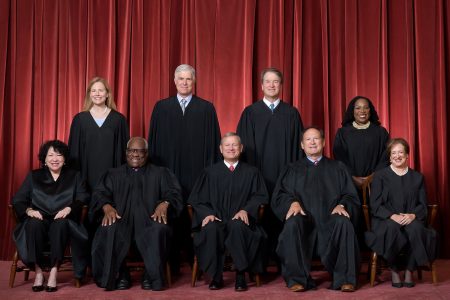
While there may be some cause for optimism that clarification on both the 14th Amendment birthright citizenship and Art. 2, § 1, Cl. 5 natural born Citizen eligibility issues will follow next month’s oral arguments, as that great and wise everyday philosopher – Yogi Berra – noted: it ain’t over ‘til it’s over. Sooo…, again…, stay tuned.
Editor’s Note: An audio recording of the May 15 proceedings will be available later that day here.
FYI – the May 15th oral arguments before the Supreme Court concern Trump’s motion for a partial stay of the national injunctions. As the Trump petition says,
“These cases—which involve challenges to the President’s January 20, 2025 Executive Order concerning birthright citizenship—raise important constitutional questions with major ramifications for securing the border. But at this stage, the government comes to this Court with a “modest” request: while the parties litigate weighty
merits questions, the Court should “restrict the scope” of multiple preliminary injunctions that “purpor[t] to cover every person * * * in the country,””
So it is unlikely the merits of the birthright citizenship argument will be addressed
However I could see a possible way the Court could rule on the merits after this hearing. Suppose the Court members decide to end nationwide injunctions (unlikely but possible), they might then rule on the merits of the case in order to prevent confusion and multiple jurisdictions having different definitions of birthright citizenship.
Should that happen, I have no doubt the Court will rule the executive order unconstitutional.
To view government’s petition for a partial stay click on link for main document on the March 13th application
https://www.supremecourt.gov/search.aspx?filename=/docket/docketfiles/html/public/24a885.html
This is good but it misses two key points, the first being The Civil Rights Act of 1866 which came 2 years prior to The 14th Amendment that act and is still on the book to this date. It states: Be it enacted . . . , That all persons born in the United States and not subject to any foreign power, excluding Indians not taxed, are hereby declared to be citizens of the United States. Anyone with dual citizenship is essentially subject to a foreign power and the US State Dept. spells this out in their rules for dual citizens. So if one is born on US soil and they’re automatically conferred foreign citizenship upon birth as many countries permit, they would be ineligible for US citizenship as they wouldn’t meet the plain text of The Civil Rights Act of 1866, they also wouldn’t meet the plain text of the 14th Amendment as being a dual citizen at birth they wouldn’t be under full jurisdiction of the United States, many mistakenly assert that passage only applies to the children of foreign diplomats, that assertion is demonstrably false as when the 14th was passed Native Americans aren’t diplomats and they and their parents were born in the interior of the United States.
Additionally, is no mentioned made of Congressional Resolution 511, where Congress declared John McCain to be a Natual Born Citizen and the basis for that declaration was that both of McCain’s parents were American citizens. That resolution was supported in the form of legal opinions from two constitutional scholars, one an Ivy League constitutional law professor the other a former US Solicitor General. Those opinions were entered into the Congressional Record. Why is this crucial? Well Congress in the entity that decides what citizenship is that authority has been repeatedly upheld by the courts.
This is why had Kamala Harris won the 2024 election President Trump likely would have sue over her eligibility, it would have been awkward to say the least for Congress to certify the election of the candidate who doesn’t meet their own resolution. Trump likely would have won in court that would have begot a whole host of problems, namely it would have null in void the tie breaking votes she cast in Congress. How would Congress and the courts even deal with that?
It would also have brought Walz Presidency.
Wong Kim Ark should have never been conferred US citizenship based on the plain text of both the Civil Rights Act of 1866 and the 14th Amendment, the court’s majority justices were very flawed in their opinion.
Justice Gray shuffled the deck several times in Ark. When commenting on Minor Vs Happersett he states that Justice Waite claims the meaning of NBC must be found elsewhere and then says the Justice referred to common law. Justice Waite went on confirm that a NBC was a child born of citizen parents born in country. This of course was ignored by Gray.
I also believe that the NBC in the 1790 act was a “providing that” and not an extension on status.
Much like the 1948 British Nationality act gave commonwealth citizenship status to children of a father from Kenya, providing that certain conditions are met. 1795 removed the provisions.
This case will be about the changeable contemporary laws of man versus the non-negotiable forever laws of Nature, me thinks.
Nature Rules! and human nature follows. – JD Mooers
The survival of each Justice will be first and foremost on each Justice’s mind, it is only natural to survive and live another day.
Will the US Supreme Court acknowledge the precedential presidential history of how “natural born Citizen” (nbC) was being interpreted by all previous US citizens, as obviously evidenced by their selections and elections of US Presidents from 1836 (Martin Van Buren) to 08-28-08 (Obama) and US Vice Presidents from 1824 (John C. Calhoun) to 08-11-20 (Kamala, https://en.wikipedia.org/wiki/2020_Democratic_Party_vice_presidential_candidate_selection >>> https://rumble.com/v59o69u-who-is-kamala-harris.html?e9s=src_v1_ucp )?
Will the SCOTUS acknowledge how previous US citizens evidently interpreted “natural born Citizen” and the 14th Amendment (ratified in 1868) originally, and when and why and how did those evidential original interpretations morph into today’s possibly illegal interpretations?
If Justice Roberts feels guilty of swearing-in FRAUD presIDent Obama twice, and if Justice Thomas feels guilty of openly stating that he is personally evading the nbC issue, will these two Justices now admit they were “wrong all along”, no matter what their personal consequences?
Naturally, then, this case will likely be mostly about:
national security versus job security
selflessness versus selfishness
repent versus invent
The current Supreme court has through willful negligence and insubordinate excuses have dishonored their allegiance to their Country and Constitution. Commonly known as “pussy footing around”. And “either poop or get off the pot”.
Once again excellently covered. I wonder if this will present the opportunity for Justice Thomas to no long avoid the issue.
Excellent analysis! Hopefully some attorneys reading this can utilize some of it in any Amicus Curia brief they plan to file.
CDR Charles Kerchner, P.E. (Retired)
Author: “Natural Born Citizen” and “Kerchner v Obama – The Advertorial Campaign“
https://www.scribd.com/user/52640192/protectourliberty/lists
https://www.protectourliberty.org