
by Joseph DeMaio, ©2025

(Jun. 28, 2025) — Introduction
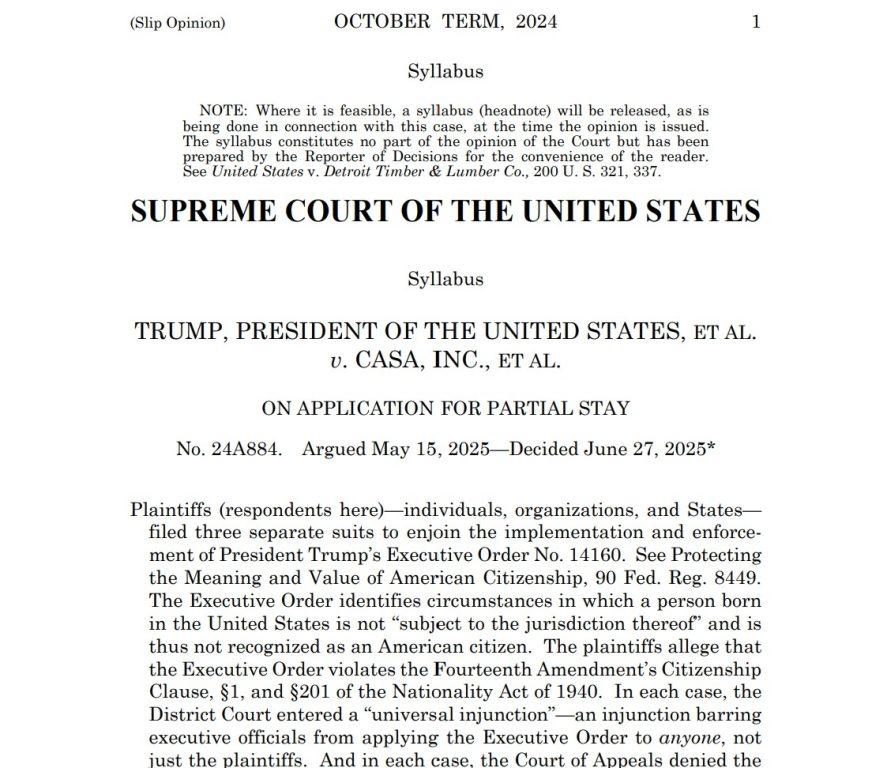
Well, whatta ya know? A semblance of rational thought may be returning to the Supreme Court. The Court has now held, in a split 6-3 decision, with Justice Barrett authoring the majority opinion, that President Trump is entitled to several “stay” orders blocking application of lower U.S District Court “nationwide injunctions” (Justice Barrett correctly re-characterizes them as “universal injunctions”) regarding his Executive Order 14160 addressing the so-called “birthright citizenship” issue under the 14th Amendment.
This is “one small step” for those who support the Constitution, but a “giant leap backward” for those who want to morph the founding document into a “suicide pact” with those who despise the Republic and hate President Trump even more. Indeed, those who are intent on persisting in their program against the Constitution and the President have now filed –virtually as soon as the toner had fused to the paper in the Trump v. CASA, Inc. SCOTUS ruling – yet another attempt to impede, block and intrude on Executive powers.
Your humble servant has previously addressed this issue here, here and here, so those offerings will not be rehashed yet again. More specifically, this offering will address in a preliminary fashion only the crux of the majority opinion –- and certain defects of the dissenting opinions of Justices Sotomayor and, in particular, Jackson. A more detailed analysis of the opinions, and their relationship to the larger “natural born Citizen” (nbC) issue will be reserved for future offerings following a more detailed review of the aggregated 119-page ruling.
Analysis
First, it is crucial to note that the CASA majority decision neither reached nor decided the underlying “birthright citizenship” issue “on the merits” under either the 14th Amendment or the Court’s prior decision in United States v. Wong Kim Ark (“WKA”). The sole issue before the Court was whether President Trump’s stay application would be granted. The Court determined that it was proper and thus, it was granted.
The immediate result was the “dagger to the heart” of the Democrats’ “lawfare” Nirvana: the tactic of “forum-shopping” to secure a single radical Democrat District Court judge somewhere who could be bamboozled into issuing a “universal injunction” applicable to anyone anywhere, even worldwide, as long as the injunction frustrated or impeded President Trump’s Executive Branch prerogatives. That dagger alone is cause for euphoria among those who support the Constitution. For those who prefer disregarding the Constitution or morphing it into a “suicide pact”…, not so much.
Second, perhaps the most stunning aspect of Justice Barrett’s majority opinion (concurred in by Chief Justice Roberts as well as Associate Justices Thomas, Alito, Gorsuch and Kavanaugh) lies in the blunt candor she fires at Justice Jackson. Indeed, the fact that, by concurring in and signing onto the majority opinion, the Chief Justice ratified the candor of Justice Barrett’s bombing of Justice Jackson’s dissent.
For example, Justice Barrett states (slip op. at 21-22: “The principal dissent [i.e., Sotomayor’s] focuses on conventional legal terrain, like the Judiciary Act of 1789 and our cases on equity. JUSTICE JACKSON, however, chooses a startling line of attack that is tethered neither to these sources nor, frankly, to any doctrine whatsoever. Waving away attention to the limits on judicial power as a “mind-numbingly technical query,” … [Jackson dissent at 3], she offers a vision of the judicial role that would make even the most ardent defender of judicial supremacy blush.” (Emphasis added)

Continuing the MOP ordnance being dropped on Justice Jackson’s dissent, Justice Barrett states: (slip op. at 22-23): “Justice Jackson’s position is difficult to pin down,” but “[w]e will not dwell on … [her] argument, which is at odds with more than two centuries’ worth of precedent, not to mention the Constitution itself. We observe only that Justice Jackson decries an imperial Executive while embracing an imperial Judiciary.” (Emphasis added) Wow.
The majority opinion finally adds (slip op. at 24): “Justice Jackson would do well to heed her own admonition: “[Everyone, from the President on down, is bound by law.”… That goes for judges, too. (Emphasis added) Double-wow.
Third, one aspect of the majority opinion, however, may be a source of indigestion with regard to the correct analysis of the nbC issue, again, an issue not before the current CASA Court, yet tangentially related. Specifically, in explaining the principle of “complete relief,” Justice Barrett states (slip op. at 17): “Here, prohibiting enforcement of [Executive Order 14160] against the child of an individual [illegal alien] pregnant plaintiff will give that plaintiff complete relief.” Curiously, she then adds: “Her child will not be denied citizenship.” Id.
That additional unnecessary side observation by Justice Barrett (likely best-characterized as “obiter dictum”) suggests that she is relying on the continued precedential value of the WKA decision, which in fact, is not only factually flawed as a result of “Gray’s Anomaly,” discussed here, but in addition is distinguishable (and thus not controlling on the “birthright citizenship” issue) by virtue of the fact that Wong Kim Ark’s parents were lawful domiciliaries in California, rather than illegal aliens not lawfully present here. That issue lies at the core of why the decision in WKA will likely be held not controlling or precedential as to either the 14th Amendment issue, but also – eventually –as to the nbC issue.
Still, Justice Barrett’s comment can be explained as being merely an acknowledgment that, under the existing flawed narratives emanating from the WKA decision, such a child would not be denied citizenship, but once the impact of “Gray’s Anomaly” and the original intent of the Founders and Framers of the 14th Amendment are factored in, a different result might well emerge.
Indeed, if on the merits, the Court eventually determines that Executive Order 14160 is constitutional and can be implemented, there is nothing to prevent the Court from declaring that from and after its decision, no child born to illegal alien parents here can be deemed to be a 14th Amendment citizen, but that as to children born here to such parents before its decision – potentially overruling WKA – their prior citizenship status constituted a “vested right” which, even if erroneously bestowed upon their child(ren) in the past, could not be voided.
That way, the future incentive for alien mothers to illegally enter the nation to have their babies born as U.S. citizens would be removed. It might not be all that President Trump, the Founders or the Framers of the 14th Amendment desired or intended, but as a “compromise” alternative, it could constitute the “grudgingly acceptable” over the “perfect.”
Turning to the dissents, the reliance by Justice Sotomayor on WKA in support of her theory that the President’s stay applications should be denied is a classic “apples and oranges/ipse dixit” (“It is so because I say it is so”) argument having no materiality or relevance to the sole issue before the Court, i.e., the propriety and constitutionality of the stay requests. Justice Sotomayor somersaults to her conclusion by assuming facts not yet in evidence, viz., that the Framers of the 14th Amendment understood and intended that a child born here to illegal alien parents (or at minimum, an illegal alien mother) would in all respects become a “citizen” subject to the jurisdiction of the United States.
Those factual predicates were never at issue in WKA and have not yet been fully adjudicated on the merits in the lower courts in CASA or other related cases. Sotomayor’s reference to certain floor comments by Senators in the Congressional Globe regarding the issue are merely anecdotal and hardly represent any “consensus” of the Senate as a body, purportedly, that the intent was to grant citizenship to the offspring of illegal aliens.

It is also troublesome that Sotomayor does not even mention, much less attempt to distinguish as inapplicable the Court’s 1884 decision in Elk v. Wilkins. There, Justice Horace Gray (yes, Virginia, the same Justice who authored the still uncorrected WKA “anomaly”) held that the 14th Amendment’s “subject to the jurisdiction” requirement meant subject to the complete jurisdiction of the United States. See Elk, 112 U.S. at 121.
The theory that a child born here to an illegal alien mother is ipso facto subject to the complete and thus exclusive jurisdiction of the United States is nonsense, despite its long-adopted ipse dixit narrative. It is as if those supporting the theory are contending that we have been doing it wrong for so long, we cannot even think of doing it correctly now and into the future. The analogy to the recognized exception denying citizenship to children born to members of a hostile occupying force, while not identical, is not that different: an illegal alien mother who has unlawfully entered the country is not supposed to be here, just as a member of an invading force is also not to be welcomed, except by those intent on disregarding our immigration laws.
Moreover, Justice Sotomayor’s reliance on WKA in support of her position (Justice Jackson doesn’t even mention WKA in her dissent, which, as stated by Justice Barrett, is “untethered” to any recognizable legal principle or doctrine “whatsoever”) is even weaker. She fails to address at all, much less defend or rationalize, “Gray’s Anomaly.” Indeed, she or her law clerks may not even be aware of the anomaly’s still-uncorrected existence. That factual blunder, your humble servant posits, renders the precedential gravitas and viability of the majority opinion therein at minimum, highly suspect.
Oddly, Justice Sotomayor’s dissent cites (slip op. at 8) a case – Hintopoulos v. Shaughnessy – which on the 14th Amendment “birthright citizenship” merits issue seems to support, rather than undermine, the constitutionality of President Trump’s Executive Order 14160. Normally, it is the better practice to find, cite and rely on appellate case precedent that supports your position rather than the position of your adversary. This is particularly so in the case of Supreme Court dissenting Justices with access to the best law library in the world; premier computer legal authority search capabilities; and elite Ivy-League law clerks who attended Hahvahdh, Yale, Columbia or Princeton. Sheesh.
Problematically as well – and with reference to the nbC question which was clearly not before the Court in CASA – Justice Sotomayor cites in support of her position the decision in Lynch v. Clarke, 1 Sand. 583 (1844). This is the same New York Chancery Court decision relied upon by Justice Gray in WKA, cited before committing his blundering anomaly. It stands as a state court decision of a court of equity where the judge claims that, prior to the 14th Amendment, purportedly “it was the undisputed law of the United States [that] every person born within the dominions and allegiance of the United States, whatever were the situation of his parents, is a natural born citizen.” Lynch v. Clarke, 1 Sand. Ch. 583, 663 (N. Y. Ch. 1844).
The irrelevancy of Lynch to the CASA emergency stay appeal is manifest. Moreover, its flawed logic as to the nbC issue is also clear, as discussed here, because Judge Sandford’s comment constitutes obiter dictum. The sole issue in the Lynch case involved whether Julia Lynch was a “citizen” and not whether she was in addition an nbC. And as Justice Scalia once noted: “Dictum settles nothing, even in the court that utters it.” Jama v. Immigration and Customs Enforcement, 543 U.S. 335, 351,. n. 12.
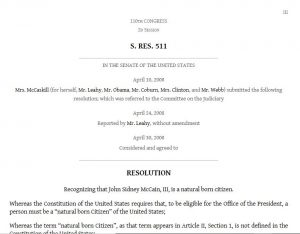
Finally, while Justice Sotomayor may not be aware of Gray’s Anomaly, it appears to have had substantive negative impact elsewhere. Specifically, the anomaly seems to have been the source for the misplaced factual assertion in Senate Resolution 511 in 2008. That resolution purported to confirm the nbC bona fides of Senator John McCain, discussed (and dissected) here.
In addition, the anomaly seems to have also been the source for the erroneous assertion in a law review article that the “concept of a natural born Citizen [sic] has remained constant…” from that which was articulated by Congress in 1 Stat. 103 in 1790 up to and including today…, despite its complete repeal 58 months after its original enactment, by 1 Stat. 414 in 1795. See On the Meaning of “Natural Born Citizen” – Harvard Law Review. The “[sic]” reader signal in the preceding sentence is necessitated because the law review article authors improperly capitalize the “C” in “citizens” for their article, while the Congress in 1 Stat. 103 did not.
While the capitalized “C” appears in the term “natural born Citizen” set out by the Founders in Art. 2, § 1, Cl. 5 of the Constitution – the presidential “Eligibility Clause – it does not appear in 1 Stat. 103 nor elsewhere in our immigration and naturalization laws. The reader signal seeks only to clarify that which could be a mere typo and eliminate the conclusion that in enacting 1 Stat. 103, Congress was equating the term “citizen” with the term “Citizen” as used by the Founders in the Constitution. That did not happen.
Conclusion
The CASA decision, limited as it may be to the “stay” applications, contains numerous potential indicators of where the Justices may land when directly presented with the 14th Amendment “birthright citizenship” question. Of equal if not greater significance, the majority opinion, concurrences and dissents may also signal how the Justices might treat the nbC issue, if ever it were to reach the Court on the merits. However, given the Court’s apparent goal of continuing to “evade” the question, it would be unwise to hold one’s breath. That said, the era of “move along…, nothing to see here” and comfortable indifference to the original intent and understanding of the Founders regarding presidential eligibility should come to an end…, and sooner rather than later.
To be continued.