

by Cheryl Lacey, DSJ, Take The Lead On Education™, ©2024
(Nov. 5, 2024) — School education systems have seen significant financial investment over the past 50 years – more teachers and substantial spending on infrastructure.
But one thing hasn’t changed: the school calendar.
Breaking Down the Numbers in Australia
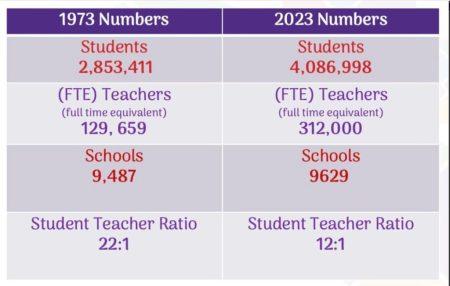
In 1973, Australia had 2.85 million students, 129,659 full-time equivalent (FTE) teachers, and 9,487 schools, with an average student-teacher ratio of 22:1.
By 2023, there were 4.08 million students, 312,000 FTE teachers, and 9,629 schools, improving the student-teacher ratio to 12:1.
Despite the significant investment in school staff and facilities, the 40-week instruction model with 12 weeks of school closures (on average) remains unchanged.
The Cost of an Unchanged Model
Each year school facilities in more than 9500 schools—classrooms, halls, playgrounds, and administrative offices—sit idle for 12 weeks.
Over 300,000 school staff are on break simultaneously.
While we could argue over the wasted resources, the bigger issue is leaving families grappling with work schedules, holiday programs, expensive childcare, and some cases reduced work hours. Single parents and shift workers face even more severe financial and logistical challenges under this model.
Lessons from the U.S.A.
In the U.S., schools offer summer programs with extra support in core subjects like English and Mathematics. This keeps schools productive and benefits students academically, acknowledging that few parents have 12 weeks of annual leave.
Why hasn’t Australia adopted a similar approach?
We’re stuck with the ‘we’ve always done it this way’ mindset. While many unions play a crucial role in respectfully negotiating for workers with employers so that everyone benefits, teacher’s unions tend not to. They prioritize the traditional school structure, and protect the teacher workforce at the expense of families. Consecutive state governments have also been unwilling to effect change. This stalemate has exacerbated consequences that are hard to reverse.
Despite significant investment our school calendar year remains rigid.
The Push for More Student-Free Days
Recent efforts in Victoria, following the momentum of New South Wales teacher unions, advocate for more student-free days for planning and preparation. This move will add to teacher workload, with greater expectations placed on them for planning, professional learning and administration.
It’s another indication that governments react to usually by doing stuff with schools systems without giving any consideration to family needs and taxpayer expectations.
Reimagining Schools as Community Hubs
The current school calendar was designed for a different era. Today our social and economic realities call for more innovative solutions.
Imagine schools operating year-round—not just for a national curriculum, but as community hubs offering enrichment programs, recreational options, tutoring, elective workshops, work experience, and apprenticeships.
A 52-week school model doesn’t mean continuous instruction; it means transforming schools into versatile resources that support families, teachers, and the broader community.
School facilities could be staffed by a mix of educators, support workers, community volunteers, and allied professionals at different times for different needs and wants. Annual leave for staff and holidays for students can also be staggered throughout the year.
This model could also bring parents and children together for family education and personalised family services – leaving teachers to focus on education. It could also yield a viable income for schools through lease agreements and more.
Read the rest here.