

by Sharon Rondeau

(Dec. 5, 2023) — On August 10, 2023, a Writ of Error Coram Nobis filed in the Shelby County Criminal Court by Tennessee inmate Jason Lamar White claiming new evidence in his 2017 drug-related conviction was denied a hearing by Division III Judge James Jones, Jr.
According to USLegal.com, “Coram Nobis” signifies the claim that “a ‘fundamental error’ or ‘manifest injustice’ has been committed” relative to the outcome of a case. “A writ of error coram nobis is an extraordinarily rare remedy, known more for its denial than its approval,” the website states.
In White’s Coram Nobis petition, he presented a sworn affidavit from a co-defendant, Kristina Cole, which he claimed was “exculpatory,” demonstrating that text messages which then-Bartlett Police Department Detective Mark Gaia sent from Cole’s phone went to a third defendant, Montez Mullins, and not White.
In 2016, all three defendants were implicated in a “conspiracy” to distribute methamphetamine in a “drug free zone” and convicted at various levels. Initially intended to be a witness for White’s defense, Mullins was later charged in the case, an issue White has stated his attorney at the time should have challenged.
Mullins confessed to carrying out the plot without Cole and White’s involvement, but his claim, according to a government investigator, was not credible.
Gaia, who is reportedly no longer a law enforcement officer, at first claimed Cole sent three text messages to White while coordinating the delivery of a package containing methamphetamine delivered to her home on February 3, 2016 by the Bartlett Police Department with Gaia on-scene. However, during his testimony at trial, Gaia admitted to having sent one of the texts himself during the time Cole was in police custody.
The package was originally addressed to a nonexistent address, but the BPD produced a new shipping label with which it made the “controlled delivery” to Cole’s home.
All three were convicted of participating in the alleged scheme. At sentencing, White, who was already completing a 21-year sentence on an unrelated charge and is now 42, received the harshest sentence of 60 years’ imprisonment without the possibility of parole and a $2,000 fine. Cole received 13.5 years and was granted early parole this past April after receiving a recommendation from Gov. Bill Lee. Mullins, who was serving concurrent sentences for unrelated crimes, received another 30 years.
Court Acknowledges Document Errors
As The Post & Email has reported, White’s online and hard-copy records have been replete with inconsistencies, the most glaring of which is an upgrade of the charges brought against him without explanation.
White’s original charges were a Class “B” felony and Class “E” felony, respectively. In July 2021, The Post & Email discovered the two lower charges disappeared from his record, replaced by two more serious Class “A” felony charges on which he was ultimately convicted. Additional discrepancies and inaccuracies in the facts of the case have also been noted in the online record.
White appealed Jones’s ruling on the Coram Nobis to the Western Division court at Jackson. Although rejecting the premise of White’s appeal, in an opinion issued September 20, the court ordered the trial court where Jones, who replaced Carter upon his retirement last year, is now seated, to “correct” White’s record so that the “judgments” meted out “reflect the offenses for which Petitioner was actually convicted.”
Judge Carter, Before and After Retirement
In July 2022 and after years of waiting on White’s part, Carter held a hearing on White’s post-conviction petition.
Held in New Mexico prisons since May 2019, White was transported back to Shelby County to make his case. Although choosing to represent himself, Carter appointed Atty. Shae Atkinson of Memphis as White’s “elbow counsel,” a relationship which concluded after the post-conviction petition hearing.
Prior to the hearing, White had petitioned for the recusal of Carter and the entire 30th Judicial District, which includes Shelby County, because of what White alleges was bias against him as evidenced by a May 16, 2016 “ex parte” exchange between prosecutor Christopher Scruggs and Carter. Both parties refused, and in his appeals, White maintained his then-counsel should have advocated for it and therefore rendered ineffective assistance.
On appeal, the court wrote on the issue:
…the pretrial colloquy between the trial court and Prosecutor when discussing Petitioner’s transfer into Shelby County custody was not improper and not prejudicial toward Petitioner. Nothing resulting from that hearing reflected any prejudice by the trial court toward Petitioner, and Petitioner did not have a constitutional or statutory right to be present at this conversation. As stated above, Petitioner had the opportunity to question Counsel about this exchange and whether it would have given rise to a motion to disqualify, but Petitioner did not question his trial attorney about these topics. For these reasons, we conclude Counsel’s failure to move to recuse the trial judge was neither deficient performance nor prejudicial toward Petitioner. Counsel did not render ineffective assistance as to this issue.
Carter issued a denial of White’s post-conviction claim of ineffective assistance of trial counsel in an opinion released two weeks after his retirement foreshadowed by two Criminal Court clerks. The Post & Email was unable to obtain a response from the court as to why Carter’s opinion was delayed until then.
Just prior to retiring and despite an order from the appellate court to do so, Carter issued an opinion stating he would not conduct a “finding of fact” to ascertain whether Cole’s post-conviction claim of ineffective trial counsel had been properly addressed by his court.
As The Daily Memphian reported in August, Carter was subsequently hired by Shelby County Mayor Jim Strickland to conduct an “efficiency study” of the courts at a pay rate of $200 hourly. As for Jones, not long after he was elected and sworn in, the Tennessee Board of Judicial Conduct issued a public reprimand for his role in asking a Florida court, using official judicial stationery, to rule leniently in a case in which his wife had been tangentially involved without making that disclosure.
Petitions and Appeals
Throughout the now six-year saga, White, along with Cole, has maintained his innocence, seeking relief in the trial court through a post-conviction petition as well as with the appellate court on numerous occasions, including in a filing in which he claimed “extraordinary” circumstances regarding Carter’s lack of action on the post-conviction petition. Thus far, no favorable ruling has emanated from either court.
Cole, too, is struggling to clear her record following her release from custody in April. Oddly, although having prosecuted her, Scruggs was one of two individuals who submitted letters recommending clemency.
A Writ of Coram Nobis Cole submitted to Shelby County in August was denied a hearing in an opinion incorrectly identifying the prosecutor in her case.
White’s appeal to Carter’s denial of post-conviction relief is below.
Following the appellate court’s denial of his Coram Nobis filing, White filed a petition to rehear with the same court which was denied by a three-judge panel on November 2. “Our review of the record leads us to conclude the petition to rehear raises issues and arguments which Petitioner presented on appeal,” the court wrote. “Petitioner argues this court misstated, disregarded, or otherwise misapprehended the material facts and relevant authorities in its earlier opinion, but after reviewing the opinion, the record, and the relevant authorities, the court disagrees. Because the issues Petitioner raises in his petition to rehear were fully addressed in our September 20, 2023 opinion, we conclude Petitioner is not entitled to have his claims reheard.”
As the panel noted, White raised the matter of the May 16, 2016 discussion concerning a transfer order between Scruggs and Carter in which Scruggs made statements White characterized to the courts as “ex parte” communication.
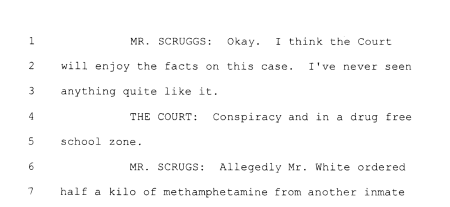

As a result of the appellate court’s denial of the Coram Nobis filing, White recently retained Atty. Terrell Tooten of Memphis to represent him on that aspect of his case. On October 31, Tooten filed a Notice of Appearance with the Jackson appellate court.
White Speaks
On November 27, White spoke with this writer, during which he took issue with the appellate court’s conclusions on his post-conviction petition. “I pointed out to the court that Judge Carter was directing the prosecution to file motions to squash Gaia’s subpoena and other subpoenas,” he told us. “The court’s opinion was:
Nothing in the record shows that the court directed the State to quash Petitioner’s other subpoenas. The post-conviction court responded that Petitioner could file subpoenas, but someone from the State needed to “come to Court and actually pay attention to it.” The court also stated:
Page 22, appellate court’s September 20, 2023 opinion (below)
“OK, so they’re saying there’s nothing in the record to say that Judge Carter directed them about any motion to quash my subpoenas,” White continued. “I have the transcript from May 19, 2022, and Shae Atkinson said to the judge,” (paraphrased) ‘I reached out to Ms. Byrd again trying to get Mark Gaia served'” (p. 10 of below transcript). “And then on Pat Vincent” (p. 11): ‘Does the court know who I can talk to about getting it addressed?'” (paraphrased)
Pat Vincent was the presiding grand jury foreman when White was indicted for the alleged drug conspiracy. As we have reported, neither Vincent nor Gaia responded to subpoenas or provided testimony at White’s 2022 post-conviction petition hearing or at any time afterward.
In response to Atkinson’s relaying of White’s ongoing efforts to subpoena Vincent and Gaia, Carter responded, “I don’t know what else I can do.” Further, he remarked:
…The proper procedure is he can subpoena anybody he wants in the world including the Pope of the Catholic Church. It would be on the State then to file a motion to quash that subpoena or that individual through, you know, counsel to file it if they felt that it was honest.

“Because Pat Vincent was at one point a grand jury foreman,” Carter continued, according to the transcript [sic]. “I don’t know whether his was the one that applied to mister — but I can’t see any relevance in a post-conviction hearing. But again, it’s not up to me to say that just out loud even though I can. It would be up to somebody to file a motion saying, you know, quash this. Then it would be up to Mr. White then to respond. If he can show a reason for it, then by all means he should be able to do so.”
“The judge is stating he would ask Ms. Byrd to file a motion to quash because ‘I can’t see any reason to subpoena him,'” White said. “He was biasing the state’s attorney as to what he thought was best — to file a motion to quash the subpoena. In the appellate court’s ruling, they said there was nothing in the record to say Judge Carter was doing that. They’re lying. He’s saying this to me in fraud, because how can the courts say that you’re getting a right to due process and they’re reviewing everything to meet their standard of review, but then they’re coming back lying by saying that a judge didn’t do this, didn’t do this, when you have documents to prove that he did do it? How can they make a sound determination? Wouldn’t that be him acting in the interest of the state? That would mean that he would be demonstrating bias toward me.
“I filed a petition for rehearing and pointed these things out, where Judge Carter was indeed directing the prosecutions to squash other subpoenas. I thought it was significant, because a lot of people are promoting nowadays that the judicial process is broken. How is it fair? Whether or not you’re being represented by an attorney or representing yourself, if you have clear and convincing facts of what’s going on, why are the courts not taking judicial notice of corruption?
“About Mark Gaia, they stated he was nowhere to be found, but a female answered the door, advised that he was ‘an ex-Bartlett officer now’ and closed the door. They were refusing to allow me a full evidentiary hearing to establish how Mark Gaia presented all these false pretenses on the stand before the jury. During the trial, when he was forced to admit he sent the third text message saying, ‘What do you want me to do with it?’ prior to that he testified that my brother, Dustin White, showed up with the same number in his phone that was blowing up Ms. Cole’s phone. So if you sent the third text message, ‘What do you want me to do with it?’ but you just testified before that Dustin White showed up with the same number in his phone, why didn’t you arrest Dustin White? Why didn’t you take a statement from Dustin White? That would have made him a part of the ‘conspiracy’ if he shows up with the same number blowing up his phone that was blowing up her phone.
“My lawyer didn’t do anything on my behalf because he was pretty-much assisting them in convicting me because once I got convicted, it was going to take scientific facts to get this overturned.
“This is when it violates our constitutional rights. If they had ruled appropriately on what the evidence simply states, they would have agreed with me that Judge Carter should have recused himself. People need to understand the judicial process is not fair and impartial because they have more of an interest to protect the judges. Even Bobby Carter — they reappointed him and gave him $200 an hour.”
White informed us he is in the process of appealing an element of the case to the Tennessee Supreme Court.