
by Sharon Rondeau
(Oct. 10, 2023) — On August 31, 2023, Shelby County, TN Criminal Court Division III Judge James Jones, Jr. denied a petition for Writ of Error Coram Nobis filed by Tennessee inmate Jason Lamar White, who in 2017 was sentenced to 60 years in prison following convictions on drug-related charges.
According to Cornell Law School via the Legal Information Institute, “The writ of coram nobis is a Latin term applied in common law to call to the court’s attention facts that would have changed the judgment but were outside the record and unknown to the court at the time of judgment. The writ of coram nobis is intended to correct a final judgment by the same court in which it was rendered by redressing a fundamental error, such as a deprivation of the right to counsel in violation of the Sixth Amendment.”
White has denied any involvement in the scheme alleged by Shelby County wherein a box of methamphetamine arriving from California, repackaged and newly-addressed by the Bartlett (Memphis) Police Department to the home of his girlfriend, Kristina Cole, was left on her front porch on February 3, 2016, leading to her arrest and ultimate incarceration as well as White’s own additional six-decade sentence.
A third defendant originally identified as a witness and offering a confession in which he stated neither Cole nor White played a role in the drug shipment, Tennessee inmate Montez Mullins was sentenced to 30 more years in prison.
At the time of his arrest and later arraignment, White was serving the final months of a 21-year sentence for an offense committed when he was 18. Now 42, the additional 60 years without possibility of parole imposed by the trial court renders him a prisoner for life.
In an August 10 opinion, Jones wrote that in White’s Coram Nobis petition, he failed to present what he claimed to be “newly discovered evidence” which could have resulted in a different trial outcome.
While reporting on White’s case in late August, The Post & Email learned from public reporting that Jones, elected in August 2022 to replace the retiring Robert “Bobby” Carter, Jr., received a “public reprimand” from the Tennessee Board of Judicial Conduct for petitioning, in his official capacity, a Florida court for mercy for two defendants tangentially involving his wife, who also signed the letter. According to the Board, Jones reportedly used “official court stationery” and did not disclose his wife’s relationship to the named defendants.
Since the new sentence was imposed, White has submitted numerous appeals and petitions to the Tennessee courts, including the state’s highest court, requesting relief on a myriad of issues, including claims of ineffective assistance of counsel, discrepancies in the charges levied against him, ex parte communication between the prosecutor and trial judge, and more recently, an affidavit from Cole, who gained her release in April following a December clemency recommendation from Gov. Bill Lee.
Cole, too, who served six years of her 13.5-year sentence with no prior criminal record, filed a petition for Writ of Error Coram Nobis denied last month while incorrectly identifying the prosecutor in her case as Paul Hagerman when it was Christopher Scruggs.
As Cole has pointed out, Scruggs reportedly wrote a letter to the Board of Parole favoring her early release.
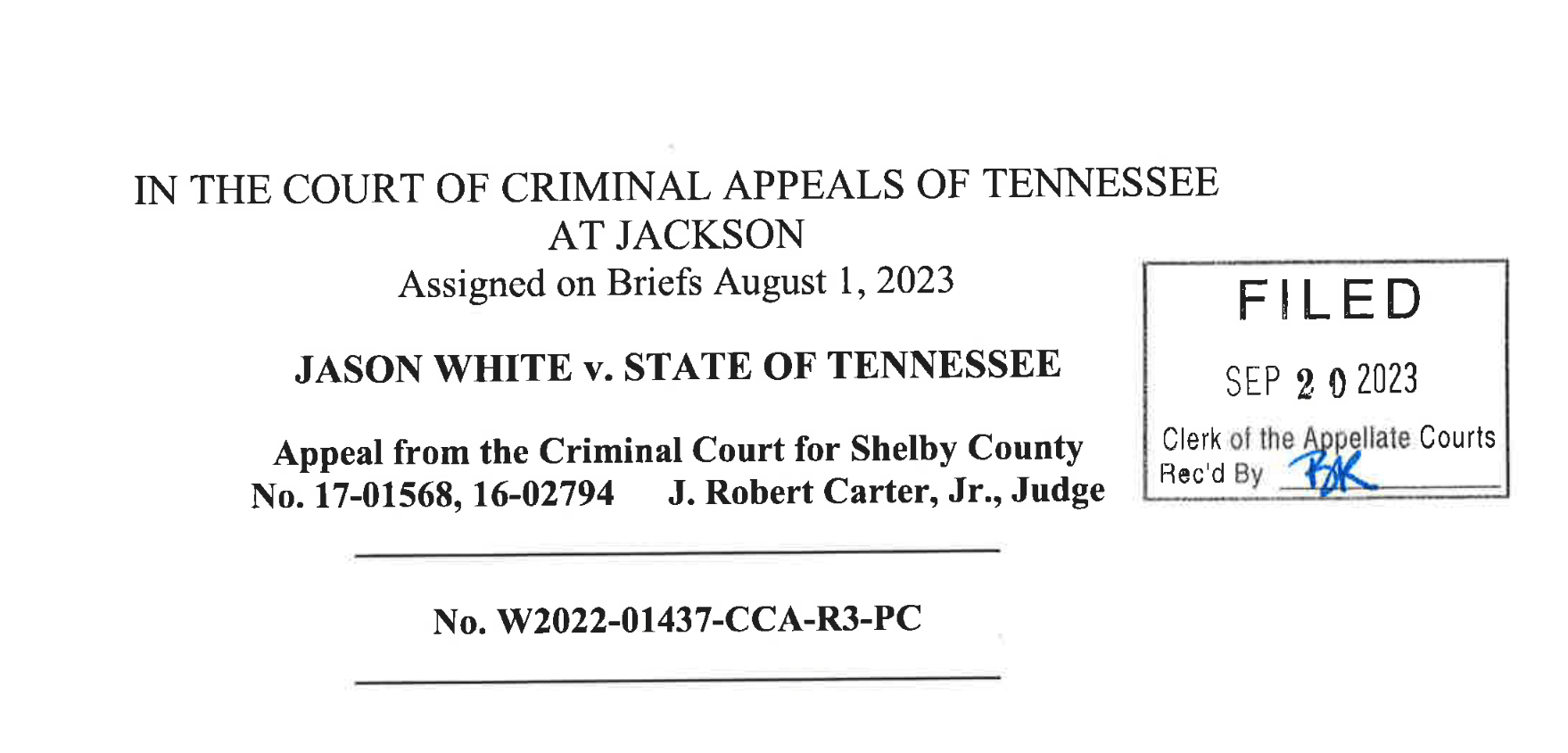
On September 20, in a 35-page opinion outlining White’s case from the government’s point of view, including copious references to applicable laws and prior opinions, a three-member appellate court panel at Jackson upheld the opinion of the “post-conviction court,” which also tried White and co-defendants Kristina Cole and Montez Mullins.
“Based on the foregoing reasons, authorities, and the record, the judgment of the post-conviction court is affirmed,” the panel concluded on the final page of the opinion after addressing and denying each of White’s claims.
While ruling negatively on White’s claims, the panel acknowledged differences in the charges noted in the “capias” authorizing his arrest in April 2016 and those appearing on two grand-jury indictments, including a “superseding indictment.” “The capias, presentence report, and judgments reflecting charged offenses different from those listed in the original and superseding indictments were all entered into the record, and Petitioner questioned Counsel about these discrepancies,” the court wrote on page 27 regarding White’s contention that his then-counsel was ineffective by failing to challenge the inconsistencies.
Having covered the case since 2017, The Post & Email has frequently noted differences between case documents extending to White’s online record.
“In reviewing the issue for plain error, we noted that both the original and superseding indictment charged Petitioner with the same offenses-the offenses for which he was ultimately convicted,” the court wrote on page 33. “…We concluded that Petitioner was not entitled to plain error relief because in issuing the superseding indictment, the State did not alter the charges against Petitioner.”
The court’s closing statement, however, states:
…as this court noted above, the judgment forms reflect the incorrect conviction offenses; specifically, they list the conviction offenses as conspiracy to promote manufacture of methamphetamine. The court, therefore, remands this case to the Criminal Court for Shelby County for entry of corrected judgments which reflect the offenses for which Petitioner was actually convicted.
In another development, The Post & Email has learned White was informed that his request to have his conviction reviewed by the Justice Review Unit established by Shelby County District Attorney General Steve Mulroy following his 2022 election has been advanced to a second phase.