
by Joseph DeMaio, ©2026
(Oct. 4, 2026) — As faithful P&E readers will recall, over the years your humble servant has made several “modest proposals” seeking to address unresolved issues then percolating in the Republic. Most, if not all of those proposals, have dealt with the “birthright citizenship” and “natural born Citizen” (“nbC”) matters under the 14th Amendment and “Eligibility Clause” provisions of the Constitution.
Well, a recent decision of Florida federal District Court Judge David Leibowitz declaring a federal statute – 18 U.S.C. § 611 unconstitutional – presents an opportunity for one more proposal. This one, however, would be specifically directed to the clarification, if not outright resolution, of the question of who, exactly, can be eligible to the presidency as an nbC, a question being continuously “evaded” by the Supreme Court.
The October 1, 2026 decision – United States v. Cox – concludes that a non-citizen foreigner (Chelsea Cox), who knowingly voted in the 2020 general election while fully aware that she was not a U.S. citizen, could not be prosecuted under the federal statute. The basis for Judge Lebowitz’s decision was that Congress lacked the authority to enact the law in the first place since the Constitution vests the States – here, Florida rather than the Congress – with the exclusive power to set the qualifications for electors.
Stated otherwise, Judge Leibowitz asserts that Congress lacks the power to make U.S. citizenship a precondition of voting for federal officers. The States can do so, and Florida did. Accordingly, while Cox could still be prosecuted under Florida law, because the federal law was in his view “void ab initio” (unconstitutional from the beginning), the federal case was required to be dismissed. The real question now will be how long it takes for this decision to meander through the appeals thicket and end up on the SCOTUS oral argument docket, perhaps as early as 2027 as we near the 2028 general election extravaganza. Sounds like “shadow docket” material…, no?
Significantly, in reaching his decision, Judge Leibowitz took pains to also emphasize the exclusive authority of the States to exercise their “plenary authority” over the appointment of presidential electors. He states (slip op. at 15-16):
“[T]he States – and not the federal government – have the constitutional authority to set voter qualifications. See also Katzenbach v. Morgan, 384 U.S. 641, 647 … (1966) (explaining that ‘the qualifications established by the States for voting for members of the most numerous branch of the state legislature also determine who may vote for United States Representatives and Senators.’); McPherson v. Blacker, 146 U.S. 1, 27 (1892) (noting the States have ‘the broadest power of determination’ over the appointment of Presidential electors); Bush v. Gore, 531 U.S. 98, 104 (2000) (under Article II, § 1, cl. 2, “the state legislature’s power to select the manner for appointing electors is plenary.”) (Emphasis added)
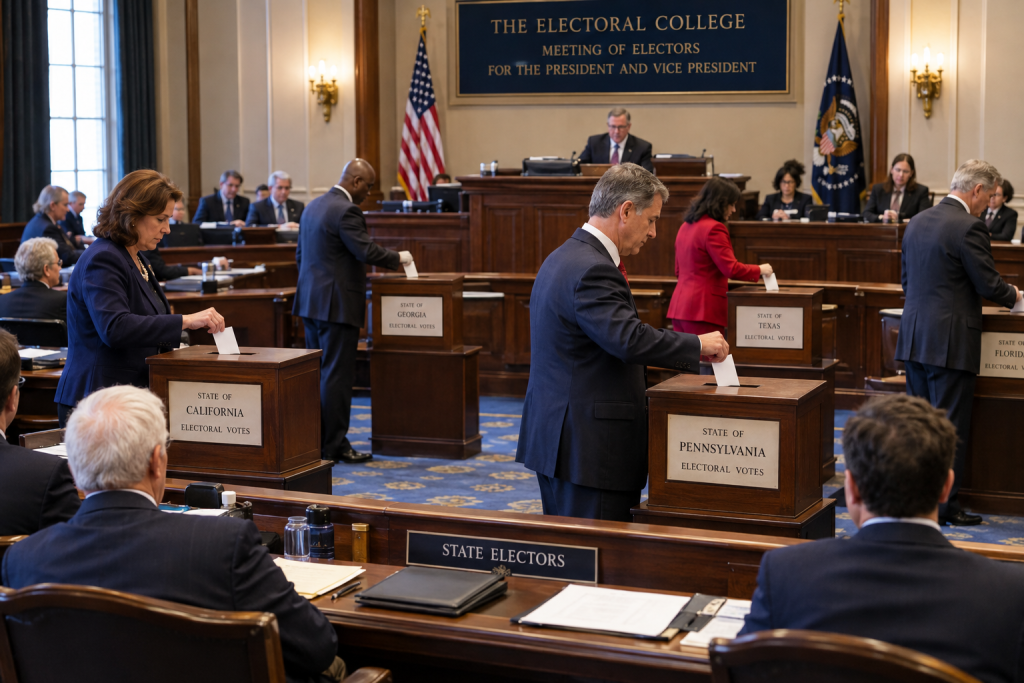
The precedents identified by Judge Leibowitz noted above provide the genesis for the following new “modest proposal.” Accordingly, since the term “plenary” means “complete in every respect;” “absolute” and “unqualified,” short of enacting at the state level a provision which would directly violate the Constitution – the “Supreme Law of the Land” – it would appear that under the precedents cited in Cox, a State may establish as a mandatory requirement that a presidential elector (i.e., the person designated to cast his/her ballot in the Electoral College following each quadrennial presidential election) must cast the ballot only for an nbC as that term is referenced in the SCOTUS decision of Minor v. Happersett.
The Minor decision, of course, states with regard to the definition of an nbC that
“[t]he Constitution does not in words say who shall be natural-born citizens. Resort must be had elsewhere to ascertain that. At common law, with the nomenclature of which the framers of the Constitution were familiar, it was never doubted that all children born in a country of parents who were its citizens became themselves, upon their birth, citizens also. These were natives or natural-born citizens, as distinguished from aliens or foreigners.” (Emphasis added)
Stated more succinctly, Minor states that an nbC is a person not only born here, but born to two U.S. citizen parents. The “elsewhere” note by the Court which existed in 1787 when the nbC Eligibility Clause was “ascertained,” thereafter adopted by the Founders and then added to the Constitution, was found in Book 1, Ch. 19, § 212 of Emer de Vattel’s The Law of Nations (London Ed. 1760)(hereafter “§ 212”). The restriction was added by the Founders as Art. 2, § 1, Cl. 5: (“No person except a natural born Citizen, or a Citizen of the United States at the time of the Adoption of this Constitution, shall be eligible to the Office of President.”) Interestingly, the opinion and ruling in Cox cites with approval the Supreme Court’s Minor decision.
The new “modest proposal” would comport not only with the recognized “plenary authority” of the States to set the qualifications of presidential electors as confirmed in Cox, it would implement the Constitution’s mandate that only an nbC can lawfully serve as President. The nbC language from Minor instructs nothing less.
That said, and without referencing Minor, the state nbC presidential elector mandate might simply require that the elector must vote for the winner of the popular vote and only if the general election winner was actually born here and his/her parents were at the time of birth already U.S. citizens. If that “eligibility” criterion were not satisfied, the elector’s vote would not be counted.
This protocol would be conceptually no different than the one many states have already adopted addressing the so-called “faithless elector” problem, by mandating that a state’s Electoral College electors vote only for the popular vote winner in their state. If they “go rogue” and don’t comply, their elector eligibility is revoked and their votes are not counted.
If multiple states which are possessed of enough Electoral College votes enacted this restriction, the nbC issue would unquestionably end up on the SCOTUS oral argument docket and finally, a decision on the merits of the presidential nbC question might be answered…., with no more “evading” of the issue by the Court.
There are, however, a couple of flies in the ointment. First, Judge Leibowitz relied on two lawyers to opine as personal amicus curiae to him in the Cox case. One of those lawyers was a former Solicitor General of the United States, one Paul Clement. P&E readers will recall that Mr. Clement co-authored (with Neal Katyal, another former Solicitor General) a law review article in 2015. That article concluded that if one were only a “citizen at/by/from birth,” such was “good enough” to deem one an nbC for presidential eligibility purposes.
Parenthetically, that conclusion was offered to support the purported nbC eligibility of Senator Ted Cruz, a result addressed – and dismantled – by your servant here, here and here. Accordingly, one would not be surprised if Mr. Clement’s name showed up in any challenge to a state’s hypothetical protocol suggested here, as he would appear to be heavily invested in the “close enough for government work” nbC definition.
Moreover, and problematically, the “citizen at/by/birth” definition for an nbC posits precisely the opposite intent of the Founders when they selected the nbC term as defined by de Vattel in § 212. As recently confirmed in the recent (poorly-reasoned) “birthright citizenship” decision in Trump v. Barbara, by definition, a child born here to an alien mother and/or father while purportedly a 14th Amendment “citizen” cannot be an nbC as intended by the Founders because the child will lack sole and exclusive unity of fidelity and allegiance to the United States due to potential competing claims of citizenship between or among nations.
A president must possess exclusive fidelity and allegiance to the United States as an nbC – whether as defined by § 212 or as recognized by the unanimous decision in Minor – or he/she will be constitutionally ineligible. This is why, for example, Kamala Harris was and even today remains a Jamaican-U.S. dual citizen under the Jamaican Constitution and the 14th Amendment. Her nbC ineligibility was addressed here.
While many “blue” states would outright refuse to even consider enacting legislation mandating that their presidential electors adhere to the nbC definition set out in § 212 as recognized in Minor, there may be several, perhaps even many “red” states which would be willing to pursue the “modest proposal.”
In conclusion, at the end of the day, what exactly is objectionable or problematic with requiring state presidential electors to adhere to a definition of an nbC recognized in a unanimous Supreme Court decision instead of a flawed opinion of two former Solicitors General which advocates an nbC definition directly at odds with the intent of the Founders?
Your servant will wait.
Leave a Reply