
by William L. Kovacs, ©2026
(Sep. 21, 2026) — A July 23, 2026, New York Times article, “Big Businesses Quietly Desert Climate Goals,” illustrates an unsettling feature of American policymaking: major corporations often adjust their policy priorities to accommodate the beliefs and preferences of whichever administration holds power. The potential rewards are substantial—subsidies, grants, tax preferences, favorable regulations, and permit approvals. In 2001, to ensure new policies rested on sound facts, economics, and science, Congress enacted the Information Quality Act. Unfortunately, presidents of both parties resisted its implementation to control the facts supporting regulatory change.
Climate policy provides a striking example. The article describes how major corporations have dramatically changed their climate policies since President Trump returned to office. My purpose is not to debate climate change. I use the article for a different reason: it demonstrates how quickly corporate regulatory policy can change when political power changes hands.
Big businesses make ambitious commitments during one administration and retreat from them during the next. Many will likely change direction again under a future Democratic administration—and perhaps reverse course once more under the next Republican administration.
The American people ultimately bear the cost of these regulatory swings.
Energy infrastructure cannot be turned on and off like a light switch. Moving from fossil fuels toward wind and solar requires enormous investments in generation, transmission, manufacturing, and related infrastructure. Reversing course requires still more investment. The Obama and Biden administrations committed vast federal resources to renewable and lower-carbon energy. In contrast, the Trump administration subsequently canceled, stalled, or blocked tens of billions of dollars in planned, approved, or already developing projects.
The pendulum swings in the other direction as well. Under Trump 47, domestic oil and gas permitting on federal and Indian lands increased substantially. The Bureau of Land Management reported approving 6,027 oil and gas drilling permits between January 20 and December 31, 2025—63.7 percent more than during the comparable period of the Biden administration. A future Democratic administration could reverse course again.
That is the larger problem.
The Bush, Obama, Trump 45, Biden, and Trump 47 administrations have pursued significantly different climate and energy policies. Yet the public debate surrounding these changes too often focuses on political objectives rather than establishing a factually sound foundation for government policy.
Business participates enthusiastically in the process. Companies lobby for or against regulations, subsidies, tax incentives, permits, and government programs depending upon their economic interests and the political environment.
The corporate climate promises described by The New York Times demonstrate the problem. Walmart promised to reduce greenhouse gas emissions by roughly one-third within five years and nearly two-thirds within ten years. JBS pledged to eliminate or offset its emissions within twenty years. PepsiCo established ambitious greenhouse-gas reduction goals.
Technology companies went even further. Google promised to operate on carbon-free energy around the clock by 2030. Microsoft described its climate program as a “moonshot” and pledged to become carbon negative by 2030.
Then reality intervened. As energy demand increased—particularly because of the explosive growth of data centers—some companies abandoned targets, changed measurements, extended deadlines, or otherwise modified their commitments. Google shifted its emphasis toward achieving net-zero emissions. Microsoft acknowledged that its emissions had increased substantially as it expanded the infrastructure needed to support data centers and artificial intelligence.
These developments raise an obvious question: Were the original commitments based upon rigorous analysis of what was technologically and economically achievable, or were they responses to the political and social pressures of the moment?
The question applies equally to government.
Federal policy should not oscillate dramatically simply because control of the White House changes. Nor should scientific and technical information become another weapon in the continuing battle among administrations, corporations, interest groups, and political parties.
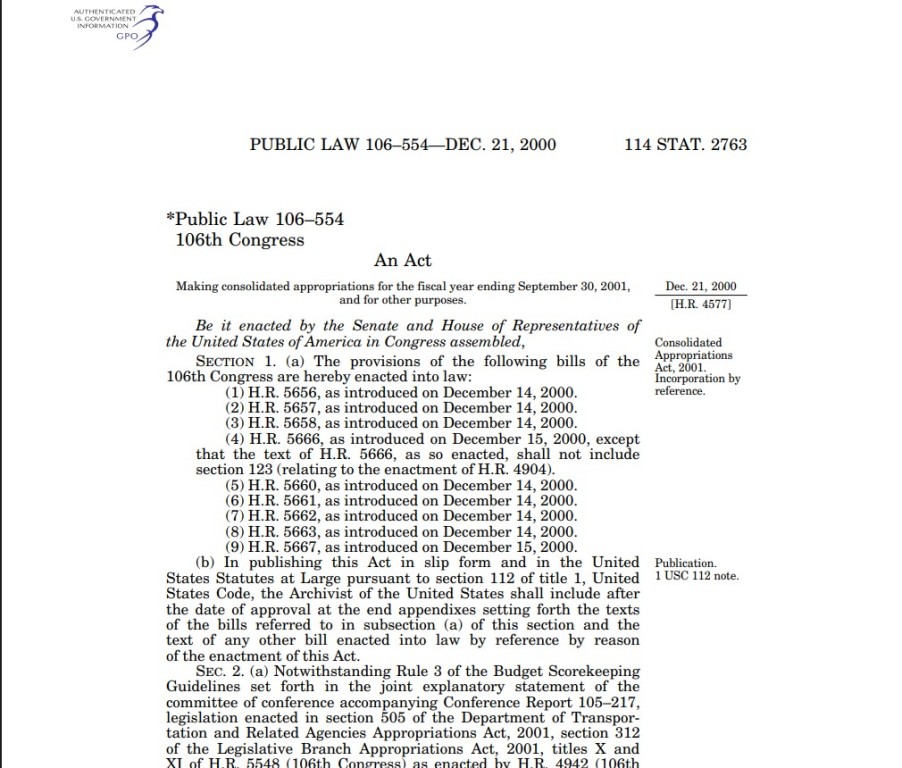
Congress has already enacted a law intended to address part of this problem. In 2001, Congress enacted what became known as the Information Quality Act. The law directed the Office of Management and Budget to establish government-wide standards to ensure the “quality, objectivity, utility, and integrity” of information federal agencies disseminate. Agencies were also required to establish procedures allowing affected persons to seek correction of information they believed failed to meet those standards.
While the George W. Bush administration directed agencies to draft the IQA Guidelines, it never required federal agencies to implement them in practice. Because Congress failed to conduct adequate oversight, agencies were able to ignore the law.
OMB issued government-wide guidelines, and federal agencies established information-quality procedures. Yet the Information Quality Act has remained largely invisible to the American public and has never become the powerful discipline on federal policy making that it could be.
Government reviews have documented some of the shortcomings. The Government Accountability Office has found deficiencies in agency transparency, public access, reporting, and handling correction requests. In many cases, citizens may not even know that mechanisms exist to challenge questionable government information.
Congress should strengthen the Information Quality Act and make compliance with its principles mandatory in federal policy making. Before an agency substantially changes a major regulatory policy, it should identify the scientific, economic, and technical information supporting the change. Influential information should be subjected to appropriate peer review and transparent quality standards. Citizens and affected parties should have an effective mechanism for challenging information that is inaccurate, unreliable, or manipulated.
Most importantly, agencies should have to explain when and why the factual basis for a policy has changed.
If one administration concludes that a particular energy policy is essential to the public interest and the next administration reaches the opposite conclusion, the public deserves more than a change in political philosophy. It deserves to know what facts changed.
High-quality information will not eliminate political disagreement. Nor should it. Elections have consequences, and presidents are entitled to pursue different policy priorities within the law. But elections should not change facts.
Requiring the government to identify, disclose, and defend the information underlying major policy changes would make arbitrary regulatory swings harder. It would also make it harder for corporations and interest groups to manipulate government policy merely by changing their political arguments to accommodate the administration currently in power.
The Information Quality Act cannot eliminate politics from government. It can, however, force politics to confront the facts.
William L. Kovacs served as senior vice president for the U.S. Chamber of Commerce and chief counsel to a congressional committee. His books include: Congress: An Irrelevant Institution or Guardian of the Republic, Reform the Kakistocracy, the recipient of the 2021 Independent Press Award for Social/Political Change, and Devolution of Power. He can be contacted at wlk@ReformTheKakistocracy.com
Leave a Reply