

by James Lyons-Weiler, PhD, Popular Rationalism, ©2026
(Sep. 1, 2026) — HHS says hospitals and clinics turned distressed minors into recurring customers, secured payment through questionable coding, and expanded under federal and professional protection.
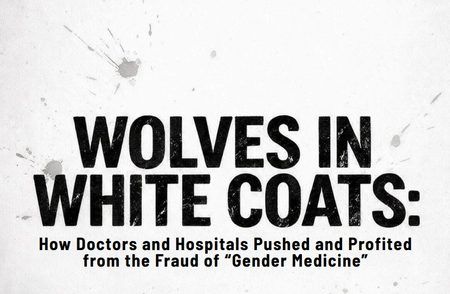
On August 13, 2026, the Department of Health and Human Services released Wolves in White Coats: How Doctors and Hospitals Pushed and Profited from the Fraud of ‘Gender Medicine.’ The 64-page commissioned report draws on insurance claims, CMS coding guidance, Justice Department investigations, hospital materials, whistleblower testimony, scientific literature, and interviews with patients and parents. Its conclusion is stated in the title: HHS says pediatric gender medicine became an industry that harmed children and rewarded the institutions delivering it. [1],[2]
The release was paired with federal referrals. Vice President JD Vance, acting as chairman of the White House Task Force to Eliminate Fraud, referred providers named in the report to the Department of Justice. Secretary Robert F. Kennedy Jr. sent the same claims cohorts to the HHS Office of Inspector General. Kennedy’s August 12 letter identifies providers whose claims exhibit ‘potentially anomalous billing patterns’ and asks OIG to investigate possible violations of federal law. [2],[3]
HHS describes a national system driven by three forces. Hospitals found a long-duration revenue model. Advocates and providers used diagnostic codes that could secure insurance payment when a gender-related diagnosis might fail. Federal officials and professional societies then supplied the legal, financial, and institutional protection that allowed the model to spread. The report’s five chapters build that case in sequence. [1]
The report’s central charge
HHS says hospitals enabled a rapid medical shift despite scant evidence for long-term safety and efficacy. The report uses the term ‘sex-rejecting procedures’ for puberty blockers, cross-sex hormones, mastectomy, genital reconstruction, and related operations. It argues that these interventions placed physically healthy minors on a path of repeated endocrine visits, laboratory monitoring, prescriptions, mental-health encounters, surgeries, revisions, and adult follow-up. [1]
The report was commissioned by HHS and written by contributors from the Center for Christian Virtue, Independent Women’s Forum, the Ethics and Public Policy Center, and clinical practice. They include Aaron Baer, Victoria Coley, Neeraja Deshpande, Eithan Haim, Jordan Jantz, Aaron Kheriaty, May Mailman, Andrea Mew, Rachel Morrison, and Quentin Van Meter. The report describes itself as noncomprehensive and points readers to a separate HHS evidence review for its full clinical assessment of pediatric gender medicine. [1],[5]
Its thesis is broader than insurance fraud. HHS says financial incentives attracted hospitals, gender ideology shaped clinicians and medical organizations, Biden-era policy pressured providers and payers to expand access, and weak oversight left families with few brakes on the process. The report presents the billing data as the most measurable part of a much larger institutional failure. [1]
A lifelong revenue stream
HHS traces the expansion from a handful of specialized clinics in the early 2010s to programs at more than 225 hospitals and health systems by the early 2020s. The report starts with the economics of pediatrics: lower physician compensation, thinner departmental margins, and less institutional influence than high-revenue adult specialties. Gender clinics, HHS says, changed that calculation by bringing endocrinology, adolescent medicine, plastic surgery, urology, and gynecology into a continuing chain of reimbursable care. [1]
The report calls this the ‘captive patient’ model. Endocrine Society and WPATH guidance called for clinical assessments every three to six months, periodic laboratory testing, bone-density scans, and continuing multidisciplinary follow-up. HHS interprets that schedule as a predictable stream of office visits, prescriptions, facility fees, monitoring, and later procedures extending into adulthood. [1]
Read the rest here.
Leave a Reply