
by Joseph DeMaio, ©2026
(Mar. 20, 2026) — As we enter the final days leading up to the oral arguments in Trump v. Barbara, it may be prudent to review the briefs on the merits of President Trump and his opponents, as well as the myriad amicus curiae (“friend of the court”) briefs that have been filed.
To begin with, as your humble servant has posited here, the merits Opening Brief of the President, authored by Solicitor General D. John Sauer, is not merely persuasive, it is compelling. Read it for yourself. And as for the opposition’s merits brief, your servant has made his views known here. To summarize the opposition’s position: “Since we’ve been doing it wrong for so long, it would be inconvenient and unreasonable to make us do it right into the future.”
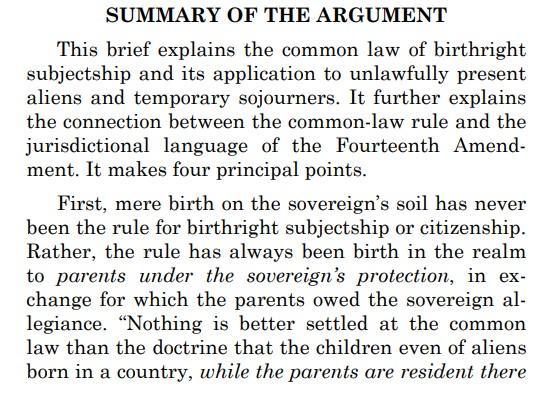
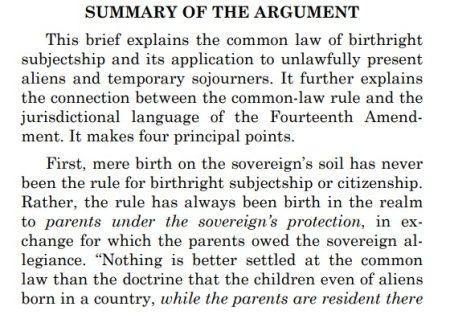
In plain English, General Sauer’s merits Opening Brief clearly articulates what the authors of the 14th Amendment meant and intended when they conditioned the creation of “birthright citizenship” in children born here to be “subject to the complete political jurisdiction” of the United States. They did not intend mere birth here to a non-resident, non-domiciled illegal alien mother to be all that was needed. Indeed, the crucial element of domicile is further emphasized – and with identical compelling impact – in General Sauer’s just filed merits Reply Brief.
While various other amici curiae opposing President Trump seek to perpetuate the mistaken, unconstitutional and even disingenuous policy of “birth tourism” fostered and exacerbated by the regime of “Robinette the Marionette” – aka “Dr. Jill’s meal ticket” – General Sauer’s Opening Brief explains why precisely the opposite intent was at the core of the amendment’s authors…, and it isn’t even close.
Confirming the “not even close” gibberish of most of the amicus briefs opposing President Trump are the sob story fabrications of the SEIU amicus curiae, dismantled here. While your servant has suggested that, under Supreme Court Rules, the SEIU brief might well qualify to be stricken, leaving it as part of the record in the case could instead serve the purpose of underscoring the desperation and intellectual flailing of those opposing President Trump’s Executive Order 14160. Your servant calls it “intellectual flailing;” General Sauer calls it “gerrymandering the definition of jurisdiction….” (See Reply Brief at 14).
Standing in stark contrast to the gibberish masquerading as logic of the SEIU amicus brief are, in particular, the amicus briefs of three entities and individuals. Your servant has previously noted the excellent brief of the State of Tennessee (joined in by twenty-three other “red” states) as well as that of NYU Law School Professor Richard Epstein, authored by his legal counsel, one Benjamin Flowers, a former solicitor general of the State of Ohio. Both the Tennessee+ and Epstein briefs are true “friend of the court” briefs and, with any sort of luck, will guide the Court in its deliberations.
In the meantime, one additional amicus brief supporting President Trump has been filed, and it too is an excellent exposition of the issues and of the intent of the authors of the 14th Amendment, particularly with regard to the “subject to the jurisdiction” element. That brief (authored, BTW, on his own behalf) is that of University of Minnesota Law School Professor Ilan Wurman.
Not only does the brief identify and precisely define the historical “lay of the land” regarding the intent of the drafters of the 14th Amendment, it is noteworthy that General Sauer has taken note of Professor Wurman’s work. Specifically, both in General Sauer’s merits Opening Brief and his Reply Brief, he cites and favorably references Professor Wurman’s scholarship on the issues. Parenthetically, such references in both General Sauer’s Opening Brief and Reply Brief cannot (or should not) be lost on the Supreme Court Justices.
Long story short: the upcoming oral arguments, slated for April 1, 2026, will be extremely interesting, particularly for those who think the intent of the authors of the 14th Amendment in 1868 – as opposed to result-oriented talking head prognosticators in 2026 – should prevail.
As the saying goes: “May you live in interesting times.”
Comments
9 responses to “The Birthright Citizenship Homestretch”
Re. Quotable Quotes: The chief author of the 14th Amendment, Sen. John A. Bingham, wrote: “Every human being born within the jurisdiction of the United States of parents not owing allegiance to any foreign sovereignty is, in the language of your Constitution itself, a natural born citizen.” Cong. Globe, 39th, 1st Sess., 1291 (1866), Sec. 1992 of U.S. Revised Statutes (1866) … see more quotes regarding citizenship, citizenship kinds, and allegiance at: https://cdrkerchner.wordpress.com/2024/06/14/quotable-quotes-re-citizenship-kinds-allegiance-and-the-presidential-eligibility-clause-in-the-united-states-constitution/
More comments and discussion of this article here: https://freerepublic.com/focus/f-news/4371611/posts
In the same session Congress passed the 14th Amendment, it had already enacted the Civil Rights Act of 1866, denying citizenship to U.S.-born children “subject to any foreign power.” No effort was made to repeal it, showing the 14th didn’t change that view.
One week before he introduced the citizenship clause for the 14th Amendment, Senator Howard said,
“A citizen of the United States is held by the courts to be a person who was born within the limits of the United States and subject to their laws.” Congressional Globe, 39th Congress, 1st Session, May 23rd, 1866 pg 2765.
“All from other lands, who, by the terms of your laws and in compliance with their provisions become naturalized, are adopted citizens of the United States; all other persons born within the Republic, of parents owing allegiance to no other sovereignty, are natural born citizens. Gentlemen can find no exception to this statement touching natural born citizen except what is said in the Constitution in relation to [Native American] Indians.” [underline emphasis added] Source: Congressman John Bingham (R) OH the “Father of the 14th Amendment”, 1862, Congressional Globe – http://www.usnaturalborncitizen.com/bingham.html
Quotable Quotes re Citizenship, Citizen Kinds, and Allegiance: https://cdrkerchner.wordpress.com/2024/06/14/quotable-quotes-re-citizenship-kinds-allegiance-and-the-presidential-eligibility-clause-in-the-united-states-constitution/
Considering what has been going on in our country at least since Barack Hussein Obama was a constitutionally ineligible candidate, who was elected president twice and sworn in both times by Chief Justice John Roberts, then why have current President Donald Trump and other Republican politicians (and some Democrats) been talking about presidential candidates in 2028 and beyond such as Marco Rubio and/or others who are NOT Article 2, Section 1, Clause 5 qualified? You can’t have it “both ways,” can you?
Is this concern of mine not a valid one since I’m just an average American citizen instead of an attorney or constitutional scholar? Maybe it’s because I don’t have “standing!” Funny thing to me is that I am a military veteran, a retired law enforcement and criminal court officer, a taxpayer, a voter, a law-abiding citizen, a grandparent, etc!
Tom, et al,
The reason you and I don’t have “standing” is because America’s nationally “sindicated” judicial network has us “sitting” in the bleachers, while paid attorneys argue back and forth for years on their biased “US citizenship” interpretations, like some endless tennis match.
Time for “We the Lay People” to start standing and moving down to the playing field and redirect all US attorneys to remain sitting up in the bleachers!
Then, Non-attorney President Trump will lead the playing field of non-attorney U.S. citizens with the following “end this corrupted legal tennis match” speech:
“Whereas, the US Constitution and its 27 Amendments is the supreme law of the land 1789- Today.
Whereas, all US Citizens can either follow, or amend the US Constitution such that there never can be an expedient “living Constitution” decision with any legal weight.
Whereas, the “natural born [sole-US-]Citizen” (nbC) presidential (1787- Today) and vice presidential (1804- Today] qualifier was evidently interpreted, via the historical selection and election of US Presidents and Vice Presidents for some 184 continuous years (1824- 08-27-08), to mean, essentially, “a child who is born within and subject to the sole jurisdiction of USA to sole-US-citizen-parents who have no publicly disclosed foreign citizenships or allegiances.”
Whereas, Pelosi-Biden-Obama criminally “overruled” said 184 years of Precedential Presidential nbC-qualification on 08-28-08/The DNC-nbC-COUP:
>>>
Whereas, the 14th Amendment for some original 30 continuous years (1866- 1898) was evidently interpreted to mean, essentially, “former negro slaves born and domiciled and fully subject to the jurisdiction of the USA, are to become and treated as full and equal US citizens by all living former non-slave US citizens.”
Whereas, the US Supreme Court criminally judged the Dred Scot case and, later, the Wong Kim Ark case in 1898, which re-imagined the 14th Amendment to include non-domiciled children born on US soil of foreign-citizen parents to be granted, essentially, “US birthright citizenship with chain migration privilege.” https://www.thepostemail.com/2025/01/23/birthright-citizenship-president-trump-and-the-constitution-versus-the-supreme-court/
Now, therefore, the original interpretations of “natural born Citizen” and the 14th Amendment as evidently revealed by the recorded historical actions of previous generations of We the US citizen-People will re-remain in full force and effect today, thus, resulting in the nullification of Obama and Kamala illegal titles and terms in office after 08-28-08, and the nullification of the so-called “anchor baby birthright citizenships” since 1898.
Let the history of original We the People’s evidentiary actions in these two citizenship controversies now prevail over the distracting hysteria of today’s national media-activist-judiciary “sindication”! GOD BLESS AMERICA”
Your excerpt is forceful advocacy, but as analysis it overstates the current posture.
The procedural posture is this: the government filed its merits brief on January 20, 2026, respondents filed on February 19, 2026, and the government’s reply brief was filed on March 19, 2026. Oral argument is set for April 1, 2026. The Supreme Court docket also shows a very large amicus field on both sides, including originalist and conservative amici for the government, and historians, immigration scholars, civil-rights groups, states, and the ABA for respondents.
On the government’s side, Sauer’s brief does make a clean and serious argument. It frames the Citizenship Clause around “complete political jurisdiction,” argues that citizenship turns in part on parental domicile and allegiance, and says children of temporarily present or unlawfully present aliens are outside that rule. The just-filed reply doubles down on domicile, expressly arguing that children of illegal aliens and sojourners are “not domiciled in, and so are not subject to the complete political jurisdiction of, the United States.”
But the main weakness in your passage is that it treats the opposition as merely defending administrative convenience. That is not a fair summary of the respondents’ actual brief. Their position is that the text, original public meaning, structure, and especially Wong Kim Ark foreclose the government’s domicile theory. They argue the Clause constitutionalized a broad jus soli rule, with narrow historic exceptions such as children of diplomats, occupying enemy forces, and certain tribal-status cases, and they explicitly argue that Wong Kim Ark includes children of foreign nationals without requiring parental domicile.
So the real fault line is narrower and more serious than your draft suggests: whether “subject to the jurisdiction thereof” means full political allegiance of the sort tied to domicile, as the government argues, or ordinary legal subjection to U.S. law with only a few traditional exceptions, as respondents argue. That is a genuine interpretive dispute, not just inertia versus reform.
A second caution: your paragraph leans hard on “domicile” as though that point were already settled by Wong Kim Ark. The government’s reply says Wong Kim Ark repeatedly referred to residence and domicile and that its broader statements about non-domiciled aliens are dicta. Respondents answer that Wong Kim Ark discussed domicile because Wong’s parents happened to be domiciled here, not because domicile was a constitutional prerequisite, and they quote the opinion’s language about temporary visitors being amenable to U.S. jurisdiction. That clash is central, and it is exactly where the Court is likely to focus.
In rhetoric, your piece works as polemic. In legal persuasion, it would be stronger if you trimmed the insults and sharpened the doctrinal contrast. Calling the other side “Robinette the Marionette” may energize allies, but it weakens credibility for anyone reading this as a serious merits analysis.
A tighter version would be:
As the Court approaches the April 1, 2026 oral argument in Trump v. Barbara, the central issue is whether the Fourteenth Amendment’s phrase “subject to the jurisdiction thereof” requires mere territorial birth plus ordinary legal obedience, or instead the fuller political allegiance traditionally associated with domicile. The government’s opening and reply briefs, filed January 20 and March 19, argue for the latter reading and contend that children born here to unlawfully present or merely temporary aliens do not automatically qualify for citizenship at birth. Respondents, relying heavily on Wong Kim Ark, argue that the Citizenship Clause adopted a broad jus soli rule subject only to narrow historical exceptions. The case therefore turns not on convenience, but on whether Wong Kim Ark is read as confirming or foreclosing a domicile-based limitation.
If you want, I can turn this into a Barnes-ready email or a John Jay Committee memo with Robert Barnes, Walker Todd, Joe Nierman, and David Freiheit all folded into the framing.
SCOTUS could/should also consider the point that Wong Kim Ark (1898) decision regarding the 14th Amendment and Birthright Citizenship was not unanimous and was wrongly decided by the majority back then. It might be time for SCOTUS to do that, i.e., reverse the error of the 1898 decision in regards to what “subject to the jurisdiction” means in the 14th Amendment per the Congressional Record and debate per those who proposed, wrote, and passed the 14th Amendment. They have reversed other wrong past decisions. It’s time to reverse the non-unanimous, wrongly decided WKA (1898) SCOTUS decision.