
by Joseph DeMaio, ©2026
(Feb. 27, 2026) — Introduction

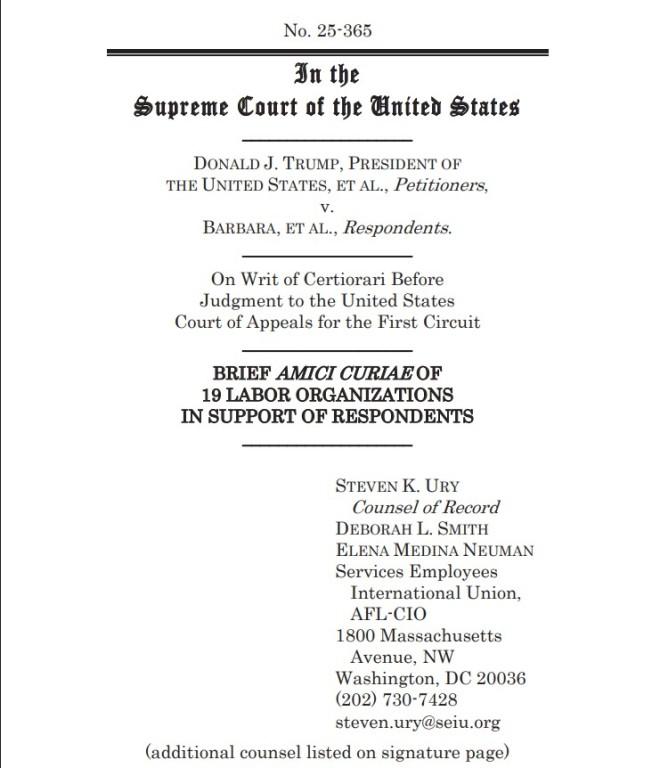
The “birthright citizenship” saga continues with the filing of a series of amicus curiae briefs in the Trump v. Barbara “birthright citizenship” case now pending in the Supreme Court. One of the latest is the brief of the Service Employees International Union (SEIU), opposing, of course, President Trump’s efforts to restore the original meaning of the 14th Amendment after decades of misinterpretation by the judiciary; “scholars;” “armchair experts;” and, naturally, an omniscient media.
As a preliminary matter, the Latin legal term “amicus curiae” translates as “friend of the court.” The term has come to encompass legal briefs filed not by the actual parties to legal matters before a court, but instead by non-parties who may support one or the other of the actual parties. In either event, the original purpose of such briefs was to bring to the court’s attention issues or matters which either might not have been raised by the parties or adequately briefed by them, but which the various amici curiae may believe should be considered as bearing on its deliberations.
Although faint shadows of that original “independent” purpose still remain, today’s amicus briefs usually abandon any pretense of independently bringing matters to a court’s attention in order to better assist the court. Instead, today’s amicus briefs usually function as aggressive non-party advocates for the party they favor, i.e., the party in whose favor they want the court to rule.
These briefs are decidedly no “friend of the court,” but rather are weaponized warriors for “their” party and, importantly, hostile adversaries of their enemy: “the other side.” Such is the case now seen in the 35-page amicus curiae brief of 19 “labor organizations” (a woke euphemism for “unions”), led by the SEIU filed in the SCOTUS “birthright citizenship” case. A more aggressive, confused and clueless labor union in this nation would be hard to find.
Analysis of the SEIU Brief
Apart from the fact that the first five pages of the SEIU amicus brief consist only of self-serving “puff-piece” advertisements of the identities and policies of the amici labor unions – advertisements of literally zero interest or concern to the Court – the remaining substantive textual portion of the brief spans a mere 5½ pages and cites only two (2) appellate cases, United States v. Wong Kim Ark (“WKA”) and Ng Fung Ho v. White, 259 U.S. 276, 284 (1922). This is not exactly an intellectual “deep dive” into the legal issues surrounding the 14th Amendment.
WKA is cited only once (in a solitary footnote, n. 3) in support of the labor union’s claim that birthright citizenship “has been repeatedly affirmed by this Court….” The citation neglects mentioning, of course, that WKA is entirely distinguishable from the factual situation addressed in EO 14160 and in addition, naturally, that WKA was wrongly decided. Infirmities such as those rarely detain aggressive labor unions.
Moreover, the brief’s citation to the Ng Fung Ho case is even more curious. That case is cited for its weak vanilla statement that “[t]he denial of citizenship is a deprivation of ‘property and life and all that makes life worth living….’”
This unremarkable – and completely irrelevant – quote comes from a case involving a 5th Amendment violation of due process resulting from the denial of a judicial trial and not from a case directly concerning the 14th Amendment “birthright citizenship” or “subject to the jurisdiction” issues. Indeed, it would appear that the Ng Fung Ho quote was randomly “cherry-picked” from a case one of the amicus lawyers remembered from his/her days on moot court in online nighttime law school rather than to assist the Court on the “subject to the jurisdiction” clause of the 14th Amendment.
Adding confusion to irrelevance, the remaining 25 pages of the brief – accounting for over 70% of its wandering bulk – consists of a collection of personal experience “stories” or “examples” of eleven (11) unidentified individuals where validation of EO 14160 would purportedly have “adverse” consequences on those unknown persons or their offspring. This is merely another way of arguing that adhering to the law as intended by the Framers of the 14th Amendment would be inconvenient and, accordingly, should be avoided simply by ruling against President Trump. Keep doing it the wrong way…, move along…, nothing to see here.
The SEIU brief begins its argument (brief at 7) with the woefully inaccurate and misleading claim that “President Trump’s Order rescinding birthright citizenship….” (Emphasis added). In truth, EO 14160 does nothing of the kind. The only thing being “rescinded” – and, BTW, prospectively only – is perpetuation of the flawed and improper interpretation of the 14th Amendment handed down by misinformed and confused jurists such as Justice Horace Gray in his WKA majority opinion, addressed, post.
Those people who have in the past improperly benefited from erroneous interpretations of the 14th Amendment will not have their status as U.S. citizens impacted at all, let alone “rescinded.” This is because, as the lawyers for the SEIU know (or should know), the EO operates prospectively only. Any suggestion that the order “rescinds” the principle of birthright citizenship is patently untrue. Those improperly awarded it in the past will be due process “grandfathered” and unaffected, as the order aims to affect only future births.
The SEIU brief next bamboozles the Court (as well as readers of the brief) that mere U.S. citizenship is “required to be President,” citing “U.S. Const. art. II, § 1.,” The brief thus disregards and ignores all of the legislative history and intent of the Founders that only a “natural born Citizen” (“nbC”), as opposed to a native-born citizen – with exceptions for “citizens” until Martin Van Buren was elected in 1837 – could hold the presidency under the “Eligibility Clause,” Art 2, § 1, Cl. 5. Sneaky…, but not altogether unexpected.
The SEIU screed next contends (brief at 9) that if EO 14160 is validated, “… an untold number [of children born, e.g., to illegal alien parents on U.S. soil] would become effectively stateless.” That is a flat-out misrepresentation of the law. While the offspring of illegal aliens and other foreign parents temporarily or not lawfully here would not be awarded automatic U.S. citizenship – as has improperly happened in the past – they would still possess the citizenship status of their parents (usually the father). Accordingly, contrary to the SEIU claim, they would categorically not be stateless. Indeed, in so arguing, the SEIU brief is in effect directly denigrating and discriminating against those nations of which the children’s parents are members, their illegal or unlawful presence in the United States notwithstanding.
Capping off the screed’s arguments section, the SEIU concocts (brief at 11) the ominous specter of a “maelstrom of instability…” should EO 14160 be validated by the Court. Really? The only “maelstrom” churning the waters is the continued push by persons and organizations such as SEIU to weld into place a protocol which was (a) never intended by the Framers of the 14th Amendment; (b) which is undercut by other Supreme Court precedent; and (c) which metastasized out of the foggy ruminations of Justice Horace (“Gray’s Anomaly” Gray, as aptly described in Chief Justice Fuller’s dissenting opinion in WKA.
The SEIU Brief next proceeds to offer a series of union member “stories” purporting to fortify invalidation of EO 14160. The SEIU Brief notes (at 12, fn. 19) that “The individuals whose stories are reported here have all consented to having their experiences being recounted in this brief. Participants chose to maintain a measure of anonymity by using initials only.” Whether those “personal experience stories” were a part of the actual record presented in the lower courts is unclear, yet another defect in the SEIU brief.
Significantly, well over two-thirds of the anonymous persons concede in their respective “stories” that the dire consequences they fear would arise only if EO 14160 had been in place in the past when they or their offspring were born. Stated otherwise, each of these “adversely impacted” persons are not impacted at all, because the order operates prospectively only. The SEIU brief “assists” the Supreme Court by contending, in effect, that it should recognize and validate a “vested right” in unaffected persons to continue “doing it wrong.” Memo to the SEIU: there is no such thing as a “vested right” to continue violating the 14th Amendment.
Among the reasons posited in the SEIU brief for ruling against President Trump is because unidentified person “J,” – who is anonymously described as a U.S.-trained Mexican surgeon with a U.S. born two-year old daughter by his Mexican wife – is under the belief that EO 14160, if validated, could “scare away a lot of people with unique sets of skills from coming to the U.S.” See SEIU Brief at 24.
Here’s a thought: those people with unique skill-sets should first experiment with coming here lawfully, as he and his Mexican wife did on visas. That way, they will avoid the fear of being lawfully deported, along with their Mexican national offspring. Under President Trump, the days of open border invasions engineered and facilitated by an incompetent drooling Chief Executive – “Robinette the Marionette” – are over.
Continuing with “J’s” sob story, the SEIU Brief asserts (id.): “Additionally, J. worries that if his children did not have U.S. citizenship due to the Order he would be prevented from traveling for his work. International travel is fundamental to J.’s profession, to update his medical knowledge and to learn from people who are the best of the best in the field.’” (Id.) Yikes…, where to start, where to start…?
First, the brief again tries to bamboozle the Court (and anyone reading it) by totally ignoring the fact that his two year-old daughter, being born before Feb. 20, 2026, remains completely unaffected by EO 14160. The goal of “J” is to perpetuate automatic birthright citizenship for his future children. His current daughter may not have been properly recognized as a U.S. citizen under the erroneous interpretations of prior politicians and immigration officials laboring under the flawed decision in WKA, but validating EO 14160 now will do nothing to change that, since it is “water under the bridge.” The SEIU attorneys must have inadvertently missed (or intentionally disregarded) that “prospective only” component of the EO.
Second, the brief offers zero explanation for why – contrary to reality – if his daughter were not a U.S. citizen, her Mexican citizenship would prevent “J” himself from traveling internationally. Even now, the daughter is too young to be “J’s” personal assistant, so any claim that her presence is a necessary precondition to allowing her father’s international travel remains…, obscure.
Third, as a sophisticated surgeon, “J” might consider just getting his daughter a Mexican passport…, or perhaps just leaving her with her mother in New York, where “J” lives as a “highly-paid professional.” (Id. at 23) The Framers of the 14th Amendment never intended it to be a mechanism to facilitate international travel, much less dependent on U.S. citizen status for a two year-old.
As for the brief’s reliance on appellate decisions, the brief states (at 9): “The denial of citizenship is a deprivation of “property and life and all that makes life worth living…,” citing Ng Fung Ho v. White, 259 U.S. 276, 284 (1922).
The SEIU confuses (and thus obfuscates) the effect of EO 14160 and the unremarkable quote from the Ng Fung Ho case. The only thing that EO 14160 does is restore the intent of the 14th Amendment’s framers by denying United States citizenship to those not legally entitled to it. A person born here to an illegal alien mother will still have the citizenship of his/her parents, but will not have automatic U.S. citizenship. That was the articulated intent of the Framers of the amendment, as extensively documented in President Trump’s Merits Brief. And, BTW, that will be true only prospectively as to people born here from and after February 20, 2026, as plainly stated in EO 14160 itself.
The SEIU amicus brief thus also misleadingly suggests that, if validated, the Executive Order will somehow retroactively strip persons of their existing citizenship who have in the past erroneously and improperly secured automatic U.S. citizenship under the deeply flawed WKA decision. Perhaps those folks should be retroactively so stripped, but that is not what would happen. The SEIU brief, seeking to “assist” the Court in arriving at the “right” decision, instead misleads the Court …, and anyone else who reads the brief.
The SEIU brief also contends (at 10) that “Children deprived of nationality are denied a sense of belonging, experience trauma, and suffer other negative psychological harms. The need to belong is one of the most fundamental human drives, the loss of which results in negative health outcomes.” This is perhaps the most confused and misleading assertion of the entire SEIU brief, and certainly of far less than zero assistance to the Court in analyzing the issues.
To begin with, EO 14160 deprives no one of “nationality.” A person born here to illegal aliens or other parents subject to the EO will possess the citizenship/nationality of his/her parents, normally the father. Parenthetically, this result is confirmed in the teachings of “the founding era’s foremost expert on the law of nations” (California Franchise Tax Board v. Hyatt, 587 U.S. at 239 (2019)), Emer de Vattel. See “The Law of Nations,” Book 1, Ch. 19, §§ 212, 215. As faithful P&E readers know, your humble servant posits that de Vattel was the source for John Jay’s and the Founders’ “natural born Citizen” presidential eligibility restriction in the Constitution.
The SEIU brief intentionally obfuscates the issue by suggesting that the withholding of U.S. citizenship or “nationality” from anyone except those the Framers intended for it to be extended will somehow eradicate a person’s otherwise existing Mexican, Somalian, French, Kenyan, Peruvian, Icelandic or Japanese citizenship. It will not do so, and moreover, it cannot do so. The SEIU erroneous assertion (at 9) that the EO will render children “stateless” is itself instead best labeled: “brainless.”

Finally, Rule 37 of the Supreme Court Rules governing amicus curiae briefs provides: “Brief for an Amicus Curiae 1. An amicus curiae brief that brings to the attention of the Court relevant matter not already brought to its attention by the parties may be of considerable help to the Court. An amicus curiae brief that does not serve this purpose burdens the Court, and its filing is not favored.” (Emphasis added) Under Supreme Court Rule 37(5), an amicus curiae is also required to set out its “interest” in the case and the party it supports. This rule would seem to render the otherwise mandatory principles of party-litigant “standing” inapplicable. Thus, instead of being required to establish “a stake in the outcome” of the dispute (i.e., standing), amicus curiae need only identify their “interest” in the matter.
Furthermore, against the backdrop that the majority of the anonymous members of the amici labor unions admit that the EO would have negatively impacted them only if it had been in place when the persons related to those members were born – and it indisputably was not –, if they were parties, the amici, their members and their complaints would be tossed out the door for failure to state a claim upon which relief could be granted. That is Civil Procedure 101, even at online nighttime law schools.
Conclusion
Given that the Merits Briefs of both President Trump and “Barbara” have exhaustively presented to the Court their respective arguments in support of (and in opposition to) EO 14160, a strong argument can be made that the SEIU amicus curiae brief, in particular, completely fails to comply with Supreme Court Rule 37 – and arguably even mocks it – and thus unduly burdens, rather than assists the Court.
Accordingly, the SEIU amicus curiae brief should be ordered stricken by the Court or, at minimum, like a humorless failed joke, ignored.