

by Cheryl Lacey, DGSJ, ©2026
(Feb. 2, 2026) — I recently came across a 2011 ABC article on Victoria’s education system. It quoted the then Liberal Minister for Education, Martin Dixon, reflecting on the reform agenda introduced by the previous Labor government, including the Blueprint for Schools of 2003, revised in 2008.
Dixon praised the coherence the policy had delivered.
“If you walk into schools there’s a common language, an understanding of how children learn and what is good teaching practice, so we’re in a pretty good place there.”
But he added that this was not sufficient.
“My job is to move to the next step.”
That next step, Dixon explained, would expand the breadth of the curriculum, with a greater focus on the arts, foreign languages, and sport.
“It’s not just about maths and literacy,” he said.
“They are very important, but we’ve got to educate the whole child.”
The Whole Child
The whole child approach to education is intended to give children the foundation they need to become well-rounded, healthy individuals. Schools that take this approach believe they can equip all children with the education and essential life skills required for them to reach their full potential.
As an educator, I see that this has far-reaching implications for educators and other staff working in schools. As a parent, it absolutely terrifies me.
The reason for my fears can be stated very simply: socialism.
Two Common Interpretations of “The Whole Child”
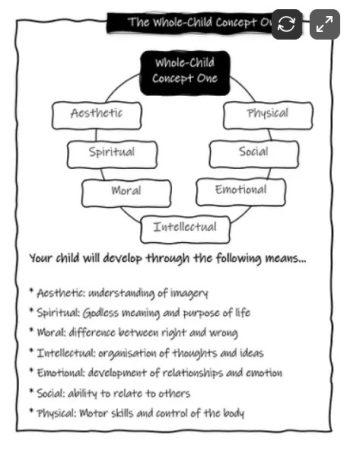
The Whole Child — Concept One
Some, but not all, research into this concept of the whole child suggests that many children live unfortunate lives – as a result of poverty or poor parenting on one hand, or due to being spoiled or leading a life deemed not worth living on the other. The assumption is that the role of school education is to remedy these problems.
It appears that government, researchers, and bureaucracy know best and that “best” involves giving schools greater authority and recognition across all areas of child development. That is, over the whole of the child’s life.
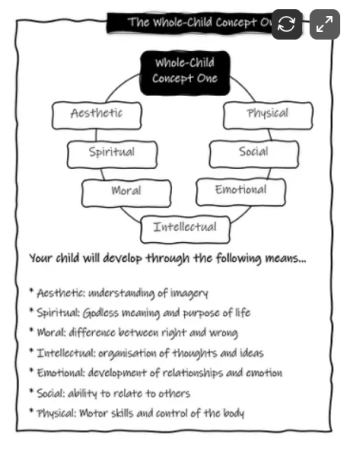
In this concept, the focus is on the environment in which children learn – whether indoors, outdoors, or online. These surroundings include the social and cultural influences that operate wherever children learn and are taught.
We could celebrate these elements; they sing to parents wanting the best for their children. At the same time, we could be concerned, because they are open to interpretation. If stretched beyond what parents believe schools should be responsible for, the boundary between school education and life itself disappears.
The truth is that the where, when, what, how, and by whom moments of a child’s education can never be fully known or controlled, by their parents or anyone else.
Being responsible for a children’s education does not mean having the perfect setting to do it all on your own. This applies to home and school.
Read the rest here.