
by James Lyons-Weiler, PhD, Popular Rationalism, ©2026

(Jan. 9, 2026) — The 2025–2030 Dietary Guidelines for Americans represent more than an update. They mark a rare epistemic correction. Instead of doubling down on nutrient-avoidance ideology or industry-tied formulations, the new pyramid reframes meals around real food, satiety, and metabolic leverage. This shift prioritizes protein, intact fats, and whole foods while deemphasizing processed starches, added sugars, and hyper-engineered calorie carriers.
The Pyramid Structure
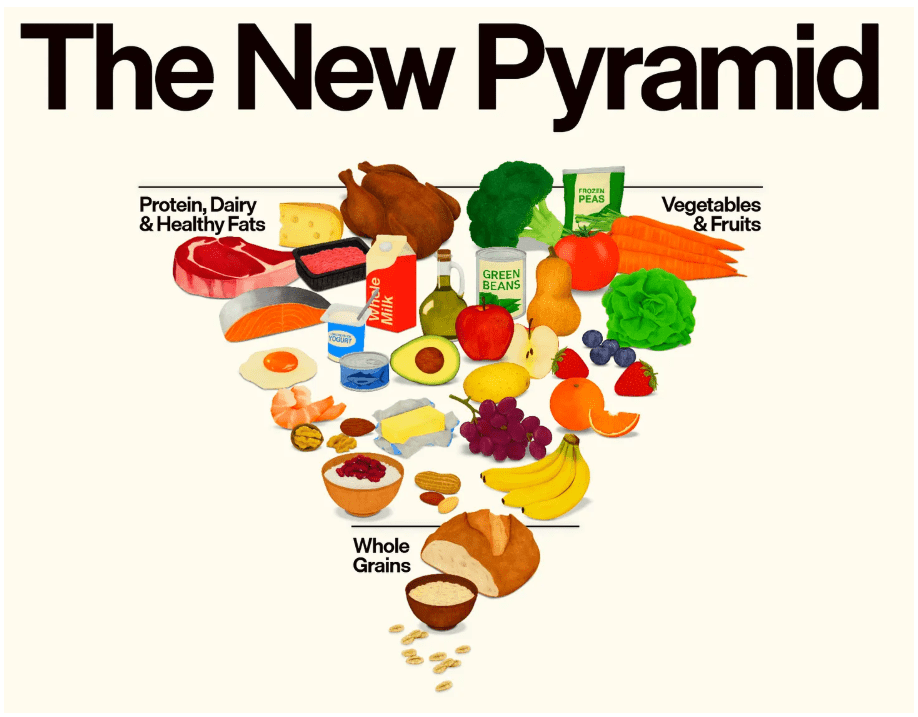
RealFood.gov’s visual places “Protein, Dairy & Healthy Fats” at the base. Fruits and vegetables follow. Whole grains appear at the apex—a role reversal from the 1992 model. The operational logic is that appetite regulation and metabolic signaling depend on food structure and satiety-per-calorie more than on broad macronutrient quotas. The document names high-quality protein, whole/full-fat dairy, and healthy fats and oils as foundation elements. It sets a protein target of 1.2–1.6 g/kg/day, states that no amount of added sugars or non-nutritive sweeteners is recommended, and frames ultra-processed foods as exposures to reduce or avoid. The guidelines say to prioritize oils with essential fatty acids (e.g., olive oil) and allow butter or tallow as optional inclusions.
Appetite Control and Processing Level
The central empirical claim is not macro-based. It’s structural: ultra-processed foods drive excess intake. In Hall et al.’s NIH inpatient randomized crossover trial (Cell Metab. 2019; PMID: 31105044), participants consumed significantly more calories and gained weight on an ultra-processed diet compared to an unprocessed diet, even when macros were matched. This isn’t about sugar or salt in isolation. It’s about engineered formulations that disable satiety signaling. The pyramid responds by repositioning minimally processed proteins and fats as anchors.
Protein as Anchor
The guidelines prioritize protein explicitly and quantitatively. Controlled studies show that higher protein diets reduce ad libitum calorie intake. Mamerow et al. (J Nutr. 2014; PMID: 24477298) found that spreading protein evenly across meals maximized 24-hour muscle protein synthesis. Weigle et al. (Am J Clin Nutr. 2005; PMID: 16002798) showed that increasing protein from 15% to 30% of energy reduced overall caloric intake. The 1.2–1.6 g/kg/day target balances metabolic support and satiety without exceeding realistic intake limits.
Fats and the Saturated Fat Ceiling
The new pyramid includes healthy fats from meats, dairy, eggs, nuts, seeds, olives, and avocados. However, it does not endorse unlimited fat. The guidelines say to prioritize oils with essential fatty acids (e.g., olive oil) and allow butter or tallow as optional inclusions. But the 10% of total daily calories cap on saturated fat remains intact. The Daily Servings chart translates this into operational ranges: for a 2,000-kcal pattern, only 4.5 teaspoons (1.5 tablespoons) of added fats are budgeted—whether olive oil, butter, or other sources.
USDA’s nutrition panel states that butter contains 102 kcal and 7 g saturated fat per tablespoon. At 1.5 tbsp/day, a person consumes ~153 kcal and 10.5 g saturated fat, which already uses ~47% of the saturated-fat ceiling (22.2 g/day for 2,000 kcal). At 3 tbsp/day, butter alone would hit 21 g saturated fat—near the full limit. These values enforce a substitution reality: butter is allowed, not unlimited, and this also means that calories still matter.
PREDIMED and the Real Fat Trial
The best single RCT evidence for “healthy fats” remains PREDIMED (NEJM 2018; PMID: 29897866), which found reduced cardiovascular events when participants consumed a Mediterranean diet supplemented with either 4+ tbsp/day extra virgin olive oil or 30 g/day mixed nuts. This is not an endorsement of butter. It’s an endorsement of unsaturated fats inside a plant-forward pattern. The guidelines reflect that: olive oil is preferred, butter is allowed, portion size controls risk.
Snack at Your Own Risk
The guidelines are clear: “Avoid highly processed packaged, prepared, ready-to-eat, or other foods that are salty or sweet, such as chips, cookies, and candy that have added sugars and sodium (salt).” With high-satiety long-burn foods eaten at mealtime, the urge to snack between meals will be reduced.
Rejection of Prior Assumptions
The HHS flatly rejects a former DGAC recommendation to “reaffirm replacing butter with vegetable oils.” The Scientific Foundation report criticizes past emphasis on linoleic-rich vegetable oils and overreliance on surrogate endpoints and confounded observational studies. It cites Ramsden et al.’s recovered-data re-analyses of the Minnesota Coronary Experiment and Sydney Diet Heart Study (BMJ 2013, 2016; PMIDs: 23386268, 27071971), which found increased mortality in the vegetable-oil arms despite reduced cholesterol. These re-analyses form the backbone of the current administration’s pivot back to whole-food, minimally processed fats.
Carbohydrates and Whole Grains
Whole grains remain in the pyramid, but no longer dominate it. Dose-response meta-analyses (e.g., Aune et al., BMJ 2016) link whole grain intake to lower cardiovascular risk, but refined carbohydrates elevate glycemic load and disrupt insulin dynamics. The pyramid de-emphasizes grains without banning them—a move toward flexibility and personal tailoring, especially in insulin-resistant populations.
Low-Carbohydrate Pattern Acceptance
Goldenberg et al. (BMJ 2021; PMID: 33441384) meta-analyzed low-carb diets and found short-term remission benefits in type 2 diabetes, with attenuation by 12 months. The pyramid does not suppress this: RealFood.gov acknowledges low-carb patterns as legitimate variants, not fringe behavior.
Energy Intake and Caloric Balance
The Guidelines do not prescribe rigid calorie restriction. Instead, they contextualize energy needs:
“The calories you need depend on your age, sex, height, weight, and level of physical activity.”
“Pay attention to portion sizes, particularly for foods and beverages higher in calories.”
— Dietary Guidelines for Americans, 2025–2030, p. 2
The document offers serving targets by food group (e.g., vegetables, fruit, protein), but always with the phrase: “…adjusting as needed based on your individual caloric requirements.”
This pattern repeats across recommendations, and applies to the use of fats as well.
Instead of telling people to count calories, the pyramid achieves energy and appetite control through:
- Prioritizing high-satiety foods
- Eliminating ultra-processed formulations
- Limiting added sugars and refined carbs
- Structuring meals around protein and plants
It provides ceilings where needed (e.g., saturated fat ≤10% of calories) but allows individuals to calibrate their total intake according to body size, activity level, and goals. Older adults are explicitly advised to consume fewer calories with higher nutrient density.
Practical Leverage Points
The pyramid works best when interpreted through behavioral control levers:
- Eliminate liquid calories.
- Start meals with protein + plants.
- Add starch or grains last.
- Measure added fats with spoons.
- Watch the scale trend and adjust servings, not macronutrients.
Read the rest here.