
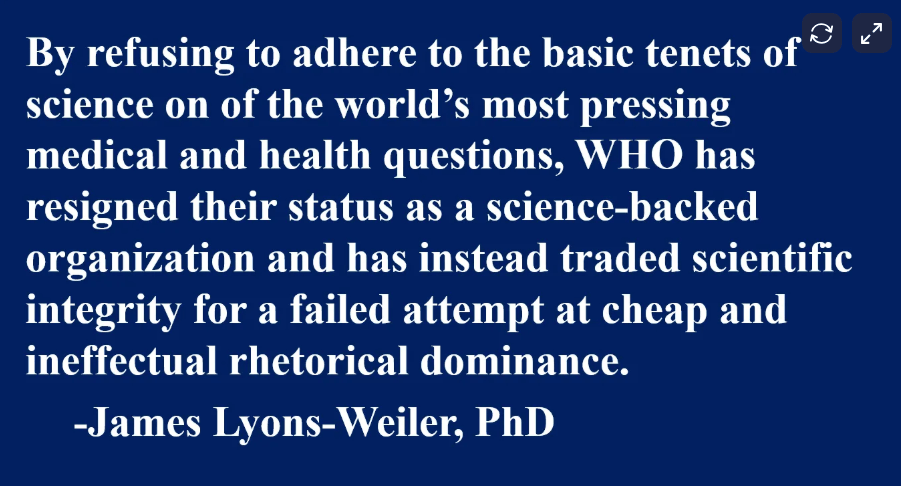
by James Lyons-Weiler, PhD, Popular Rationalism, ©2025
(Dec. 12, 2025) — Executive Summary
On 11 December 2025, the World Health Organization (WHO), via its Global Advisory Committee on Vaccine Safety (GACVS), published a high-profile statement declaring that a “new analysis” reaffirmed that there is “no causal link between vaccines and autism.” This categorical claim rests on a review of selected epidemiological studies from 2010 through August 2025, along with older conclusions from WHO’s earlier position papers (2002, 2004, 2012). However, the WHO’s conclusion is not warranted by the evidence it cites. It reflects multiple forms of confirmation bias in design framing, evidence selection, analytic assumptions, and rhetorical structure.
These include:
- Pre-commitment to a conclusion before disclosing evidence — WHO announced the conclusion of “no causal link” before releasing its full study list, protocols, or bias assessments, foreclosing legitimate scientific review.
- Substitution of a weak population-average null for the real causal hypothesis — WHO addresses only the average association in pooled populations, not whether vaccines may contribute to autism in susceptible subgroups.
- Reliance on underpowered, exposure-misclassified, and methodologically constrained studies — The cited literature largely avoids studying total vaccine schedules, dose response, or timing clusters.
- Systematic dilution and misclassification of risk in biologically plausible subgroups — High-risk children are selectively removed from vaccinated cohorts through early dropout or censoring, biasing results toward nulls or spurious protections.
- Failure to model or test interaction terms, gene–environment effects, or effect modification — This leaves the key hypothesis (vaccines + susceptibility → autism) formally untested.
- Dose–response gradient never evaluated — WHO makes categorical safety claims without modeling the biological gradient of cumulative exposures (e.g., aluminum, immune activation).
- Meta-analysis used to amplify design bias, not resolve it — Pooled estimates aggregate the same flaws embedded in each study and mask heterogeneity across subgroups.
- Linguistic overreach that violates statistical epistemology — WHO’s categorical claim of “no causal link” overstates what observational studies can demonstrate, violating norms set by ASA, PRISMA, and Hill’s principles.
- Suppression of dissent and mechanistic plausibility — WHO ignores mechanistic literature, whistleblower testimony, and methodological re-analyses, replacing rebuttal with dismissal.
Opaque methodology and refusal to publish study-level detail — Without study lists, inclusion criteria, or audit trails, the review cannot be independently reproduced or critically evaluated.
Each step in WHO’s reasoning channels the synthesis toward a predetermined outcome, an exercise in confirmation uber-bias. This report lays out that process in full, with reference to primary studies, methodological critiques, and the statistical literature on bias, confounding, and causal inference.
1. WHO Answers the Wrong Question
WHO frames its analysis around the question: > “Do observational studies detect a population-level association between specific vaccines and autism diagnoses?”
This is no longer a question of interest. It’s 2025. Of course vaccines do not cause autism in everyone.
The scientific and public concern is: > “Can vaccines or components thereof contribute to autism risk in biologically susceptible subgroups via dose-, time-, or interaction-dependent mechanisms?”
WHO never addresses this version. It instead substitutes a weaker, more easily satisfied population-average null hypothesis.
This is a textbook example of hypothesis substitution (see Gelman & Loken, 2014, “The garden of forking paths”).
2. Recycling a Pre-Filtered Corpus
WHO states that it reviewed 31 primary studies and five meta-analyses. However, it failes to release:
– The full list of included studies;
– The risk-of-bias assessments;
– The effect-size estimates and bounds and their limits;
– The inclusion/exclusion rationale.
All evidence points to WHO re-using the same set of studies long favored by U.S. CDC, IOM, and AAP: Madsen et al. (2002), Hviid et al. (2003, 2019), Jain et al. (2015), Zerbo et al. (2017), Taylor et al. (2014), and others — all documented in the past as severely limited and flawed.
This is a confirmation-biased sampling frame. As shown by publication bias metrics (see Ioannidis, 2005; Dwan et al., 2008), selective evidence inclusion distorts both summary conclusions and public health messaging.
3. Designs Inadequate to the Hypothesis
Every major study relied upon by WHO is observational. Most are:
– Retrospective;
– Single-vaccine in focus (MMR, TCV);
– Registry-based diagnosis;
– Underpowered for small subgroup effects; – Over-adjusted for covariates.
None are prospective, randomized trials. None test interaction terms. None model multivariate susceptibility.
Importantly, not all childhood vaccines have been tested even for association with autism, so their design absolutely falls short of its claim.
According to Pearl (2009) and VanderWeele (2015), causal inference requires explicit modeling of counterfactuals and effect modification. WHO’s sources do neither.
4. Underpowering and Dilution
Most of the key studies cited (e.g., Mrozek-Budzyn et al., Price et al., Fombonne et al.) are too small to detect effects smaller than RR = 1.5. Subgroup risks (e.g., mitochondrial disorders, low birth weight, preterm birth) would require stratified samples powered to detect RR = 1.2 or lower. None are.
Yet WHO uses these null results to infer absence of risk. This is a violation of Goodman and Berlin’s (1994) caution that absence of evidence is not evidence of absence, especially in underpowered observational contexts.
Read the rest here.