

by Sharon Rondeau
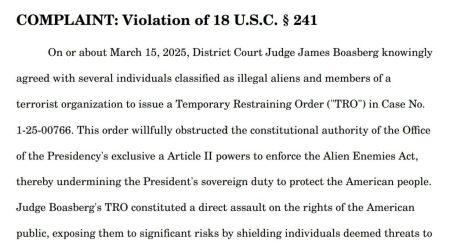
(Jun. 3, 2025) — On April 28, The Post & Email reported the launch of a website containing a “class-action” criminal complaint against U.S. District Court Chief Judge for the District of Columbia James E. Boasberg, a leading figure in judicial actions halting or delaying various aspects of the Trump administration agenda from taking effect.
The document package was written indicating a possibility of additional judicial complaints to come.
In mid-March, Boasberg ordered the reversal of airliners deporting more than 100 illegal aliens to El Salvador under the 1798 Alien Enemies Act (AEA). When the administration said it could not return the deportees, Boasberg declared it to be in criminal contempt.
On April 16, a hearing on the contempt finding was halted by the U.S. Court of Appeals for the District of Columbia Circuit. Two days later, the U.S. Supreme Court ruled Boasberg’s court was an incorrect venue for adjudication of the case and that the administration could resume deportations under the AEA.
Legal challenges to the removal of aliens continue to arise, with lower court judges often issuing temporary injunctions or restraining orders and upon appeal, the Supreme Court at times ruling in the administration’s favor.
“There are a number of judges within these United States of America who have acted in criminal violation of their Oaths to uphold the US Constitution, the State Constitutions and the federal and State laws,” the preamble to the complaint reads. “This form is a protest and a registry of individuals who seek legal action for the criminal acts conducted by Federal Judge JAMES EMANUEL BOASBERG specifically. The information requested in this form is required, pursuant to the ‘Rules of Criminal Procedure’, for a filing to be ‘legitimate’ and recognized by any Court or administrative body adjudicating the matter between this Class-Action and the rogue judges.”
Boasberg is accused of violating U.S. 18 U.S.C. § 241, § 242 and § 2339B, each accompanied by an affidavit. The complaint claims Boasberg “deliberately obstructed the Office of the President, preventing the faithful execution and enforcement of laws established under the authority of the United States, thereby exhibiting a willful disregard for its grave consequences.”
Members of the public are invited to sign the complaint with their names or anonymously. The group of citizens behind the effort plans to send the documentation to the Justice Department for action but has encountered difficulty in obtaining a direct conduit to Attorney General Pam Bondi’s office.
Thus far, the group sent several emails to Senior Assistant United States Attorney at the U.S. Department of Justice Jared English and Assistant United States Attorney at the U.S. Attorney’s Office for the District of Columbia Samuel White requesting a secure method of contacting Bondi’s office but has not received a response.
A letter sent to English and White intended for Bondi reads as follows:
Attorney General Pam Bondi
Office of the Attorney General
United States Department of Justice
Subject: Collective Concern Regarding Criminal Offenses and Request for Action
Dear Attorney General Bondi,
As we are sure you are aware, the Fourth Amendment to the United States Constitution confers the fundamental right to be the accuser in matters of legal violations. This right includes the ability to file a complaint supported by oath or affirmation, thereby satisfying the constitutional provisions necessary to establish probable cause. Under these protections, when the complaint is sworn under oath and the legal elements of an offense are fully satisfied, the mandate of the Fourth Amendment is clear: warrants “shall issue.” This legal principle ensures that the process of addressing alleged crimes remains impartial and grounded in constitutional law.
Furthermore, the Sixth Amendment guarantees that the accused has the right to face their accusers once such warrants are issued. This safeguard balances the rights of the accuser and the accused, ensuring fairness and due process. Together, these amendments form a cornerstone of justice, providing a mechanism for accountability and protecting the integrity of both accusers and defendants.
In the present matter, the criminal complaints forthcoming satisfy these constitutional provisions and meet the Probable Cause Standard and Standing Doctrine. Probable cause is established when all elements of a crime, as defined by federal statutes, are met and corroborated by evidence. Similarly, the Standing Doctrine affirms the legal position of the accuser to initiate these complaints. These foundational principles are fully satisfied, warranting immediate action.
As individuals reporting these violations, we exercise our statutory rights under 18 U.S.C. § 1512(a)(2)(C) and § 1512(b)(3) to inform you, as the Attorney General, of the commission of federal offenses. These provisions prohibit any retaliation against those who report violations of federal law. Additionally, Section 1513 explicitly criminalizes retaliatory acts, ensuring that whistleblowers are protected from harm or intimidation.
The Fourth and Sixth Amendments, together with the Probable Cause Standard and Standing Doctrine, unequivocally establish the right to file complaints and secure warrants when constitutional provisions are met. Warrants “shall issue” as a constitutional mandate, ensuring justice is served impartially. Every constitutional mandate shall be satisfied as will every element of the offenses alleged in the complaints supported by oath or affirmation. With respect AG Bondi your duty is clear and without question.
We respectfully urge your office to act without delay upon receipt of these forthcoming complaints by pursuing the issuance of warrants for the officials who solicited, induced, facilitated, promoted, or otherwise contributed to the commission of the crimes soon to be alleged, thus ensuring accountability for all parties guilty and protect the public as a whole and restore public trust in your office, the legal system, law enforcement, and the judicial system. As a steward of public trust and a defender of constitutional integrity, your decisive leadership in this matter is crucial to upholding the rule of law and preserving justice.
To streamline the submission process for the forthcoming complaints, I kindly request an email address for direct communication. The existing electronic system is overly restrictive and creates significant barriers, making it difficult for individuals to file comprehensive complaints. Its complexity often serves as a deterrent, discouraging victims from pursuing justice effectively. This information falls under confidentiality protections and shall not be disclosed to anyone not specifically and directly authorized by yourself and no other.
Thank you for your time and dedication to this urgent matter.
Respectfully,
“The existing electronic system is overly restrictive and creates significant barriers, making it difficult for individuals to file comprehensive complaints,” the complaint originator wrote in an email to the officials in a request for a different method. “Its complexity often serves as a deterrent, discouraging victims from pursuing justice effectively.”
The Justice Department’s website allows for the reporting of “a crime,” which is divided into 14 subcategories, including “Other Crimes.” Submitting a “complaint” opens a dropdown box with subcategories “Discrimination or Civil Rights Violations” and “Complaints against DOJ Employees or DOJ-Funded Organizations.”
Failure to respond on the part of the two prosecutors, the originator told The Post & Email Thursday, now may require “escalation” and constitutes:
– Obstruction of Justice – Their deliberate refusal to respond has actively impeded legal proceedings.
– Deprivation of Constitutional Rights – The obstruction has resulted in a violation of due process rights protected under the First, Fourth, Sixth and possibly the Fifth and Fourteenth Amendments.
– Conspiracy Against Rights – Given the coordinated nature of their actions, there is substantial evidence suggesting an intent to suppress legal proceedings.
In light of their attempts to make contact with the DOJ and specifically, Bondi’s office, we asked the originator, “Given the lack of contact information with AG Bondi via email, will you be sending the complaint by USPS or another delivery method? Is the DOJ obligated to provide a ‘secure method of communication’ with the attorney general’s office?” to which he responded:
The USDOJ purports on its website that electronic contact is sufficient to at least initiate communications between the DOJ offices and complainants. We know, for certain, the email addresses we’ve reached out to are valid and acting members of the USDOJ and that they are receiving our email requests. Given we have shown sufficient grounds to issue a Warrant, those members by ignoring our simple and quickly answerable requests are attempting to obstruct the Warrants being issued and thus the completion of justice being served.
If the USDOJ does not provide us an electric means to transmit the complaints, the filings will be mailed via USPS Collect on Delivery (https://store.usps.com/store/product/shipping-supplies/collect-on-delivery-form-3816-S_FORM_3816 – here is the link to order “Collect on Delivery” forms). This process is completely avoidable if the USDOJ fulfilled their advertised promise of providing us an efficient avenue by which to contact them; but because they have chosen not to, they will fit the bill if we are forced to mail them a tangible copy.
“In addition to the US AG, have you considered sending the complaint to the U.S. Attorney for the District of Columbia?” we followed up.
Considering the current political tilt of Washington D.C., in principle it would be beneficial to contact the U.S. attorney for D.C. However, considering the chances the attorney(s) would act on principle rather than his/her own dispositions (which very likely align with Boasberg), we’ve chosen to focus on getting the attention of our best chances for attaining justice. That being pursuing AG Pam Bondi and Consult Stephen Miller who routinely speak out against internal corruption such as what was conducted by Boasberg.
The number of signatories the complaint has garnered is 26, the originator told us.
“Have you launched complaints against other jurists, as you suggested in the introduction to the Boasberg documents?” we asked.
At this time, multiple complaints are in development but are awaiting the “green light”, per se, from AG Bondi demonstrating she is willing to flower the seed of the complaints. If AG Bondi struggles or hesitates in issuing warrants and/or following through on charges against Boasberg, the work done so far on other complains would be for naught.
“If you ‘escalate’ the issue,” we then asked, “to whom will you present your case of obstruction and constitutional violations?”
The next avenue afforded to citizens is to petition the senate for oversight on the federal judges. The Senate can investigate/try impeachments and other oversteps of the U.S. Constitution. An appeal to the US Senate may be entertained if the USDOJ elects to not issue warrants or fulfill the will of the citizens.
Another possible path, he said, is to “Petition for Mandamus. Prosecutorial discretion is not an option when a complaint clearly establishes every element of the alleged offense and describes the person to be seized. And is sworn under oath or affirmation. At that point, the legal principle of ‘warrants shall issue’ takes effect, requiring enforcement without discretion.”
Concluding, he wrote:
This is the supreme law, and upholding it is not optional. The Attorney General is bound by duty to support and defend it, and failure to do so would be a public violation of her oath for all to witness.
That said, our position is not adversarial. We stand in full support of her office and its mission. However, should circumstances demand it, we retain the absolute right to exercise this legal recourse in pursuit of justice without retaliation.