
by Sharon Rondeau
(Apr. 28, 2025) — On Monday, a group of citizens launched an encrypted website where members of the public may read and sign a multi-part “Class-Action Criminal Complaint” concerning the recent actions of U.S. District Court for the District of Columbia Judge James E. Boasberg and “a number” of other jurists.
Nominated for the federal bench by Barack Obama, Boasberg has served on the district court since 2011, becoming chief judge in March 2023. He previously was an assistant U.S. attorney for the District of Columbia and associate judge for the DC Superior Court.
The complaint, which registers all signatures digitally and provides an option for anonymity, is directed to U.S. Attorney General Pamela Bondi with a request that she “act swiftly by pursuing warrants against all parties implicated in the alleged crimes.”
“Such action is essential not only for holding these individuals accountable but also for protecting public trust in your office, the legal system, law enforcement, and the judiciary as a whole,” the cover letter states. “We assert, with reasonable cause, that District Court Judge James Boasberg has committed the offenses detailed in this Complaint, including two felonies under federal laws established by the authority of We the People.”
The document package consists of a cover letter; three complaints, each pertaining to a federal statute alleged to have been violated; and three respective supporting affidavits.
The letter to the attorney general terms all signatories “whistle-blowers” entitled to protection under 18 U.S.C §§ 1512(a)(2)(C) and 1512(b)(3).
The first complaint alleges Boasberg committed a “violation of 18 U.S.C. § 241” as a result of rulings he issued to halt President Trump’s efforts to deport criminal illegal aliens deemed members of the Tren de Aragua organization commencing on March 15, 2025.
The statute, “18 U.S. Code § 241 – Conspiracy against rights,” was passed in 1948, with the most recent modification made in 1996. It reads:
If two or more persons conspire to injure, oppress, threaten, or intimidate any person in any State, Territory, Commonwealth, Possession, or District in the free exercise or enjoyment of any right or privilege secured to him by the Constitution or laws of the United States, or because of his having so exercised the same; or
If two or more persons go in disguise on the highway, or on the premises of another, with intent to prevent or hinder his free exercise or enjoyment of any right or privilege so secured—
They shall be fined under this title or imprisoned not more than ten years, or both; and if death results from the acts committed in violation of this section or if such acts include kidnapping or an attempt to kidnap, aggravated sexual abuse or an attempt to commit aggravated sexual abuse, or an attempt to kill, they shall be fined under this title or imprisoned for any term of years or for life, or both, or may be sentenced to death.
“How do you allege Boasberg violated 18 USC § 241?” we asked an individual close to the effort, receiving the following reply:
Four foreign nationals, through their attorneys, petitioned Boasberg to agree with them to ‘injure or oppress’ the President in the “free exercise” of his constitutionally secured Executive rights under Article II and the Alien Enemies Act. Their intent was to threaten and intimidate the President with contempt charges. At the same time, they asked the judge to injure or oppress U.S. citizens who were enjoying the free exercise of the suffrage of their votes and the enjoyment of the enforcement of immigration laws, suggesting that the due process protections for those laws would fail to safeguard them. This would leave their communities exposed to the domestic violence perpetrated by gang members and terrorists. By asking the judge to endorse this, they engaged in a conspiracy.
“Section 241 makes it unlawful for two or more persons to agree to injure, threaten, or intimidate a person in the United States in the free exercise or enjoyment of any right or privilege secured by the Constitution or laws of the United States or because of his or her having exercised such a right.
“Unlike most conspiracy statutes, §241 does not require, as an element, the commission of an overt act.
“The offense is always a felony, even if the underlying conduct would not, on its own, establish a felony violation of another criminal civil rights statute. It is punishable by up to ten years imprisonment unless the government proves an aggravating factor (such as that the offense involved kidnapping, aggravated sexual abuse, or resulted in death) in which case it may be punished by up to life imprisonment and, if death results, may be eligible for the death penalty.
“Section 241 is used in Law Enforcement Misconduct and Hate Crime Prosecutions. It was historically used, before conspiracy-specific trafficking statutes were adopted, in Human Trafficking prosecutions.
Source: https://www.justice.gov/crt/statutes-enforced-criminal-section
After being sworn in on January 20, the president designated Tren de Aragua (TdA) “a terrorist organization.” Even earlier, during his campaign, Trump announced he would invoke the Alien Enemies Act to remove criminal illegals from the country.
On April 23, the Justice Department announced that for the first time, a TdA member was arrested on “terrorism related” charges.
“In less than 100 days, the Trump Administration has arrested 394 members of the Tren De Aragua—a vicious gang known for human trafficking, kidnapping, drug trafficking and other heinous acts terrorizing American communities,” the Department of Homeland Security (DHS) reported on March 21. “Members of this vicious terrorist gang are responsible for the brutal assault and murder of nursing student Laken Riley and 12-year-old Jocelyn Nungaray.”
At the opening of his show at 4:00 p.m. Friday, Will Cain of Fox News reported the FBI has determined TdA is a tool of the Venezuelan government being utilized to “undermine U.S. public safety,” with Trump having made the claim earlier this month.
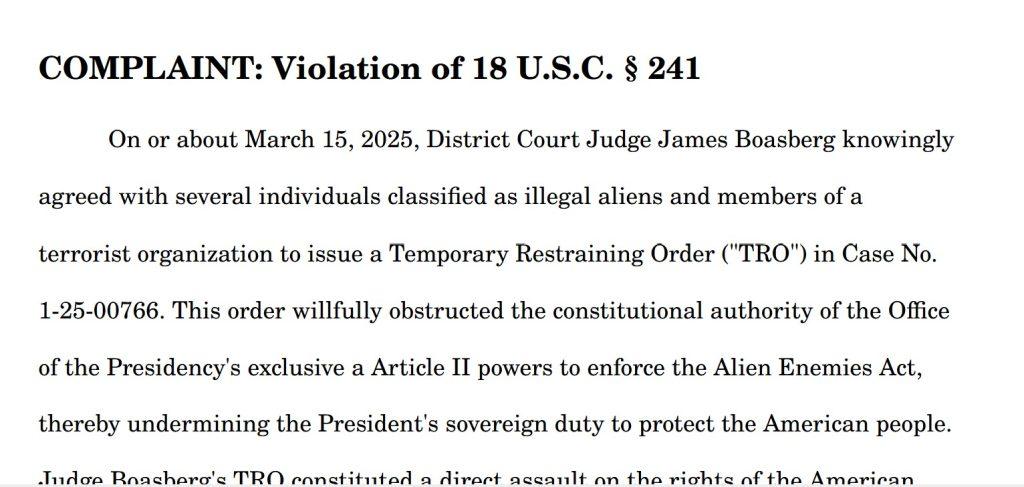
“On or about March 15, 2025,” the first complaint on the new website states, “District Court Judge James Boasberg knowingly agreed with several individuals classified as illegal aliens and members of a terrorist organization to issue a Temporary Restraining Order (“TRO”) in Case No. 1-25-00766. This order willfully obstructed the constitutional authority of the Office of the Presidency’s exclusive a Article II powers to enforce the Alien Enemies Act, thereby undermining the President’s sovereign duty to protect the American people. Judge Boasberg’s TRO constituted a direct assault on the rights of the American public, exposing them to significant risks by shielding individuals deemed threats to national security and presenting a clear and present danger to public safety and welfare. Acting under the guise of judicial authority, Judge Boasberg exploited his position to overstep lawful boundaries in a manner that is both indefensible and dangerous.”
Documents associated with the case are available here, with more than a dozen other lawsuits filed on the same premise detailed here.
On March 15, Boasberg ordered several aircraft carrying expelled criminal illegal aliens to reverse course back to the United States, a directive the administration said it was unable to carry out.
Out of 261 individuals on board the planes, White House spokesperson Karoline Leavitt told reporters, 137 were considered deportable via the Alien Enemies Act.
On April 3, Boasberg raised the question as to whether the administration had defied his order, which was stated only verbally, to return the illegals to the United States.
Five days later, the U.S. Supreme Court ruled that the administration could continue to deport individuals under the Alien Enemies Act “with due process protections” and that Boasberg’s court was the wrong venue for the plaintiffs’ complaint to have been adjudicated given they were located in Texas.
The Alien Enemies Act, 50 USC, Chapter 3, was passed in July 1798 and consists of four brief sections:
21. Restraint, regulation, and removal.
22. Time allowed to settle affairs and depart.
23. Jurisdiction of United States courts and judges.
24. Duties of marshals.
Section 21 states:
Whenever there is a declared war between the United States and any foreign nation or government, or any invasion or predatory incursion is perpetrated, attempted, or threatened against the territory of the United States by any foreign nation or government, and the President makes public proclamation of the event, all natives, citizens, denizens, or subjects of the hostile nation or government, being of the age of fourteen years and upward, who shall be within the United States and not actually naturalized, shall be liable to be apprehended, restrained, secured, and removed as alien enemies. The President is authorized in any such event, by his proclamation thereof, or other public act, to direct the conduct to be observed on the part of the United States, toward the aliens who become so liable; the manner and degree of the restraint to which they shall be subject and in what cases, and upon what security their residence shall be permitted, and to provide for the removal of those who, not being permitted to reside within the United States, refuse or neglect to depart therefrom; and to establish any other regulations which are found necessary in the premises and for the public safety.
“The Alien Enemies Act explicitly grants the President supreme and exclusive
authority to remove enemy aliens who pose risks to national security,” the complaint continues. “By preventing the execution of lawful orders under this Act, Judge Boasberg’s TRO willfully shielded individuals classified as national security threats, allowing them to remain at large. This ruling represents an egregious violation of the President’s Article II
enforcement powers, trampling constitutional authority while jeopardizing the
safety and well-being of the American public.
Aliens originating in the country declared to be “hostile” but not accused of committing crimes were to be permitted to collect their personal belongings and depart the country within “such reasonable time as may be consistent with the public safety, and according to the dictates of humanity and national hospitality,” Section 22 states.
“§23. Jurisdiction of United States courts and judges” states judges have a “duty” to apprehend enemy aliens for adjudication.
After any such proclamation has been made, the several courts of the United States, having criminal jurisdiction, and the several justices and judges of the courts of the United States, are authorized and it shall be their upon complaint against any alien enemy resident and at large within such jurisdiction or district, to the danger of the public peace or safety, and contrary to the tenor or intent of such proclamation, or other regulations which the President may have established, to cause such alien to be duly apprehended and conveyed before such court, judge, or justice; and after a full examination and hearing on such complaint, and sufficient cause appearing, to order such alien to be removed out of the territory of the United States, or to give sureties for his good behavior, or to be otherwise restrained, conformably to the proclamation or regulations established as aforesaid, and to imprison, or otherwise secure such alien, until the order which may be so made shall be performed.
Section 24 of the statute outlines the responsibilities of marshals in carrying out the removal of alien enemies from the “territory of the United States” in accordance with “the warrant” from the president, “or of the court, judge, or justice ordering the same, as the case may be.”
As a result of the Supreme Court ruling, Boasberg canceled a scheduled hearing to decide whether to issue a preliminary injunction against the government’s deportations.
On April 16, Boasberg found “probable cause” for criminal contempt on the part of the Justice Department and scheduled a hearing on the issue. The administration filed an emergency appeal, and two days later Boasberg’s order was stayed by two members of a three-judge panel of the U.S. Court of Appeals for the District of Columbia Circuit.
Responsive to the ruling, Boasberg canceled the contempt hearing.
We asked our contact person additional questions as to how the project was conceived and by whom. “I conceived it,” he told us via email. “A criminal act may not be an official act in a free society. Two of us collaborated. Two legal professionals.”
“Who is funding the endeavor?” The Post & Email asked, in response to which he revealed, “All services have been donated pro bono for the American public.”
Being aware of Congress’s responsibility, as enumerated in Article I of the U.S. Constitution, “to constitute Tribunals inferior to the supreme Court” and alter their structure if deemed necessary, we asked if sending a similar complaint to Congress might be under consideration.
“Upon receiving complaints supported by affidavits,” our contact replied, “Attorney General Pam Bondi is obligated to notify Congress of the allegations, their nature, and the applicable penalties. Additionally, she must provide Congress with a copy of the complaints for consideration in impeachment proceedings.”
“By quoting the ABA’s Rules of Professional Conduct, which mentions ‘lawyers,’ we next asked, “are you specifically seeking attorneys to become signatories to the petition?”
“No,” the originator replied. “This is simply a reminder to Attorney General Pam Bondi of her obligations under the Rules of Professional Conduct. It’s important to note that we stand firmly behind AG Bondi and fully support her efforts to prosecute these corrupt officials for their egregious actions, which align with the allegations brought against them.”
“At the outset and in the signature section, it states the complaint is against ‘a number of judges’ in addition to Boasberg,” our next question began. “Are the names of those other judges available, or should they be?”
His response was:
As we investigate their conduct, including that of Bates and Merchan, we will ensure that all relevant information is made available. If their actions fail to meet every element of a criminal offense, no allegations will be pursued. You raise a valid point—the current language may inadvertently suggest there is a multitude of judges involved. We will address this issue promptly to avoid any confusion. Thank you for bringing this to our attention.
“How many signatures are you hoping to obtain, and how long is the petition open?” we asked.
“The goal is to gather as many signatures as possible, but at a minimum, more than the count of a federal grand jury,” he replied. “Our hope is that those who have been idle—merely complaining—will step up, take action, and pursue legal measures against rogue, corrupt officials to remove them from office and safeguard the American people. As the saying goes, the only thing necessary for evil to triumph is for good men to do nothing. At this moment, we are awaiting word from Bondi’s office on a secure email through which we can submit the complaints. The process will be encrypted end to end.”
“Once the signed petitions are sent to AG Bondi, how long will you wait for a response?” we asked.
“Boasberg’s actions speak for themselves, clearly revealing his intentions, personal biases, and beliefs,” was the response. “Prosecuting his case should be relatively straightforward, and I would be surprised if we don’t receive a response within two weeks of submission. The Constitution is explicit on this matter—when all elements of a crime are met, a complaint has been filed with supporting evidence satisfying each element, and it is affirmed under oath, warrants shall be issued. This is not a matter of discretion; it is a constitutional obligation.”
Comments
One response to “Criminal Complaints Prepared against Federal Judge Ordering Halt, Reversal of Deportations”
I have posted the Petition publically and sent out to a list of contacts and friends.