

by Sharon Rondeau

(Apr. 24, 2025) — On April 17, the U.S. Supreme Court announced its scheduling of oral argument for May 15 to resolve legal challenges to President Donald Trump‘s January 20, 2025 executive order rescinding the practice of awarding citizenship to virtually anyone born within the United States.
Numerous cases filed just after the executive order was issued resulted in three temporary “nationwide” injunctions from federal courts in the Western District of Washington, the District of Massachusetts and District of Maryland.
The Trump administration has appealed each injunction to the high court, which, rather than acting on the appeals individually, scheduled a one-hour hearing for May 15 at 10:00 a.m.
The Cases
Washington
The Washington lawsuit involves four state plaintiffs — Illinois, Arizona, Washington and Oregon — claiming the executive order violates the 14th Amendment and Immigration and Nationality Act (INA). Terming it the “Citizenship Stripping Order,” the states filed an emergency motion for a temporary restraining order (TRO) to preclude its implementation.
“The individuals who are stripped of their United States citizenship will be rendered undocumented, subject to removal or detention, and many will be stateless—that is, citizens of no country at all. They will lose eligibility for myriad federal benefits programs,” the plaintiffs wrote in their complaint. “They will lose their right to travel freely and re-enter the United States. They will lose their ability to obtain a Social Security number (SSN) and work lawfully. They will lose their right to vote, serve on juries, and run for certain offices. And they will be placed into lifelong positions of instability and insecurity as part of a new underclass in the United States. In short, despite the Constitution’s guarantee of their citizenship, thousands of newborns and children will lose their ability to fully and fairly be a part of American society as a citizen with all its benefits and privileges.”
The complainants added that “The Plaintiff States will suffer immediate and irreparable harm by losing federal funding or reimbursements to programs that the Plaintiff States administer, such as Medicaid, the Children’s Health Insurance Program (CHIP), foster care and adoption assistance programs, and programs to facilitate streamlined issuance of SSNs to eligible babies—among others. By purporting to unilaterally strip citizenship from individuals born in the Plaintiff States based on their parents’ citizenship or immigration status, the Plaintiff States will be forced to bear significantly increased costs to operate and fund programs that ensure the health and well-being of their residents. The Plaintiff States will also be required—on no notice and at their considerable burden and expense—to immediately begin modifying their funding and operational structures and administration of programs to account for this change. This will impose significant administrative and operational burdens for multiple of the Plaintiff States’ agencies that operate programs for the benefit of their residents.”
On page 9, the plaintiffs cited the “Citizenship Clause” of the 14th Amendment: “All persons born or naturalized in the United States, and subject to the jurisdiction thereof, are citizens of the United States and of the State wherein they reside.”
Referencing the 1898 U.S. Supreme Court case of United States v. Wong Kim Ark, the complaint states, “There, the Supreme Court held that a child born in the United States to non-citizen parents was entitled to automatic citizenship by birth under the Fourteenth Amendment. In so holding, the Court explained:
The fourteenth amendment affirms the ancient and fundamental rule of citizenship by birth within the territory, in the allegiance and under the protection of the country, including all children here born of resident aliens, with the exceptions or qualifications (as old as the rule itself) of children of foreign sovereigns or their ministers, or born on foreign public ships, or of enemies within and during a hostile occupation of part of our territory, and with the single additional exception of children of members of the Indian tribes owing direct allegiance to their several tribes. The amendment, in clear words and in manifest intent, includes the children born within the territory of the United States of all other persons, of whatever race or color. . . . To hold that the fourteenth amendment of the constitution excludes from citizenship the children born in the United States of citizens or subjects of other countries, would be to deny citizenship to thousands of persons of English, Scotch, Irish, German, or other European parentage, who have always been considered and treated as citizens of the United States.”
An additional citation was to the relatively recent case of Plyler v. Doe in which the Supreme Court held:
A Texas statute which withholds from local school districts any state funds for the education of children who were not “legally admitted” into the United States, and which authorizes local school districts to deny enrollment to such children, violates the Equal Protection Clause of the Fourteenth Amendment.
“The Court has jurisdiction over Defendants and the subject matter of this action,” Judge John C. Coughenour, a Reagan appointee, stated on page 2 of his four-page order granting the plaintiffs’ motion for a TRO.
“There is a strong likelihood that Plaintiffs will succeed on the merits of their claims that the Executive Order violates the Fourteenth Amendment and Immigration and Nationality Act,” he wrote on page 3, referencing Ark.
In a second suit originating in Washington State, three pregnant women sued over the executive order; on January 27, Coughenour merged their case with that of the four states.
“The three women involved in the case worry their children could be born stateless, with citizenship not recognized here or in their parents’ countries of origin,” Washington State Standard reported January 27. “They hoped to represent families in similar situations through a class action lawsuit.”
One of the women later withdrew from the case.
The administration’s appeal of Coughenour’s ruling to the Ninth Circuit Court of Appeals was unsuccessful, hence its March 13 application for a partial stay to the U.S. Supreme Court.
Massachusetts
The Massachusetts case was filed by 18 states, the city of San Francisco and the District of Columbia. “Plaintiffs bring this action to protect their states, localities, and residents from the President’s flagrantly unlawful attempt to strip hundreds of thousands American-born children of their citizenship based on their parentage,” the lawsuit begins. “The principle of birthright citizenship has been enshrined in the Constitution for more than 150 years. The Citizenship Clause of the Fourteenth Amendment unambiguously and expressly confers citizenship on ‘[a]ll persons born’ in and ‘subject to the jurisdiction’ of the United States. More than 125 years ago, the Supreme Court confirmed that this entitles a child born in the United States to noncitizen parents to automatic citizenship. See United States v. Wong Kim Ark, 169 U.S. 649 (1898). Congress subsequently codified that understanding in the Immigration and Nationality Act (8 U.S.C. § 1401). And the Executive Branch has long recognized that any attempt to deny citizenship to children based on their parents’ citizenship or immigration status would be ‘unquestionably unconstitutional.’”
U.S. District Court Judge Leo T. Sorokin granted the plaintiffs’ motions for preliminary injunctions. The administration’s appeal to the First Circuit Court of Appeals for a stay was denied, after which an Application for Stay was filed with the U.S. Supreme Court by Acting Solicitor General Sarah M. Harris.
Maryland
A suit filed by five expectant women represented by CASA, Inc. of Maryland and Asylum Seeker Advocacy Project, Inc. of New York, claimed on page 4, “The 14th Amendment’s language is clear. Over a century ago, the U.S. Supreme Court confirmed that the Fourteenth Amendment’s Citizenship Clause means that people born in the United States are U.S. citizens at birth without regard to their immigration status, except for children born to foreign diplomats, on foreign ships, to occupying armies, or to Indian tribes.1 See United States v. Wong Kim Ark, 169 U.S. 649, 693 (1898). The Court has adhered to that understanding time and again in the ensuing decades.”
On February 5, U.S. District Judge for the District of Maryland Deborah A. Boardman, a Biden appointee, issued a preliminary injunction to the executive order, claiming the 14th Amendment “expressly guarantees” automatic citizenship to children born on U.S. soil, regardless of the parents’ status.
“Unlike the fourteen-day temporary restraining order issued on January 23, 2025, by Judge John Coughenour of the U.S. District Court for the Western District of Washington, today’s preliminary injunction will remain in effect until the lawsuit is resolved or the injunction is overturned by a higher court,” Ogletree Deakins reported on February 5.
On February 12, the administration said it would appeal the preliminary injunction to the Fourth Circuit Court of Appeals. On February 28, the appellate court panel, in a 2-1 decision, denied the Trump administration’s request for a partial stay, which was then petitioned to the high court.
The Executive Order
Relying heavily on the text of the 14th Amendment, the executive order, titled, “PROTECTING THE MEANING AND VALUE OF AMERICAN CITIZENSHIP,” reads, in substantial part:
Section 1. Purpose. The privilege of United States citizenship is a priceless and profound gift. The Fourteenth Amendment states: “All persons born or naturalized in the United States, and subject to the jurisdiction thereof, are citizens of the United States and of the State wherein they reside.” That provision rightly repudiated the Supreme Court of the United States’s shameful decision in Dred Scott v. Sandford, 60 U.S. (19 How.) 393 (1857), which misinterpreted the Constitution as permanently excluding people of African descent from eligibility for United States citizenship solely based on their race.
But the Fourteenth Amendment has never been interpreted to extend citizenship universally to everyone born within the United States. The Fourteenth Amendment has always excluded from birthright citizenship persons who were born in the United States but not “subject to the jurisdiction thereof.” Consistent with this understanding, the Congress has further specified through legislation that “a person born in the United States, and subject to the jurisdiction thereof” is a national and citizen of the United States at birth, 8 U.S.C. 1401, generally mirroring the Fourteenth Amendment’s text.
Among the categories of individuals born in the United States and not subject to the jurisdiction thereof, the privilege of United States citizenship does not automatically extend to persons born in the United States: (1) when that person’s mother was unlawfully present in the United States and the father was not a United States citizen or lawful permanent resident at the time of said person’s birth, or (2) when that person’s mother’s presence in the United States at the time of said person’s birth was lawful but temporary (such as, but not limited to, visiting the United States under the auspices of the Visa Waiver Program or visiting on a student, work, or tourist visa) and the father was not a United States citizen or lawful permanent resident at the time of said person’s birth.
Sec. 2. Policy. (a) It is the policy of the United States that no department or agency of the United States government shall issue documents recognizing United States citizenship, or accept documents issued by State, local, or other governments or authorities purporting to recognize United States citizenship, to persons: (1) when that person’s mother was unlawfully present in the United States and the person’s father was not a United States citizen or lawful permanent resident at the time of said person’s birth, or (2) when that person’s mother’s presence in the United States was lawful but temporary, and the person’s father was not a United States citizen or lawful permanent resident at the time of said person’s birth.
(b) Subsection (a) of this section shall apply only to persons who are born within the United States after 30 days from the date of this order.
(c) Nothing in this order shall be construed to affect the entitlement of other individuals, including children of lawful permanent residents, to obtain documentation of their United States citizenship.
In response to a question from a reporter regarding potential legal challenges to the order, President Trump said, “We think we have good grounds…It’s ridiculous; we’re the only country in the world that does this with birthright, and it’s just absolutely ridiculous, but we’ll see. We think we have very good grounds.”
Who Was Wong Kim Ark?
Wong Kim Ark was born in San Francisco in 1873 to Chinese parents who were legally domiciled in the U.S. while engaged in business until 1890, when they returned to China permanently.
In 1894, on his second round-trip trip, Ark departed the U.S. for China to visit his parents, wife and young child. Upon his return, the district United States attorney barred him from entry on the grounds that he was not a citizen and none of the existing exceptions to Chinese persons who wished to enter the U.S. were applicable.
Ark filed suit in the U.S. District Court for the Northern District of California, obtaining a favorable ruling. The federal government appealed to the U.S. Supreme Court, which, in a 6-2 decision, upheld the lower court’s ruling that Ark was a U.S. citizen, notwithstanding his parents’ Chinese citizenship at the time of his birth.
Background
On November 17, 1880, the Angell Treaty between the U.S. and China was signed at Peking by “Minister to China” James B. Angell, two other American envoys and two Chinese officials. It was ratified in the United States the following July and declared “law” on October 5, 1881.
The agreement significantly reduced the number of Chinese immigrants permitted to enter the U.S. by the Burlingame Treaty of 1868.
Accordingly, and in keeping with public sentiment, in 1882 Congress passed the Chinese Exclusion Act. Signed into law by President Chester A. Arthur, the statute placed an absolute ban on Chinese laborers entering the U.S. for a ten-year period. It also denied citizenship to persons born in China already present in the United States.
Further, any ship’s captain who “knowingly” violated the law by attempting to debark Chinese laborers would be charged with a misdemeanor “and on conviction thereof shall be punished by a fine of not more than five hundred dollars for each and every such Chinese laborer so brought, and maybe also imprisoned for a term not exceeding one year.”
Sections 4 and 5 of the Act set forth recordkeeping and identification procedures for Chinese laborers present in the country prior to or within 90 days of the signing of the Angell Treaty in the event of departure from and potential re-entry to the United States:
SEC. 4. That for the purpose of properly identifying Chinese laborers who were in the United States on the seventeenth day of November eighteen hundred and eighty, or who shall have come into the same before the expiration of ninety days next after the passage of this act, and in order to furnish them with the proper evidence of their right to go from and come to the United States of their free will and accord, as provided by the treaty between the United States and China dated November seventeenth, eighteen hundred and eighty, the collector of customs of the district from which any such Chinese laborer shall depart from the United States shall, in person or by deputy, go on board each vessel having on board any such Chinese laborers and cleared or about to sail from his district for a foreign port, and on such vessel make a list of all such Chinese laborers, which shall be entered in registry-books to be kept for that purpose, in which shall be stated the name, age, occupation, last place of residence, physical marks of peculiarities, and all facts necessary for the identification of each of such Chinese laborers, which books shall be safely kept in the custom-house.; and every such Chinese laborer so departing from the United States shall be entitled to, and shall receive, free of any charge or cost upon application therefor, from the collector or his deputy, at the time such list is taken, a certificate, signed by the collector or his deputy and attested by his seal of office, in such form as the Secretary of the Treasury shall prescribe, which certificate shall contain a statement of the name, age, occupation, last place of residence, persona description, and facts of identification of the Chinese laborer to whom the certificate is issued, corresponding with the said list and registry in all particulars. In case any Chinese laborer after having received such certificate shall leave such vessel before her departure he shall deliver his certificate to the master of the vessel, and if such Chinese laborer shall fail to return to such vessel before her departure from port the certificate shall be delivered by the master to the collector of customs for cancellation. The certificate herein provided for shall entitle the Chinese laborer to whom the same is issued to return to and re-enter the United States upon producing and delivering the same to the collector of customs of the district at which such Chinese laborer shall seek to re-enter; and upon delivery of such certificate by such Chinese laborer to the collector of customs at the time of re-entry in the United States said collector shall cause the same to be filed in the custom-house anti duly canceled.
SEC. 5. That any Chinese laborer mentioned in section four of this act being in the United States, and desiring to depart from the United States by land, shall have the right to demand and receive, free of charge or cost, a certificate of identification similar to that provided for in section four of this act to be issued to such Chinese laborers as may desire to leave the United States by water; and it is hereby made the duty of the collector of customs of the district next adjoining the foreign country to which said Chinese laborer desires to go to issue such certificate, free of charge or cost, upon application by such Chinese laborer, and to enter the same upon registry-books to be kept by him for the purpose, as provided for in section four of this act.
Why “Chinese Exclusion”?
The Library of Congress explains:
While Chinese immigration to the U.S. began with the California Gold Rush of 1849, the population of Chinese immigrants in the country increased in the following years due to the “open door” provisions of the 1868 Burlingame-Seward Treaty (Peace, Amity, and Commerce, Ta-Tsing Empire (China)-U.S, July 24, 1868. 48 U.S.T. 608). This treaty granted citizens of both the U.S. and China the rights to unrestricted travel and immigration. In 1860 there were 35,565 Chinese immigrants in the U.S., and by 1880 that number had increased to 105,613. Many of these immigrants were men who intended to return home to their families after earning some money in the U.S., where wages were higher than in China.
Thus, many Chinese immigrants were contracted laborers who worked in West Coast industries like mining, agriculture, and railroad construction. Because they could be paid significantly less than white laborers, they were often favored when companies looked to cut costs or replace workers on strike. This practice led to a widespread sentiment that Chinese laborers were stealing jobs from white laborers. Moreover, white Americans saw Chinese immigrants as unsuitable for assimilation.
According to the National Archives:
The Chinese Exclusion Act required the few non-laborers who sought entry to the United States (such as diplomatic officers) to obtain certification from the Chinese government that they were qualified to immigrate. But this group found it increasingly difficult to prove their status because the 1882 act defined laborers as “skilled and unskilled…and Chinese employed in mining.” Thus very few Chinese could enter the country under the 1882 law.
The 1882 exclusion act also placed new requirements on Chinese who had already entered the country. If they left the United States, they had to obtain certifications to re-enter. Congress, moreover, refused state and federal courts the right to grant citizenship to Chinese resident aliens, although these courts could still deport them.
When the exclusion act expired in 1892, Congress extended it for 10 years in the form of the Geary Act. This extension, made permanent in 1902, added restrictions by requiring each Chinese resident to register and obtain a certificate of residence. Without a certificate, they faced deportation.
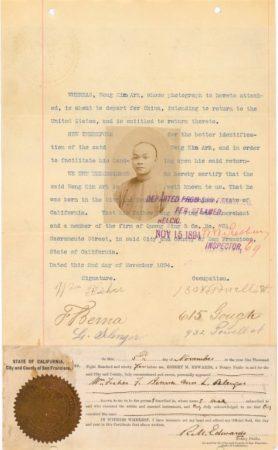
When Ark departed the U.S. in 1894, he carried a document stating he was “intending to return to the United States, and is entitled to return thereto.” It was signed by three individuals who averred Ark was “well known to us” and that his birthplace was “in the City and County of San Francisco, State of California.”

Sidebar: Were Arthur and his Nominees Legitimate?
Some have credibly raised the question as to whether Chester Arthur was a “natural born Citizen” as required by Article II, Section 1, clause 5 of the Constitution for the presidency. The same has applied to the vice-presidency since the 1804 ratification of the 12th Amendment.
According to one source, Arthur was unquestionably ineligible to serve in either post.
As vice president under President James Garfield, Arthur was sworn in to the presidency when Garfield succumbed to an infection approximately ten weeks after being shot by an assassin.
Arthur completed Garfield’s term without a vice president.
On January 17, 2017, Canada’s History reported:
Chester Arthur was most likely a citizen of Lower Canada, a British subject, born in Dunham Flats, Quebec, near the Vermont border. His father, William, was born in 1796 in Ballymena, County Antrim, in what is now Northern Ireland, where the MacArthurs, as they were originally called, immigrated from Scotland. Arthur’s grandfather, Gavin MacArthur, changed the family name to Arthur to set himself and his heirs apart from the Catholic MacArthurs. Chester Arthur’s father was named after the Protestant King William of Orange.
In 1818, at age twenty-two, William Arthur left Ireland forever and sailed from Derry to Trois-Rivieres, Quebec, in search of a better life. From Trois-Rivieres he moved to Upper Mills (now known as Stanbridge), and then to Dunham Flats, where he obtained a teaching position.
There is no record that Arthur’s father ever attempted to become a United States citizen, even though his dual jobs as a teacher and itinerant preacher took him back and forth across the border from Quebec to Vermont and New York. Arthur’s mother, Malvina Stone, a descendant of English settlers in New Hampshire, was a British subject living in Dunham Flats…
A son—likely William Chester Alan Arthur—was born in his grandparents’ house in Dunham Flats in Lower Canada in 1829, though there is no record of his birth in present-day Dunham, Quebec. (Records of the period were destroyed in a fire.)
The next year a second son—likely Chester Abell Arthur—was born in North Fairfield, Vermont, but he died in infancy. Again, no official record exists of the death, though relatives later attested the child’s body was sold to a medical school as a cadaver for dissection.
In my search for evidence regarding Arthur’s birth, the office of the secretary of state in Vermont’s capital, Montpelier, responded: “There is no record in this office showing the births and deaths of the children of William Arthur and Malvina Arthur from Jan. 1, 1822, to Jan. 1, 1841.” Similarly, the town clerk in Fairfield wrote: “[I] do not find recorded, therein, between the years A.D. 1825 and A.D. 1835, the birth of any child named Chester A. Arthur.”
The SCOTUS Opinion
According to the syllabus of the case published at the Legal Information Institute (LII), the facts agreed upon by Ark and the federal government were presented to the Court in March 1897 by attorneys Thomas D. Riordan, Maxwell Evarts, and J. Hubley Ashton as follows:
That the said Wong Kim Ark was born in the year 1873, at No. 751 Sacramento street, in the city and county of San Francisco, state of California, United States of America, and that his mother and father were persons of Chinese descent, and subjects of the emperor of China, and that said Wong Kim Ark was and is a laborer.
That at the time of his said birth his mother and father were domiciled residents of the United States, and had established and enjoyed a permanent domicile and residence therein, at said city and county of San Francisco, state aforesaid.
That said mother and father of said Wong Kim Ark continued to reside and remain in the United States until the year 1890, when they departed for China.
That during all the time of their said residence in the United States, as domiciled residents therein, the said mother and father of said Wong Kim Ark were engaged in the prosecution of business, and were never engaged in any diplomatic or official capacity under the emperor of China.
That ever since the birth of said Wong Kim Ark, at the time and place hereinbefore stated and stipulated, he has had but one residence, to wit, a residence in said state of California, in the United States of America, and that he has never changed or lost said residence or gained or acquired another residence, and there resided claiming to be a citizen of the United States.
That in the year 1890 the said Wong Kim Ark departed for China, upon a temporary visit, and with the intention of returning to the United States, and did return thereto on July 26, 1890, on the steampship Gaelic, and was permitted to enter the United States by the collector of customs, upon the sole ground that he was a native-born citizen of the United States.
That, after his said return, the said Wong Kim Ark remained in the United States, claiming to be a citizen thereof, until the year 1894, when he again departed for China upon a temporary visit, and with the intention of returning to the United States, and did return thereto in the month of August, 1895, and applied to the collector of customs to be permitted to land; and that such application was denied upon the sole ground that said Wong Kim Ark was not a citizen of the United States.
That said Wong Kim Ark has not, either by himself or his parents acting for him, ever renounced his allegiance to the United States, and that he has never done or committed any act or thing to exclude him therefrom.
Arguing against the writ of habeas corpus granted by the U.S. District Court for the Northern District of California, U.S. Solicitor General Holmes Conrad argued in a written statement that Ark “is not, under the laws of the state of California and of the United States, a citizen thereof, the mother and father of the said Wong Kim Ark being Chinese persons, and subjects of the emperor of China, and the said Wong Kim Ark being also a Chinese person, and a subject of the emperor of China.”
That, as he is informed and believes, the said person in whose behalf said application was made is not entitled to land in the United States, or to be or remain therein, as is alleged in said application, or otherwise.
Because the said Wong Kim Ark, although born in the city and county of San Francisco, state of California, United States of America, is not, under the laws of the state of California and of the United States, a citizen thereof, the mother and father of the said Wong Kim Ark being Chinese persons, and subjects of the emperor of China, and the said Wong Kim Ark being also a Chinese person, and a subject of the emperor of China.
Because the said Wong Kim Ark has been at all times, by reason of his race, language, color, and dress, a Chinese person, and now is, and for some time last past has been, a laborer by occupation.
That the said Wong Kim Ark is not entitled to land in the United States, or to be or remain therein, because he does not belong to any of the privileged classes enumerated in any of the acts of congress, known as the ‘Chinese Exclusion Acts,’1 which would exempt him from the class or classes which are especially excluded from the United States by the provisions of the said acts.
Wherefore the said United States attorney asks that a judgment and order of this honorable court be made and entered in accordance with the allegations herein contained, and that the said Wong Kim Ark be detained on board of said vessel until released as provided by law, or otherwise to be returned to the country from whence he came, and that such further order be made as to the court may seem proper and legal in the premises.
Writing the majority opinion a year later, U.S. Supreme Court Associate Justice Horace Gray, a Chester Arthur nominee, cited the Constitution, including the Article II presidential eligibility clause; the 14th and 15th amendments; British; U.S. and “common” law:
The question presented by the record is whether a child born in the United States, of parents of Chinese descent, who, at the time of his birth are subjects of the Emperor of China, but have a permanent domicil and residence in the United States, and are there carrying on business, and are not employed in any diplomatic or official capacity under the Emperor of China, becomes at the time of his birth a citizen of the United States, by virtue of the first clause of the fourteenth amendment of the constitution: ‘All persons born or naturalized in the United States, and subject to the jurisdiction thereof, are citizens of the United States and of the State wherein they reside.’
…In Dred Scott v. Sandford (1857) 19 How. 393, Mr. Justice Curtis said: ‘The first section of the second article of the constitution uses the language, ‘a natural-born citizen.’ It thus assumes that citizenship may be acquired by birth. Undoubtedly, this language of the constitution was used in reference to that principle of public law, well understood in this country at the time of the adoption of the constitution, which referred citizenship to the place of birth.’ Id. 576. And to this extent no different opinion was expressed or intimated by any of the other judges.
…The supreme judicial court of Massachusetts, speaking by Mr. Justice (afterwards Chief Justice) Sewall, early held that the determination of the question whether a man was a citizen or an alien was ‘to be governed altogether by the principles of the common law,’ and that it was established, with few exceptions, ‘that a man, born within the jurisdiction of the common law, is a citizen of the country wherein he is born. By this circumstance of his birth, he is subjected to the duty of allegiance which is claimed and enforced by the sovereign of his native land and becomes reciprocally entitled to the protection of that sovereign, and to the other rights and advantages which are included in the term ‘citizenship.” Gardner v. Ward (1805) 2 Mass. 244, note. And again: ‘The doctrine of the common law is that every man born within its jurisdiction is a subject of the sovereign of the country where he is born; and allegiance is not personal to the sovereign in the extent that has been contended for; it is due to him in his political capacity of sovereign of the territory where the person owing the allegiance was born.’
…That all children, born within the dominion of the United States, of foreign parents holding no diplomatic office, became citizens at the time of their birth, does not appear to have been contested or doubted until more than 50 years after the adoption of the constitution, when the matter was elaborately argued in the court of chancery of New York, and decided upon full consideration by Vice Chancellor Sandford in favor of their citizenship. Lynch v. Clarke (1844) 1 Sandf. Ch. 583.
…In the act of 1790, the provision as to foreign-born children of American citizens was as follows: ‘The children of citizens of the United States, that may be born beyond sea, or out of the limits of the United States, shall be considered as natural-born citizens: provided, that the right of citizenship shall not descend to persons whose fathers have never been resident in the United States.’ 1 Stat. 104. In 1795, this was re-enacted, in the same words, except in substituting, for the words ‘beyond sea, or out of the limits of the United States,’ the words, ‘out of the limits and jurisdiction of the United States.’ Id. 415.
…To hold that the fourteenth amn dment [sic] of the constitution excludes from citizenship the children, born in the United States, of citizens or subjects of other countries would be to deny citizenship to thousands of persons of English, Scotch, Irish, German, or other European parentage who have always been considered and treated as citizens of the United States.
VI. Whatever considerations, in the absence of a controlling provision of the Constitution, might influence the legislative or the executive branch of the Government to decline to admit persons of the Chinese race to the status of citizens of the United States, there are none that can constrain or permit the judiciary to refuse to give full effect to the peremptory and explicit language of the fourteenth amendment, which declares and ordains that ‘all persons born or naturalized in the United States, and subject to the jurisdiction thereof, are citizens of the United States.’
“In the Same Words?”
In January 2021, legal scholar Joseph DeMaio, who has researched and written extensively about the U.S. Constitution’s “natural born Citizen” requirement, demonstrated Gray’s Wong Kim Ark opinion contained “misinformation” and potentially, “disinformation”:
The author of the WKA majority opinion, Justice Horace Gray (appointed to the Court by the Nation’s First Usurper-in-Chief, Republican Chester A. Arthur) – intentionally or not – fundamentally misstated the history of two of the first enactments of the Congress in reaching his ultimate conclusion that Wong Kim Ark was a “citizen” under the 14th Amendment. Here is why.
In 1790, Congress passed (and President Washington signed into law) 1 Stat. 103, entitled “An Act to Establish an Uniform Rule of Naturalization.” In that statute, Congress stated, among other things, that children born “beyond sea” to U.S. citizen parents were “considered” to be “natural born citizens.” However, only five years later, in 1795, that statute was repealed in its entirety.
Yet Justice Gray claimed in his opinion that Congress “reenacted, in the same words, the 1790 statute” (emphasis added), with alterations not germane to the question. For this demonstrable “disinformation” and/or “misinformation” transgression, under the tech tyrant censorship pogrom now in place, the WKA opinion – and all later cases, law review articles, Gray Trollop op-eds and professorial dissertations relying on it… should be memory-holed. Erased. Forgotten.
In 1795, a new statute – 1 Stat. 414, entitled “Chap. XX. An act to establish an uniform rule of Naturalization; and to repeal the act heretofore passed on that subject [i.e., 1 Stat. 103]” (emphasis added) – the Congress, apparently recognizing that it could not by a statute like 1 Stat. 103 alter or amend the intent of the Constitution’s presidential Eligibility Clause regarding the understood definition of “natural born Citizen” therein, deleted the words “natural born” before the word “citizens.”
That the Congress actually made the deletion – regardless of whether it was a conscious, intentional excision, as opposed to a “stylistic” or “accidental” omission – is beyond dispute: the words “natural-born” present in 1 Stat. 103 do not appear in 1 Stat. 414, contrary to Justice Gray’s assertion.
And yet, 103 years after 1 Stat. 414 became law – deleting the “natural-born” modifier of the word “citizens” that had previously existed – this is what Associate Supreme Court Justice Horace Gray said in the majority opinion he authored in WKA, 169 U.S. at 672-673:
“In the act of 1790, the provision as to foreign-born children of American citizens was as follows: ‘The children of citizens of the United States, that may be born beyond sea, or out of the limits of the United States, shall be considered as natural-born citizens: provided, that the right of citizenship shall not descend to persons whose fathers have never been resident in the United States.’ 1 Stat. 103 [at 104]. In 1795, this was re-enacted, in the same words, except in substituting, for the words ‘beyond sea, or out of the limits of the United States,’ the words, ‘out of the limits and jurisdiction of the United States.’ Id. 415.” (Emphasis added).
Respectfully, no, Justice Gray – and all others relying on the WKA decision to support the argument that anyone born here is both a “citizen” and a “natural born Citizen” for eligibility purposes – the Congress did not use “the same words” when it enacted 1 Stat. 414. Instead, it deleted the critical words “natural born” which had previously preceded “citizens” and corrected itself to articulate that children born to U.S. citizen parents “out of the limits and jurisdiction of the United States” were nonetheless considered to be U.S. citizens. In fact, contrary to Justice Gray’s assertion, the Congress deleted “natural born” in 1795 and has never since that time re-enacted the modifier found in 1 Stat. 103 to describe a child born to U.S. citizen parents beyond the boundaries of the United States as anything other than a “citizen.”

Coincidentally, on Wednesday DeMaio published a new article on the subject, again pointing out that Gray’s opinion misled the reader by stating the 1795 Naturalization Law was written “in the same words” as its 1790 predecessor in regard to the applicability of the term “natural born Citizen” when, “In fact, 1 Stat. 103 was instead repealed in toto, with 1 Stat. 414 replacing it. Stated otherwise, the ‘considered as natural born citizens’ verbiage was not reenacted ‘in the same words’ in 1 Stat. 414, but was instead altogether repealed, never again to be found in a federal immigration or naturalization statute.”
The DOJ Appeals to SCOTUS
For the definition of the Article II term “natural born Citizen,” DeMaio and other legal scholars, including the late Atty. Mario Apuzzo, have turned to Swiss jurist, philosopher and author Emerich de Vattel (1714-1767) whose seminal work, The Law of Nations, the American Framers were said to have often consulted as they formed the new nation.
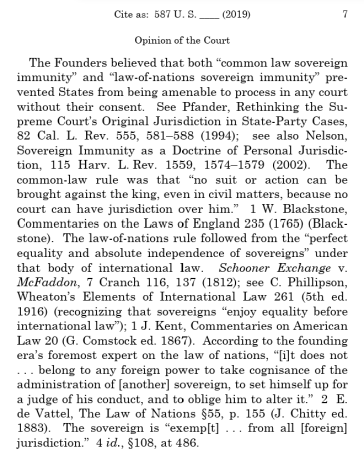
The assertion was confirmed by the U.S. Supreme Court as recently as 2019, as DeMaio pointed out, in which Associate Justice Clarence Thomas wrote for the majority 5-4 decision in Franchise Tax Board of California v. Hyatt:
“According to the founding era’s foremost expert on the law of nations, “[i]t does not … belong to any foreign power to take cognizance of the administration of [another] sovereign, to set himself up for a judge of his conduct, and to oblige him to alter it.” 2 E. de Vattel, The Law of Nations § 55, p. 155 (J. Chitty ed. 1883). The sovereign is “exemp[t] … from all [foreign] jurisdiction.” 4 id., § 108, at 486…” (DeMaio’s emphasis removed)
One of two books reportedly not returned when it was due by then-President George Washington was Vattel’s The Law of Nations, the New York Society Library reported in 2010.
In a contemporaneous press release between the Library and Washington’s estate, Mt. Vernon, in response to the question, “Why was George Washington interested in these two books?” a representative of Mt. Vernon wrote, “It appears to me that Washington might have been interested in the two books, because of background or insights they might give to the diplomatic problems faced by the new American government.”
In the administration’s Application for Partial Stay to all three injunctions, then-Acting Solicitor General Sarah Harris wrote that the executive order “is part of the Administration’s broader effort to repair the Nation’s immigration system, resolve the border crisis, and address the ‘significant threats to national security and public safety’ posed by illegal immigration.”
“Subject to the Jurisdiction Thereof”
Harris summarized Trump’s executive order, asserting that “The Order reflects that the Citizenship Clause does not extend citizenship universally to everyone born in the United States. Rather, the Clause expressly excludes from birthright citizenship persons who are born in the United States but who are not ‘subject to the jurisdiction thereof,’” citing the “Citizenship Clause” of the 14th Amendment.
Section 1 of the Order recognizes that the Constitution and the Immigration and Nationality Act (INA), 8 U.S.C. 1101 et seq., confer citizenship upon all persons born in the United States and subject to the jurisdiction thereof. See Citizenship Order § 1. Specifically, the Fourteenth Amendment to the U.S. Constitution provides that “[a]ll persons born or naturalized in the United States, and subject to the jurisdiction thereof, are citizens of the United States and of the State wherein they reside.” U.S. Const. Amend. XIV, § 1. That provision, known as the Citizenship Clause, repudiated Dred Scott v. Sandford, 19 How. 393 (1857), which infamously misinterpreted the Constitution to deny U.S. citizenship to people of African descent based solely on their race. Congress has reaffirmed the Citizenship Clause in the INA, which provides that “a person born in the United States, and subject to the jurisdiction thereof,” is a citizen of the United States. 8 U.S.C. 1401(a).
Section 1 of the Order identifies two circumstances in which a person born in the United States is not subject to its jurisdiction: “(1) when that person’s mother was unlawfully present in the United States and the father was not a United States citizen or lawful permanent resident at the time of said person’s birth, or (2) when that person’s mother’s presence in the United States at the time of said person’s birth was lawful but temporary (such as, but not limited to, visiting the United States under the auspices of the Visa Waiver Program or visiting on a student, work, or tourist visa) and the father was not a United States citizen or lawful permanent resident at the time of said person’s birth.” Citizenship Order § 1.
Section 2 of the Order directs the Executive Branch (1) not to issue documents recognizing U.S. citizenship to the persons identified in Section 1 and (2) not to accept documents issued by state, local, or other governments purporting to recognize the U.S. citizenship of such persons. See Citizenship Order § 2(a). Section 2 specifies that those directives “apply only to persons who are born within the United States after 30 days from the date of this order,” i.e., after February 19. Id. § 2(b). Section 2 also makes clear that the Order does not “affect the entitlement of other individuals, including children of lawful permanent residents, to obtain documentation of their United States citizenship.” Citizenship Order § 2(c).
Section 3 of the Order directs the Secretary of State, Attorney General, Secretary of Homeland Security, and Commissioner of Social Security to take “all appropriate measures to ensure that the regulations and policies of their respective departments and agencies are consistent with this order.” Citizenship Order § 3(a). It also directs the “heads of all executive agencies and departments” to “issue public guidance” within 30 days (i.e., by February 19) “regarding th[e] order’s implementation with respect to their operations and activities.” Id. § 3(b).
2. The Order reflects that the Citizenship Clause does not extend citizenship universally to everyone born in the United States. Rather, the Clause expressly excludes from birthright citizenship persons who are born in the United States but who are not “subject to the jurisdiction thereof.” U.S. Const. Amend. XIV, § 1. The original public meaning of the term “jurisdiction” refers “political jurisdiction” (which turns on whether a person owes allegiance to, and is entitled to protection from, the United States), not regulatory jurisdiction (which turns on whether a person must follow U.S. law). Elk v. Wilkins, 112 U.S. 94, 102 (1884). A person born in the United States is subject to its political jurisdiction only if, under background legal principles as understood at the time of ratification, he owes primary allegiance to the United States rather than to an “alien power.” Id. at 101-102; see Cong. Globe, 39th Cong., 1st Sess. 572 (1866) (statement of Sen. Trumbull) (“What do we mean by ‘subject to the jurisdiction of the United States?’ Not owing allegiance to anybody else. That is what it means.”).
Applying that test, this Court has identified multiple categories of people born in the United States who nonetheless lack a constitutional right to U.S. citizenship. Children of foreign diplomats, children of alien enemies, and children born on foreign public ships in U.S. waters fall in that category because they owe primary allegiance to foreign nations. See United States v. Wong Kim Ark, 169 U.S. 649, 693 (1898). The Court has also held that children of tribal Indians lack a constitutional right to citizenship because they owe “immediate allegiance to their several tribes.” Elk, 112 U.S. at 99; see Indian Citizenship Act of 1924, ch. 233, 43 Stat. 253 (statutory extension of U.S. citizenship to Indians born in the United States).
On page 7, Harris referred to Vattel as “the founding era’s leading expert on the law of nations” and his treatise of that name. Vattel, she contended, “wrote that citizenship by virtue of birth in a country extends to children of ‘citizens’ or of ‘perpetual inhabitants,’ but not to children of foreigners who lack ‘the right of perpetual residence.’”
A substantial body of historical evidence shows that the children of temporarily present aliens or of illegal aliens similarly are not subject to the political jurisdiction of the United States. Emerich de Vattel, the founding era’s leading expert on the law of nations, wrote that citizenship by virtue of birth in a country extends to children of “citizens” or of “perpetual inhabitants,” but not to children of foreigners who lack “the right of perpetual residence.” Emerich de Vattel, The Law of Nations §§ 212-213, at 101-102 (1797 ed.) (emphasis omitted). And Justice Story recognized a “reasonable qualification” to birthright citizenship for “the children of parents, who were in itinere in the country, or abiding there for temporary purposes, as for health, or occasional business.” Joseph Story, Commentaries on the Conflict of Laws § 48, at 48 (1834).
Members of Congress expressed a similar understanding during debates over the Fourteenth Amendment and the Civil Rights Act of 1866, ch. 31, 14 Stat. 27, which served as the Amendment’s “initial blueprint,” General Building Contractors Ass’n v. Pennsylvania, 458 U.S. 375, 389 (1982). For instance, Senator Lyman Trumbull explained in a letter to President Andrew Johnson that birthright citizenship would extend only to persons “born of parents domiciled in the United States.” Mark Shawhan, Comment, The Significance of Parental Domicile in Lyman Trumbull’s Conception of Citizenship, 119 Yale L.J. 1351, 1352-1353 (2010) (citation omitted). Another Senator observed that “persons may be born in the United States yet not be citizens,” giving the example of a person who is “born here of parents from abroad temporarily in this country.” Cong. Globe, 39th Cong., 1st Sess. 2769 (1866). And a Representative stated that, under “the general law relating to subjects and citizens recognized by all nations,” birthright citizenship did not extend to “children born on our soil to temporary sojourners.” Id. at 1117.
Post-ratification practice points in the same direction. The Secretary of State issued an opinion in 1885 concluding that a child “born of [foreign] subjects, temporarily in the United States,” had “no right of citizenship.” 2 A Digest of the International Law of the United States § 183, at 397-398 (Francis Wharton ed., 2d ed. 1887). A state supreme court determined that the jurisdictional element of the Citizenship Clause excludes “those born in this country of foreign parents who are temporarily traveling here.” Benny v. O’Brien, 32 A. 696, 698 (N.J. 1895). And legal scholars explained that “[t]he words ‘subject to the jurisdiction thereof ’ exclude the children of foreigners transiently within the United States.” Alexander Porter Morse, A Treatise on Citizenship 248 (1881) (citation omitted).
This Court in Wong Kim Ark then addressed, as the “question presented” in that case, “whether a child born in the United States, of parents of Chinese descent, who, at the time of his birth, are subjects of the Emperor of China, but have a permanent domicil and residence in the United States, * * * becomes at the time of his birth a citizen of the United States.” 169 U.S. at 653 (emphasis added). After analyzing that question, the Court concluded that “[t]he Fourteenth Amendment affirms the ancient and fundamental rule of citizenship by birth within the territory, in the allegiance and under the protection of the country, including all children here born of resident aliens.” Id. at 693 (emphasis added). The Court then summed up its holding as follows: “[A] child born in the United States, of parents of Chinese descent, who, at the time of his birth, are subjects of the Emperor of China, but have a permanent domicil and residence in the United States, * * * becomes at the time of his birth a citizen of the United States.” Id. at 705 (emphasis added).
This Court has since recognized that Wong Kim Ark addressed only the children of foreign parents who were “permanently domiciled in the United States.” Kwock Jan Fat v. White, 253 U.S. 454, 457 (1920); see Chin Bak Kan v. United States, 186 U.S. 193, 200 (1902). The Department of Justice, too, noted that Wong Kim Ark “goes no further” than addressing the children of foreigners “domiciled in the United States.” Spanish Treaty Claims Comm’n, U.S. Dep’t of Justice, Final Report of William Wallace Brown, Assistant Attorney-General 121 (1910). “[I]t has never been held,” the Department continued, “and it is very doubtful whether it will ever be held, that the mere act of birth of a child on American soil, to parents who are accidentally or temporarily in the United States, operates to invest such child with all the rights of American citizenship.” Id. at 124.
3. During the 20th century, however, the Executive Branch adopted the incorrect position that the Citizenship Clause extended birthright citizenship to almost everyone born in the United States—even children of illegal aliens or temporarily present aliens. See, e.g., Legislation Denying Citizenship at Birth to Certain Children Born in the United States, 19 Op. O.L.C. 340 (1995). That policy of near-universal birthright citizenship has created strong incentives for illegal immigration. It has led to “birth tourism,” the practice by which expecting mothers travel to the United States to give birth and secure U.S. citizenship for their children. See Minority Staff Report, Comm. on Homeland Sec. & Governmental Affairs, U.S. Senate, Birth Tourism in the United States (Dec. 21, 2022). And it has raised national-security concerns by extending U.S. citizenship to persons who lack meaningful ties to the country. See, e.g., Amy Swearer, Subject to the [Complete] Jurisdiction Thereof, 24 Tex. Rev. L. & Politics 135, 201 (2000) (discussing person who was born in Louisiana to temporarily present aliens from Saudi Arabia, who returned to Saudi Arabia as a toddler, and who joined the Taliban and waged war against the United States). Immediately upon taking office on January 20, 2025, President Trump accordingly issued the Citizenship Order and directed relevant agencies to start taking steps to change course.
On April 3, former Missouri Solicitor General, Rhodes Scholar and Assistant U.S. Attorney Dean John Sauer was confirmed by the U.S. Senate as solicitor general. According to the U.S. Justice Department, “The task of the Office of the Solicitor General (OSG) is to supervise and conduct government litigation in the United States Supreme Court. Virtually all such litigation is channeled through the Office of the Solicitor General and is actively conducted by the Office. The United States is involved in approximately two-thirds of all the cases the U.S. Supreme Court decides on the merits each year.”
Sauer served as the lead attorney in Trump’s 2024 appeal to the Supreme Court on the question of presidential immunity which resulted in the court’s finding that “official acts” of a president are protected from criminal prosecution. He will be arguing for the government’s interests on May 15.
Citizens, Immigration, Natural Born Citizen, Naturalized Citizen, Article II eligibility, Oh My!
Not sure if this had been known by others already, but I thought that Barron was a natural born Citizen. Seems that I thought wrong again. According to the timeline found in the below website, Barron was born before Melania was naturalized a US citizen.
https://populartimelines.com/timeline/Melania-Trump/full
What interesting is that Congressional Resolution 511 will almost certainly be discussed in those arguments. Congress declared that Natural Born Citizens are the result of two US citizen parents. A former US solicitor general and a Ivy League constitutional law professor both wrote legal opinions in support of Resolution 511 basis and they were entered into the Congressional Record. What will also be interesting is how the court addresses the passages of The civil rights act of 1866 and the 14th amendment. The former which is still on the books is big because that speaks to being subject to a foreign power, which applies to pretty much anyone who holds foreign citizenship .
Trump has a very strong case!
And make it retroactive to the year 1776.
Time to DOGE Obama’s Social Security # – It’s A Fraud, and PI Susan Daniels Has the Receipts: https://cdrkerchner.wordpress.com/2025/04/25/its-a-fraud-and-pi-susan-daniels-has-the-receipts-time-to-doge-obamas-social-security/ #elonmusk #DonaldTrump #DonaldTrumpJr #solicitorgeneral #DOGE #joerogan #TuckerCarlson #AlexJonesShow
Spread the word!
CDR Charles Kerchner (Ret)
http://www.ProtectOurLiberty.org