
by Joseph DeMaio, ©2025
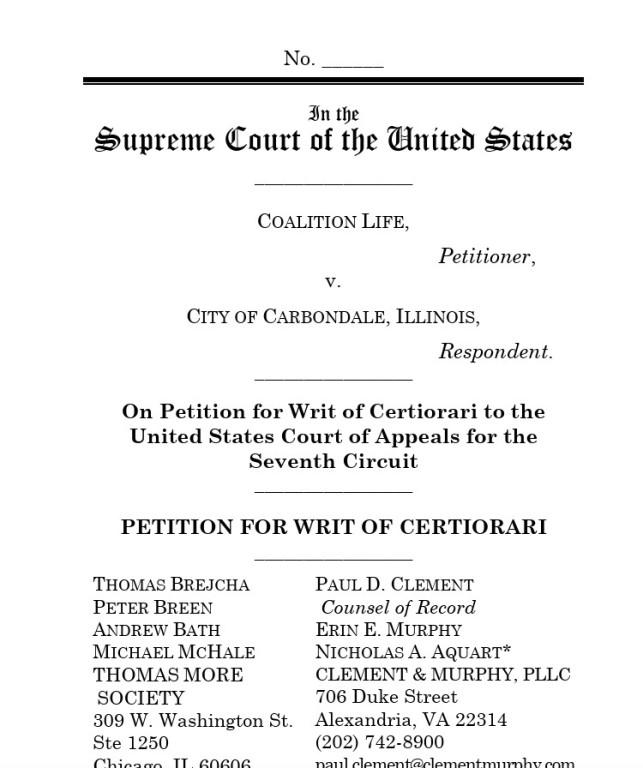
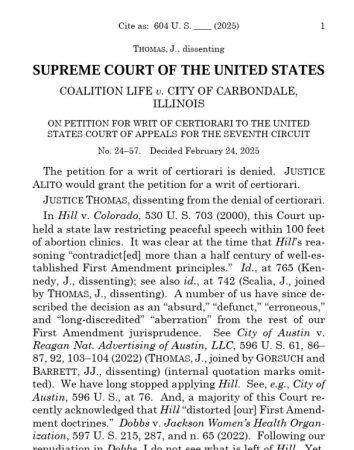
(Feb. 25, 2025) — The First Amendment suffered a body blow yesterday, and virtually no one in the electorate noticed, thanks to an indifferent press. Worse, it remains to be seen if anyone cares. In a case called Coalition Life v. City of Carbondale (“Coalition”), a majority of the Supreme Court voted to deny a petition for certiorari. The vote in conference was 7-2 against a grant of review. Only Justice Thomas formally dissented from the denial, with Justice Alito adding only that “he would grant the petition,” without further elaboration. Still, 2 out of 7 is not enough.
In order for such a petition to be granted, it takes the votes of at least four Justices in conference. Less than that will result in a denial of the petition. The case involved the First Amendment free-speech rights of a pro-life organization which asserted its right to express anti-abortion views was being denied by an ordinance of the City of Carbondale, Illinois. The federal Court of Appeals for the Seventh Circuit had ruled against Coalition.
Justice Thomas’s dissent came in the form of an 8-page “opinion relating to order [denying certiorari]”. In conclusion, Justice Thomas dissented because he saw the Court’s denial of the Coalition petition to be a refusal to provide clarity and “an abdication of our judicial duty.” Ever since the Court’s 1803 decision in Marbury v. Madison, the Court has adhered to the rule that it is the final interpreter of the Constitution, subject to the power of amendment.
Against that backdrop, a persuasive argument can be made that it is the duty of the Court to “clarify” what, precisely, the natural born Citizen (“nbC”) eligibility restriction means. That species of SCOTUS opinion has been addressed by your humble servant in the past here in the context of the still-unresolved issue of the definition of a “natural born Citizen” found in Article 2, § 1, Clause 5 of the Constitution, the presidential eligibility restriction. Moreover, the Coalition case involved an amendment to the Constitution; the nbC issue involves a core provision of the original Constitution.
Interestingly enough, the Coalition Life petitioner seeking certiorari review by the Court was represented by one Paul Clement, a former Solicitor General of the United States under President George W. Bush, now in private law practice in the D.C. Metro area. Interestingly enough as well, the attorney representing Carbondale, and opposing the grant of review being sought by Coalition and Mr. Clement, was one Neal Katyal, a former Acting United States Solicitor General under President Barack Obama, now also practicing in Washington.
Studious P&E readers will recall that Messrs. Clement and Katyal joined in 2015 in publishing an article entitled “On the Meaning of ‘Natural Born Citizen.” The primary goal of the article was to support the (purported) nbC eligibility bona fides of then-Senator John McCain. Readers will also recall that your servant — with due respect to the well-credentialed Messrs. Clement and Katyal – has disagreed with their analysis and critiqued their article here, here and here.
But I digress.
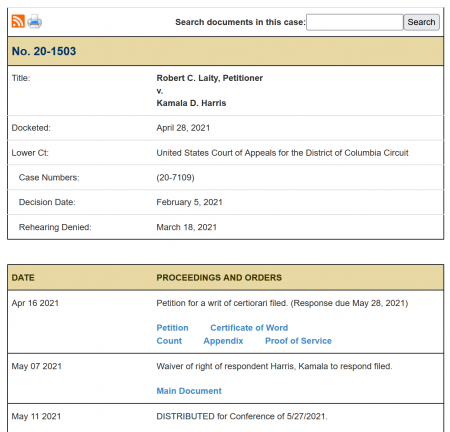
The post you are now reading poses the question: If Justice Thomas felt strongly enough to compose and release an 8-page dissenting “opinion relating to order [denying certiorari]” in the Coalition case, why did he not find similar impetus for doing the same thing in 2021 in the case Laity v. Harris? That case directly challenged the claimed nbC bona fides of Kamala D. Harris (Mr. Laity even captioned his certiorari petition as being related to “Purported Vice President Kamala Devi Harris”). Unsurprisingly, and as usual, the lower courts, including the D.C. District Court and D.C. Circuit Court of Appeals, rejected Mr. Laity’s challenge to Ms. Harris’s nbC eligibility and dismissed his complaint and action on the basis of his lack of “standing.”
P&E readers and students of the nbC issue are also well aware of Justice Thomas’s assertion that the Supreme Court was “evading” the nbC issue. The lack of requisite litigant “standing” has been the primary basis upon which denials of virtually all prior attempts to bring the nbC question before SCOTUS are based. Mr. Laity alleged that the nbC question presented a “grave” issue necessitating in the Court recognition of “standing,” which argument was rejected.
But even assuming that Mr. Laity lacked the necessary constitutional “case or controversy” standing to bring his case to the Court, there would appear to have been no impediment under the “understood” protocols of the “opinions relating to orders” practices of the Court for a Justice – Clarence Thomas or any other Justice – to declare, in the interests of “clarification” and adherence to the Court’s duty to interpret the Constitution, what in that Justice’s view the nbC term meant to the Founders and, of equal importance, what it means today.

Such an opinion could go a long way toward clarifying, even in the absence of a formal “precedential ruling on the merits,” what the nbC term means. It is fine that Messrs. Clement and Katyal are smart and well-credentialed attorneys, but they are not Justices of the Supreme Court. Short of a formal precedential decision by SCOTUS, the issue of nbC eligibility will continue to surface every four years, and potentially, even more frequently.
Stated otherwise, it is ironic that Justice Thomas decided to author a formal “opinion relating to order [denying certiorari]” in the Coalition case, and yet did not do the same thing in the 2021 Laity v. Harris case. One possible, yet troublesome conclusion, is that he agreed that the Laity petition was properly denied. That potential would in addition be consistent with his prior statement that the Court is “evading” the nbc issue.
And if that is so, then the argument that the Court is not taking more seriously its duty to interpret the Constitution takes on added significance. Even if an “opinion relating to orders” concurred in the Laity case petition denial, while lamentable, it would have provided limited clarity to a festering question which the Court seems unwilling or unprepared to address and answer. Issues of this significance should not be left to non-SCOTUS Justices or well-credentialed lawyers…, or even Internet essayists.
Unfortunately, once someone has been sworn in, they’re not going to do anything about it.
Reply from the author:
———————–
SCOTUS should adhere to its duty and address the natural born Citizen question immediately. Similarly, it should take up the question of “birthright citizenship” as well.
The “problem” of stripping people of a prior title of “president” or “vice-president” can be “finessed” (not to be confused with doing what the Constitution has required since 1787) by simply declaring any nbC decision to be prospective only. In the same way, President Trump’s Executive Order on the “birthright citizenship” topic could (and should) be declared constitutional, but specifically making it prospective only, from and after the date of any binding precedential decision of the Court. SCOTUS could then claim: “Move along, folks…, nothing to see here….”
No one has ever argued that SCOTUS is immune to pragmatic, if unprincipled, actions. Moreover, no one has ever claimed that democracy in a constitutional republic is simple or free of sometimes messy details.