

by Cheryl Lacey, DSJ, Take The Lead On Education™, ©2024

(Mar. 28, 2024) — A school is a system within a whole raft of other systems. The intersections, influences and impact on education and life are limitless.
If the tea leaves are accurate, schools in Australia are about to have one of the biggest shake-ups the country has seen.
In keeping with the usual political narrative, it involves money. It also involves the ongoing power play between federal and state governments – a consequence of ‘unfinished business’, about who has constitutional authority over the education and lives of families and who refuses to be held accountable.
A federal government portfolio – Social Services, to be precise – is chaffing at the bit to see states and territories share the financial burden of their signature initiative[1] – Australia’s National Disability Insurance Scheme (NDIS).
The NDIS is Australia’s first national Scheme for people with disability. It provides funding directly to individuals.[2]
Estimated at $22 billion in running costs in 2019, it grew to $37.4 billion in 2023, with an anticipated blowout to $50 billion and more in the next few years.
Much of this blowout can be attributed to the relinquishment of responsibility for just about everything. Another factor is the new philosophy flooding our institutions – ready access to open-ended spectrums and medication – a strategic source of relinquishment.
Fundamental issues aren’t sought or addressed, which compromises those with genuine needs. This is in stark contrast to the NDIS’s claimed intent.
Although intended to assist people with disabilities and their families and carers, not everyone with a disability needs to join the NDIS[3]. State health and education systems can provide foundational support for those not required to participate in NDIS.[4]
This is easier said than done, and it’s where things get yucky for families, schools and the services they promise or hope to provide.
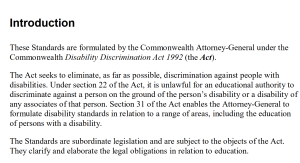
Foundational support in schools requires changes at the coal face of already unaccountable education ecosystems. Yet according to the Disability Standards for Education 2005[5] (DSFE), education providers are legally required to make reasonable adjustments for students with disabilities.[6]
When things get this tough, it pays to return to where schemes should have begun—the first principle of a shared language of agreement.
What is a reasonable adjustment?
According to DSFE, ‘an adjustment is reasonable in relation to a student with a disability if it balances the interests of all parties affected.’[7]
A reasonable adjustment expected by schools is ‘a measure or action taken to help a student with a learning difficulty and/or disability participate in their education on the same basis as their peers.’[8]
Balance and the same basis may seem fair and reasonable or music to the ears of the ‘let’s not measure anything champions.’ That is until the definition of disability kicks in. Let me summarise in four words. (details are at the bottom of the article).
We are all disabled!
Read the rest and hear Cheryl’s interview on “Rise And Thrive: Conversations For Greatness” with John Merkus here.