

by Sharon Rondeau
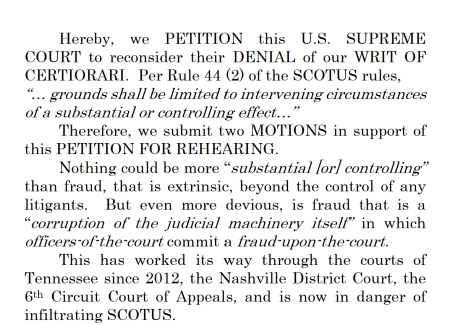
(Jan. 9, 2024) — On December 26, Dr. Byron Bush, a retired dentist and former 2020 candidate for U.S. Senate from Tennessee, along with his wife, Kelly Diane Bush, filed a Petition to Rehear with the U.S. Supreme Court given the court’s December 12 denial of a Writ of Certiorari in their case against the former Reliant Bank of Brentwood, TN and three Tennessee Judicial defendants.
After seeking redress through state and federal courts, in August the Bushes took their grievance to the nation’s highest arbiter, contending that a “fraud upon the court” had dogged their case from its inception in 2013 when Reliant sued them, eventually obtaining a judgment stemming from a commercial loan the bank extended in 2007.
The Bushes’ December 26 filing is here:
In 2022, Reliant was absorbed by United Community Bank of South Carolina, a subsidiary of United Community Banks, Inc. In its January 3, 2022 announcement of the completion of the merger, United Community Banks, Inc. wrote, “Reliant has a highly-valued franchise built upon providing outstanding service and developing deep and long-lasting relationships with its customers in the middle Tennessee market.”
In the press release, then-Reliant Chairman and Chief Executive Officer DeVan Ard (Jr.), now deceased, was quoted as having said, “We are excited that by joining United, we are able to continue with the community service and relationship banking principles that built this company…”
Fraud was repeatedly committed, Dr. Bush wrote in successive pleadings, resulting from Reliant’s admitted “mistake” which was “ONLY disclosed during Depositions and 2014 Trial Testimony… AFTER Reliant had submitted their Loan documents to the Court in a SWORN AFFIDAVIT, attesting them to be ‘true and correct.’ The loan documents were no ‘mistake.’ They cannot be both ‘true and correct’ and simultaneously a ‘mistake.’”
The “Fraud-upon-the-court,” Dr. Bush maintains, was and is compounded by each judge’s failure to address the bank’s admission and failure to disclose its “mistake… the concealment for 3-4 years… and the document alteration” within each court’s opinions, orders, and rulings.
Executed on November 30, 2007 and now in contention for a full decade, the loan on which the Bushes paid had been obtained to develop five acres of commercial property with a hotel and shopping center in close proximity to a busy airport. However, as of July 2012, the economic downturn catalyzed by the 2008 real-estate market collapse and withdrawal of two developers’ interest ultimately rendered it impossible for them to continue making payments, Dr. Bush told The Post & Email. Relying on the Security Agreement he signed when the loan was executed, he and his wife considered the bank’s foreclosure of the property satisfactory to settle the amount owed.
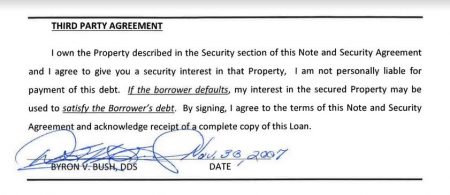
The Security Agreement reads:
I own the Property described in the Security section of this Note and Security Agreement and I agreed to give you a security interest in that Property. I am not personally liable for payment of this debt. If the borrower defaults, my interest in the secured Property may be used to satisfy the Borrower’s debt. By signing, I agree to the terms of this Note and Security Agreement and acknowledge receipt of a complete copy of this Loan.
In future years upon loan renewal, Dr. Bush has recounted, he was told he did not need to renew the Security Agreement since the original agreement remained “in effect.”
During trial, however, the “mistake,” then-Reliant Bank senior vice president Rick Belote testified, was Reliant’s Security Agreement guarantee that if Dr. Bush were to default, the bank’s foreclosure on the property would be sufficient to satisfy the debt, with no additional remuneration due.
After their default, “It foreclosed, and Reliant sold it and bought it themselves on December 4, 2012,” Dr. Bush told us in a 2021 interview. “They were the only ones who showed up for the sale.”
Reliant then departed from the terms of the Agreement and filed suit against the Bushes for the difference between an appraisal it commissioned following the foreclosure and the Fair Market Value at which the bank later listed the property for sale. According to Dr. Bush, the appraiser was relatively inexperienced, recorded the property’s value at an unprecedented low, and was related to a Reliant employee.
The Bushes counter-sued, naming as defendants Ard; the bank itself; two other bank officers; and three Tennessee state judges, the latter of whom the Bushes say were culpable in “prolonging” their ordeal and depriving them of their due process rights.
“The law does not support holding a victim responsible for the mistake of another party,” Dr. Bush told us in June 2021, “and the judges’ ‘pretermitting’ (leaving out) of the facts of the case indicates corruption and ‘fraud upon the court.’”
Just after the Tennessee Supreme Court declined to hear the case for the fourth time via an unsigned order, Dr. Bush wrote, and The Post & Email reported:
“Evidently in Tennessee, a bank can allege and admit to a ‘mistake… the bank’s mistake‘ and yet hold the customer accountable, knowing it will cost the customer a million-dollar loss while the bank profits. This has now been approved by the TN Supreme Court who has just declined to hear a case where this alleged-admission of a bank ‘mistake‘ by their officers with knowledge of that ‘mistake‘ for four years while never informing the customer, along with evidence that the bank altered their loan documents to prevent the customer from renewing a Security Agreement to ‘satisfy the Borrower’s debt‘; yet none of these material facts contained within the court records have ever been acknowledged or addressed within court Opinions, as though they were never heard. Judges, officers-of-the-court have conveniently left-out, ‘pretermitted‘ this evidence, now with the blessing of Tennessee’s highest court who has refused to render any relief to the victims, ‘regardless of the type of fraud alleged.‘ To them, it doesn’t ‘matter.’ Why? At the very least it reflects an effort to protect their judicial peers who have deceived the Honorable Court and have thus committed fraud upon the court. Anyone else would be serving time.”
In September 2021 the Bushes appealed to the U.S. District Court for the Middle District of Tennessee. Reliant had succeeded in executing a judgment against the Bushes resulting in automatic monthly deductions from their bank account, although after filing in federal court, Dr. Bush said, the deductions stopped and have not resumed as of this writing.
Of their first foray in the federal court system, “it was accepted by the [federal] District Court, and we really had hope,” Dr. Bush told us. He said, however, the judge ultimately “reviewed the evidence as though it’s all the evidence, but all the evidence was missing. So he reviewed the evidence of the court only, which is the deceptive half-truth of the evidence, and in so doing, he continues this fraud upon the court. The Loan NOTE was NO MISTAKE… yet, the court does not know that the bank alleged a mistake that they have admitted to in sworn testimony; the court does not know that the bank officers knew about it for four years but never told us, and ‘wouldn’t have told us if we had asked’; and the court does not know that the bank officers intentionally made a point to ensure that we did not renew that security agreement. And those are all indicative of fraud. So the court does not know the testimony behind the allegations that we are making and proving of fraud on the court.”
Their appeal to the Sixth Circuit Court of Appeals was met with a similar denial in an opinion “not recommended for publication” issued April 10, 2023 in which a three-judge panel wrote that the federal courts lacked “subject-matter jurisdiction” (p. 3).
“Notwithstanding their arguments to the contrary, the Bushes, who lost in several state court proceedings prior to filing their federal complaint, cannot challenge those state court judgments in federal district court,” the panel wrote on page 4. “When litigants believe that they did not have a reasonable opportunity to pursue an argument in state court or disagree with the manner in which a state court resolved their arguments, as the Bushes do here, ‘the proper course of action is to appeal the judgment through the state-court system and then to seek review by writ of certiorari from the U.S. Supreme Court’” (citation omitted).
In light of Reliant’s request to “sanction” the Bushes for filing a “frivolous” appeal, the panel wrote, “we decline to sanction the Bushes because the Reliant defendants have not satisfied the procedural requirements of Rule 38 by seeking sanctions in a separately filed motion.”
Though representing themselves, Dr. Bush said he and his wife have incurred thousands in copying and administrative costs alone stemming from filing and refiling their appeal with the U.S. Supreme Court after a clerk requested a formatting change. At that point, Dr. Bush interpreted the request as a glimmer of hope that the case would receive a hearing.
On December 10, exactly four months after the Bushes filed an amended appeal with the Supreme Court, The Post & Email spoke with Dr. Bush, asking if the court’s decision was knowable at that time.
“We could hear today or it could be next month; I would certainly expect within a 60-day window from this point, but I said that back in August or September,” he replied. “We filed it on August 10, and just FYI, they require 40 copies of this, and we also had printed an additional 20 just for our own use. So we filed it, and all of the lower court opinions are in an 8.5” x 11” format. When I filed it the first time, I filed the appendix in 8.5 x 11, because that’s what all the lower courts required. So when the Supreme Court received it, they looked at it, shipped it back to me, asked for a couple more opinions from the lower courts and required that it be reformatted into 6 1/8 by 9.25. The rules for filing are extensive. So we refiled it. Instead of taking it and pushing it aside, they looked at it and I assume thought it was worthy of consideration and asked for a correction in size. We had to reprint it twice, and it cost us $7,000 to ship it. Most people couldn’t do that.
“Last year the court received over 8,000 petitions, and of those, they heard 80,” he continued. “That’s 1%. But my wife and I are embedded in faith and prayer, and we believe with God we have a 100% chance.”
On December 13, however, the court declined to grant a Writ of Certiorari which Dr. Bush is now hoping will be set aside in the interest of not only his case, but also others who could be victimized by a lending institution in a similar fashion and by judges who leave out sworn testimony.