
by Sharon Rondeau
(Dec. 29, 2023) — In Part 1 of this series, the non-profit Look Ahead America (LAA)’s Director of Research, Ian Camacho, detailed to The Post & Email the origins of several of the new cases of potential voter fraud the organization has identified and referred to law enforcement over the last seven months and their current status, if known.
The cases, now numbering 281, can be found in a ten-page compilation published in an LAA press release on December 4.
Founded in early 2021 by Matt Braynard, LAA maintains that “There are millions of rural and blue-collar patriotic Americans who are disaffected and disenfranchised from the nation’s corridors of power. Their fears ignored, their priorities dismissed, their values ridiculed, they’ve become cynical and pessimistic about a government that so often does not hear their voices.”
The group’s stated mission, therefore, is to “register, educate, and enfranchise these disaffected citizens and ensure that their voices are not just heard but heeded and that the American Dream becomes their dream again.”
Encompassed within that, the website states, is “ensuring voter integrity” and “fighting corporate censorship” through citizen engagement with state legislators.
On Wednesday, in a summary of its 2023 accomplishments, LAA wrote, in part:
2023 was a tremendous time of progress for Look Ahead America, and 2024 is shaping up to be our most important year yet…
We cleaned thousands of illegitimate voters off the roles [sic], successfully opened hundreds of cases with election authorities, earned criminal referrals going after those committing voter fraud, and earned our first convictions.
The Post & Email reported on one such conviction here.
Election Fraud is Detectable
In his day-to-day work, Camacho has overseen the research conducted by volunteers across the nation with the purpose of improving election integrity using resources available to the average citizen. Those reference materials include the National Change of Address (NCOA) directory compiled by the U.S. Postal Service; property and tax records; voteref.com, a service launched in 2021 by the non-profit Restoration Action, Inc. to “provide public access to official government data pertaining to elections, including voter registration rolls, with a goal of encouraging greater voter participation in all fifty states”; and state-issued voter rolls, among others.
After identifying, through multiple levels of sourcing, what appear to be double voters or voters otherwise violating state or federal election law, LAA volunteers compile the data and provide it to Camacho, who contacts the applicable local election officials with the evidence. While acknowledging he does not possess “legal authority” to act on the data other than by providing it to authorities, Camacho told The Post & Email he believes in addition to the case referenced above, two more the group conveyed to officials in Indiana and Texas, respectively, are under investigation and will likely result in prosecutions.
In Part 1 and even before, Camacho related that at times, it appears prosecutors choose not to pursue clear-cut cases of ballot fraud out of “political” considerations, countering that with, “Election integrity does not have a side, just as truth doesn’t take a side. It is what it is.”
Widespread Cheating?
Referencing a December 13, 2023 Rasmussen/Heartland Institute survey which reported “17% of mail-in voters admit that in 2020 they voted in a state where they are ‘no longer a permanent resident,'” Camacho observed that LAA’s conclusion on that particular data point was “17.1% in our Georgia report and 20% in Wisconsin,” with perhaps a 1% deduction for margin of error in the latter.
“It’s pretty close to what they found,” Camacho observed. ”We used a pretty small sample size, and so did they, but our data seemed to match what they found, which corroborates that this seems to be the case nationwide.”
In a case involving an apparent double voter in Wisconsin and Arizona flagged by the ERIC system, an organization founded in 2012 of which Camacho and others have been critical, the latter’s deputy county attorney claimed there was “insufficient evidence” to go forward.
ERIC’s stated purpose is “to help states improve the accuracy of America’s voter rolls, increase access to voter registration for all eligible citizens, reduce election costs, and increase efficiencies in elections.”
Wisconsin
Last year in the state of Wisconsin, an ERIC member, LAA volunteers identified numerous cases of voters having supplied post-office boxes as residential addresses when registering to vote, with the legislatively-created Wisconsin Election Commission (WEC) declining to “take action” absent a “formal complaint” from a Wisconsin registered voter.
However, as reported in Part 1, Camacho cited six cases in four counties referred to the WEC on which the commission appears to be taking action. ”Those entail either a fine of $1,000 or a six-month prison term, which probably isn’t going to happen, but we’ll see,” he said.
Indiana
Camacho also described the case of a double voter in Indiana and Arizona on which it appears Indiana officials are taking action following his testimony there in November. As for Arizona, Camacho said officials have shown unwillingness to pursue the approximately 100 cases LAA has referred.
He additionally noted that effective in 2022, Indiana law stipulates that “Voting more than one ballot at the same election” is a “Level 6 felony.”
Georgia
A 2022 case involving Georgia and South Carolina showed a voter who “went to South Carolina, registered to vote and then came back and voted in Georgia anyway. She basically confessed to it when they asked her,” Camacho said.
When bringing it to the attention of Georgia elections officials, Camacho said, “It’s harder in Georgia because they often say, ‘This is an NCOA (national change of address) move’ and that’s not enough to remove a person because they could just be there temporarily. However, because we also showed that it was an out-of-state registration which was recent and she still voted [in the first state], that was enough for them to say she knowingly did it.”
“They have sat on so much from 2020, but they had no problem going after that one,” Camacho observed. ”It seems very arbitrary, as if they’re trying to squash things.”
Non-Residential Addresses
Another aspect of LAA’s research has been flagging voter registrations bearing a non-residential address such as a post-office box or vacant lot in violation of state law. On August 3, 2022, The Post & Email reported:
Neither Georgia, Wisconsin nor Arizona allows the use of non-residential addresses for drivers’ licenses and voter registration; however, LAA researchers identified 335 such voters in Arizona, 65 in Wisconsin and 1,401 in Georgia, with 928 of those in Fulton County alone.
On July 25, 2022, an investigator for Georgia Secretary of State Brad Raffensperger told Camacho he opened a new case “stemming from a complaint you filed, which involves 22 Gwinnett County (GA) PO Box Voters,” pledging to keep him abreast of any new developments.
In an interesting twist regarding Georgia, Camacho related that the recording of a controversial January 2, 2021 phone call among Trump, several White House attorneys and Georgia Secretary of State Brad Raffensperger and his team in which Trump contested Georgia’s certification of Joe Biden’s win in the state reveals Raffensperger invoked Braynard’s name while defending his office’s certification of the vote count showing Biden won by 12,670 votes.
A transcript of the call released by CNN that day reads, in pertinent part:
Raffensperger: Well Mr. President, the challenge that you have is, the data you have is wrong. We talked to the congressmen and they were surprised.
But they — I guess there was a person Mr. Braynard who came to these meetings and presented data and he said that there was dead people, I believe it was upward of 5,000. The actual number were two. Two. Two people that were dead that voted. So that’s wrong. There were two.
At times, Camacho said, in light of some of LAA’s Georgia findings, some have remarked, “This proves Trump won.” “Not necessarily,” Camacho told us, “but it calls into question the validity of the state’s certification. Biden could have won it; maybe it expanded his margin, but there’s no way it should have been certified.”
On November 17, 2021, Georgia Gov. Brian Kemp wrote a letter to “Members of the State Election Board,” requesting its “review and consideration” of an analysis he received from Georgia resident Joseph Rossi “noting 36 inconsistencies reported by Fulton County.”
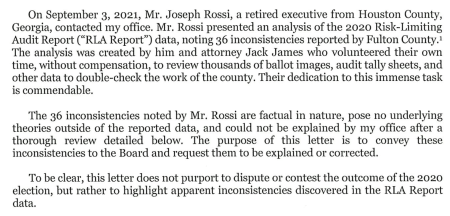
On page 2 of the letter, Kemp stated his office had already reviewed Rossi’s reported 36 discrepancies dealing with the “risk-limiting audit” (RLA) which led to his recommendation to the Board to independently assign investigators to review Rossi’s report and make any necessary changes resulting from their review to the state’s RLA process.
Kemp described the RLA data posted on the secretary of state’s website as “not inspiring confidence” and “sloppy, inconsistent, and presents questions about what processes were used by Fulton County to arrive at the result.”
In closing, Kemp, a former Georgia secretary of state, professed a desire for the Board to “safeguard the confidence I and all my fellow Georgians must have in our elections.”
On December 13, 2020, Paul Sperry of RealClearInvestigations reported:
More than 1,700 Georgians were singled out for illegally casting two ballots in 2020 elections — including last month’s hotly contested presidential race — but their fraudulent votes weren’t canceled out, according to state election officials. And so far, none of the cheaters has been prosecuted, raising concerns about continued fraud as Georgia prepares to vote again in twin U.S. Senate runoff elections next month.
The majority of double voters were Democrats who cast an absentee ballot either by mail or drop box and also voted in person on Election Day, officials said, which is a felony under state law.
The highest share of offenders were from Fulton County, which includes Atlanta — many of whom were allowed to cast a second ballot by poll workers, officials said.
A summary of hearings written by the chairman of the Georgia Election Law Study Subcommittee of the Standing Senate Judiciary Committee relates testimony from poll workers who shared their observations in sworn testimony of the November 3, 2020 election leading him to conclude that “any reported results must be viewed as untrustworthy.”
Then-chairman State Sen. William T. Ligon shared the report’s executive summary and video from the hearings here. Ligon retired on January 10, 2021 after ten years in the senate and an earlier decision not to seek re-election.
Texas and New Mexico
In a double-voting case originating in Texas, Camacho said, he found a voter in Limestone County who also voted in Otero County, NM “for almost ten years.” The exact years, Camacho said, were “2014, 2016, 2018, 2020, and 2022.” The votes were made “in person,” and the individual is a registered Republican, Camacho said. “Now they’re finally going to go after him.”
[Editor’s Note: In a four-part series published in 2022, The Post & Email reported on an Otero County citizen-driven audit of the 2020 election which yielded, according to coordinators David and Erin Clements, “significant differences in the voter-roll data and the information voters related to canvassers.”
Two months later, in June 2022, all three Otero County commissioners voted to abolish county voting machines and ballot drop-boxes effective for the November midterm elections. However, both remained in use for the June 7 primaries.
When the commissioners were reticent to certify the results of the primary, Secretary of State Maggie Toulouse Oliver “asked the state Supreme Court to step in and order the county to certify the votes, and the high court did so,” CBS News reported June 16, 2022.
The “ask” entailed a lawsuit with a writ of mandamus to the state supreme court. “In addition to the lawsuit, the Secretary of State’s Office said it was preparing a criminal case against the commissioners to be referred to the New Mexico Attorney General,” The Alamogordo News reported on June 15, 2022.
In her official statement, Toulouse Oliver wrote:
Under state law, county canvassing boards must certify the results of the election unless there is proof of discrepancies in the election returns (NMSA 1-13-5). The Otero County Commission’s stated reason for not certifying the 2022 Primary Election results is that they do not trust the vote tabulators used in the election, though they offered no evidence to prove any problems with the vote tabulators or election returns.
New Mexico’s vote tabulator systems undergo a bi-partisan certification process by the voting system certification committee following every presidential election and this process was most recently completed in 2021.
The Otero County Commission took their vote yesterday over the objection of their County Clerk, who provided the commission with findings about the Primary Election proving it was conducted legally and securely and election returns were accurate.
On June 17, 2022, a 2-1 majority of the commissioners certified the primary election but two months later voted to sue Toulouse Oliver. ”The commissioner who still voted against certifying the results, Couy Griffin, did so hours after being sentenced for breaching the U.S. Capitol during the Jan. 6, 2021, riot,” Reuters reported on the day the election was certified.]
As for the status of the Texas-New Mexico voter case, Camacho said he believes it will be prosecuted. “I’ve done everything I can; I’ve sent the affidavit; I’ll testify in court if they need me to,” he said.
In 2021, Camacho pointed out, while tightening other rules surrounding elections, the Texas legislature lowered the penalty for voter fraud from a felony to a misdemeanor. However, earlier this year and effective September 1, the law was again amended to make “illegal voting” a second-degree felony.
In closing, Camacho told us that in regard to election integrity, in his view, “You’re never really going to be done; all you can do is improve it. At the end of the day, all we can do as citizens is try to hold people accountable so that over time, there’s less and less fraud. Complacency and cynicism are what enabled these things with both officials and even more with fellow citizens. If the law is weak, we need to improve that law. It’s going to take time.”