

by Sharon Rondeau
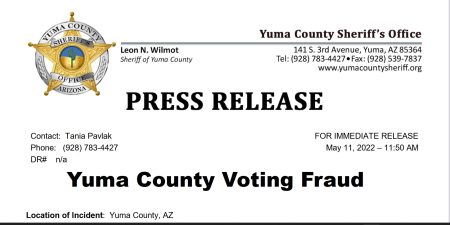
(May 15, 2023) — The non-profit organization Look Ahead America (LAA) has confirmed through official channels that a referral it made in November 2021 to the Yuma County, AZ Recorder for potential double-voting in the 2020 election was one of 16 cases under investigation as of the publication of a May 11, 2022 sheriff’s office press release.
“As of March 2022, YCSO has 16 voting/registration open cases,” the press release states. “All relevant evidence is being formally documented by the Yuma County Recorder’s Office and further investigated by the Yuma County Sheriff’s Office.”
LAA’s finding of a potential double-voter fell into one of four categories the sheriff’s office identified from the 2020 election and “a recent pattern of fraudulent voter registration forms leading up to the 2022 Primary Election.”
When the Yuma County Sheriff’s Office produced the press release last year, LAA Research Director Ian Camacho told The Post & Email in an interview Friday, he suspected the case LAA referred to the Recorder was “one of the 16.” Confirmation of that was obtained through an open records request.
Relaunched under a single umbrella in early 2021, LAA strives to increase civic engagement among members of the public. “There are millions of rural and blue-collar patriotic Americans who are disaffected and disenfranchised from the nation’s corridors of power,” the organization’s home page reads. “Their fears ignored, their priorities dismissed, their values ridiculed, they’ve become cynical and pessimistic about a government that so often does not hear their voices.”
It therefore seeks to “register, educate, and enfranchise these disaffected citizens and ensure that their voices are not just heard but heeded and that the American Dream becomes their dream again.”
“Fighting corporate censorship” and “ensuring voter integrity” are additional LAA objectives, along with shedding light on the arrest and incarceration of hundreds of citizens as a result of the January 6, 2021 incident at the U.S. Capitol.
On April 26, The Post & Email reported LAA’s referral of a potential double-voter in Tennessee and Florida who was prosecuted and entered a plea of “Nolo Contendere,” culminating in a conviction. We have reported on the organization’s earlier work here.
In December 2021, LAA’s Arizona organization held a rally for election integrity outside of then-Arizona Attorney General Mark Brnovich’s office, to whom they had sent the evidence of the Yuma County suspected double-voter but from whom they did not receive a response, Camacho told us.
As previously reported, LAA makes use of a number of tools, most of them publicly available, to scour for potential voter fraud in various forms, which include not only double-voting, but also misrepresenting a non-residential address as residential on a voter registration form or driver’s license application and claiming “indefinitely confined” status under questionable conditions, among others.
Evidence LAA collected through the National Change of Address (NCOA) list, social media, public databases and official public records led Camacho and his volunteers to conclude the voter in question cast an early ballot in Yuma County in October 2020 and voted in person in Wisconsin on November 3, 2020. The NCOA reports her as having filed a change of address to Wisconsin in September 2020, Yuma County records show she requested a mail-in ballot from Yuma County the following month.
“She voted in the 2020 election in Wisconsin and Arizona, or had 2 ballots cast in her name, making her a likely double voter if not at least an illegal voter in Arizona,” Camacho wrote in the evidence packet sent to Yuma County.
As demonstrated in documents obtained by LAA, following their obtaining of a “match” in voter identifiers in the “ERIC” system, elections officials from Wisconsin and Yuma County met to discuss their findings and concluded that the individual “voted in both states” and required referral “to the AG.”

“ERIC” describes itself as a “public charity non-profit membership organization” with a mission “to help states improve the accuracy of America’s voter rolls, increase access to voter registration for all eligible citizens, reduce election costs, and increase efficiencies in elections.”
The organization states that it utilizes the NCOA to find potential voter fraud as well as “identifies individuals who appear to be eligible but who are not yet registered by matching voter registration data against MVD data.”
“States can request reports identifying potential illegal voting activity – voters who may have cast ballots in more than one state, more than one ballot in the same state, or who may have voted on behalf of a deceased voter” “after each federal general election,” according to the website.
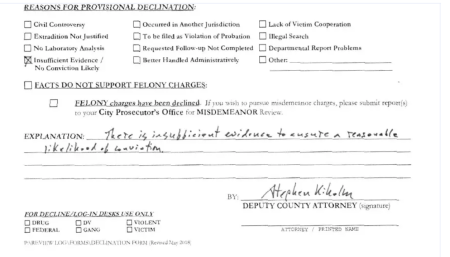
On page 7 of 7 of a Yuma County Recorder’s Office “Cross State Match” report, Deputy County Attorney Stephen Kikolm is noted to have responded to the Yuma County Sheriff’s Office that following the latter’s investigation, he chose not to prosecute due to “insufficient evidence to ensure a reasonable likelihood of conviction.”
On May 11, LAA’s founder, Matt Braynard, responded in a video release:
Well, we’re not going to stop there. We’re resubmitting this evidence and we’re encouraging all of our supporters in Arizona, especially those in Yuma County, to reach out to the Yuma County attorney’s office and encourage them to have a second look at the evidence…Unfortunately, this is a case we encounter way too many times across the country where it’s either not a priority or they sort-of decide they don’t see what’s clearly in front of them, but we’re going to continue the fight…When they decide not to prosecute these cases, what it says is that it’s acceptable for individuals to cast ballots they know they should not be casting…and our work in Georgia, Pennsylvania, Wisconsin and Arizona uncovered a substantial number of these…
“ERIC did not flag this voter,” Camacho told us. “It wasn’t until we said something. After we notified the Yuma County Recorder at the beginning of November (2021), they brought in WEC, the Wisconsin Elections Commission, then they checked with ERIC, which confirmed it.”
While he criticized ERIC for being “too expensive” and often ineffective, Camacho said in this case, “it was the tool” that confirmed the voter to be the same person voting in both locations by comparing the social security number, addresses and signatures.
The documentation shows the voter requested a mail-in ballot from Yuma County after she relocated to Wisconsin. The ballot was completed and returned, and the voter also cast an in-person vote in Wisconsin.
At the time of our interview, Camacho was not certain whether WEC was taking action on the double-voting report. As for the Yuma County attorney declining to prosecute, Camacho said he is puzzled since “the evidence is overwhelming” of a violation of law.
The April 17, 2023 investigative report states that the sheriff’s office sent the voter’s signature to the Arizona Department of Public Safety Crime Laboratory “for analysis and comparison” and that the investigator was “currently awaiting the results” (p. 5).
“The statute of limitations is five years, so technically they have until November 2025 to prosecute,” Camacho said. “Ultimately, LAA, the volunteers and I have done all we can do. It just goes to show that voter fraud is not rare; it is rarely investigated or prosecuted because it’s not politically expedient. Then when people do raise questions, they just say they’re ‘subverting the will of the people,’ which is ironic, because a person who is double-voting is actually subverting the will of the people.”
“Did it affect the presidential election?” he continued. “It did by one vote, clearly. Did it affect state and local races? That I don’t know. I’ll never know. But it’s still against the law.”
He also noted that a school-board election in his town was recently “won by three votes.”
On Monday afternoon, The Post & Email contacted Yuma County Interim Director for Elections Kika Guzman to ask about the procedure for applying for a mail-in ballot, including any required proofs of identity. We also contacted Yuma County Attorney Jon R. Smith‘s office requesting additional information as to why it chose not to prosecute the double-voter case.
As of publication, neither has responded.
If a voter’s jurisdiction participates in the ballottrax.com system, which records the status of cast ballots through wheresmyballot.com, he or she may verify whether a ballot has been counted, Camacho told us.
Yuma County is not a participating jurisdiction as of this writing, so the double-voter likely would not have had that tool available to her in 2020. Nevertheless, Camacho contended, voting twice in an election is a crime in any state or jurisdiction.
Regarding the county attorney’s declination to prosecute, Camacho observed that to in his view, the office does not “take it seriously” and shown a “lack of political will.” “When it’s a legitimate claim, they should be looking into it,” he said. “There were a number of false claims about election fraud in 2020, but if it’s legitimate, it should be checked out. LAA has no authority and can’t investigate, but we can get the ball rolling.””
Another challenge with identifying voter fraud, Camacho told us, is that average citizens fear retaliation should they discover credible evidence and subsequently report it. In addition, he said, “complacency” allows ballot fraud to continue.
“Our citizens who see things and don’t report it are part of the problem,” Camacho said. “We are where we are because of laziness, people not caring, so we’re going to get the results we deserve until people start changing — if they want to — or perhaps people are actually happy with what they have and they just like to complain.”
“Those who are leaders are far and few,” he added.
LAA’s election integrity efforts in Texas, Georgia, Wisconsin and other states has yielded cases referred to election authorities which remain open, a recent LAA report shows, while several were withdrawn due to administrative database errors or “dismissed without review.”
Racine County, WI Sheriff Christopher Schmaling similarly said he encountered a lack of will to prosecute violations of Wisconsin’s election laws his office discovered in 2021 in which the government declined to prosecute its own.
An interview between Camacho and “FiveThirtyEight” writer Kaleigh Rogers about the Yuma County/Wisconsin case prior to its consideration for prosecution is here.
LAA’s June 9, 2022 report on its Arizona findings, which is divided into six categories of voter improprieties, is here.
Comments
One response to “Why is Voter Fraud Not Prosecuted?”
Sharon, Good morning, are you aware of the motor voter fraud in California which is linked to illegal false ID set up where individuals have set up multiple identities and based on this received multiple ballots to the same address but also EDD government benefits? You may want to contact PAUL Preston and Chris Street of agenda21 radio and the NewCaliforniaState movement. The fraudulent benefits scam is believed to be into billions of dollars and believed that much of it ended up in China. Follow the money to figure out why voter fraud is not being investigated.