
by Joseph DeMaio, ©2023
(Dec. 4, 2023) — Welllll…, the natural born Citizen (“nbC”) issue and the Bing AI responses to related questions continues to evolve.
As faithful P&E readers recall, the intrepid Editor recently published a post regarding an email that your humble servant had sent to her. The post addressed, among other things, the problematic reference by Bing AI to the Harvard Law Review Forum article by Messrs. Paul Clement and Neal Katyal: “On the Meaning of Natural Born Citizen.”
Your servant has frequently criticized that article on a variety of grounds. He is not alone: see the 2016 law review article by one Prof. Saul Cornell criticizing the reasoning of the Clement-Katyal article entitled “The 1790 Naturalization Act and the Original Meaning of the Natural Born Citizen Clause: A Short Primer on Historical Method and the Limits of Originalism” in the Wisconsin Law Review.
Underscoring the continued divergence of opinion on the issue on the meaning and intent of the nbC term and the 1790 Act (1 Stat. 103), see a defense of the Clement-Katyal article entitled “Originalism, Natural Born Citizens, and the 1790 Naturalization Act: A Reply to Saul Cornell” by one Prof. Michael Ramsay, an ardent “Clement-Katyal” theory supporter.
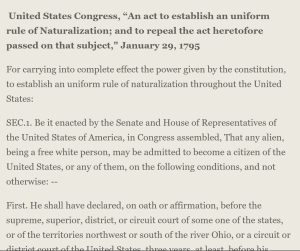
The bottom line here is that the 1790 Act – 1 Stat. 103 – coupled with its repeal in 1795 by 1 Stat. 414, sheds useful light on the intent and meaning to be ascribed by the Founders to the term “natural born Citizen” (“nbC”) as it is used in the Constitution.
As noted by the Supreme Court in Minor v. Happersett, 88 U.S. 162, 167 (1874), the Founders were conversant and “familiar with the nomenclature” of the period when they adopted the term “natural born Citizen” for inclusion as a restriction on those persons who might be otherwise eligible to the presidency. This is a critical point discussed by Prof. Cornell in his review article cited above.
The Founders did not pluck the term out of thin air. Nor did they labor and ruminate over whether it included a “citizen at birth” or a “citizen by birth” as advocated by Messrs. Clement and Katyal. They knew, without any doubt, that it meant a person born on U.S. soil to parents both of whom were already U.S. citizens. And because they were familiar with Emer de Vattel’s treatise, it is both reasonable and likely that they used – and understood they were using – the de Vattel definition.
Indeed, this conclusion is virtually compelled upon recognition that the Founders realized the need for the “citizen grandfather” exception to the nbC restriction in order for the first seven presidents to have legally served at all. Your humble servant addressed that issue here.
But I digress.
The issue to instead be addressed here is the changing and meandering responses of Bing AI over time as nbC-related questions are posed to it. Taking the welcomed and insightful suggestion of CDR Charles Kerchner – another prolific nbC contributor here at The P&E and actual veteran of the nbC wars (see Kerchner v. Obama, 612 F.3d 204 (3d. Cir. 2010)) – your servant over the past few days has posed additional queries to Bing AI to test its consistency and, thus, its “artificial” – a synonym for which being “synthetic” – reliability. The results have been interesting.
First, Bing AI continues to reference the Clement-Katyal article for the proposition that the “considered as natural born citizens” modifier of children born “beyond sea” included in 1 Stat. 103 has, purportedly as a “concept,” not changed. Not so. The authors of the article claim that “the concept of ‘natural born Citizen’ has remained constant,” a contention that is flat-out contradicted by the repeal in 1795 of that modifier by the conscious and intentional act of Congress in 1 Stat. 414. By perpetuating this manifest nugget of – let us be polite here, “misinformation” – Bing AI becomes an active participant in the misleading of, among others, the American electorate. And Congress. And SCOTUS.
Second, your servant asked Bing AI if the Founders were aware of and relied on Emer de Vattel’s “Law of Nations” when drafting the Constitution. Bing AI acknowledged the impact of de Vattel and praised his intellect, stating: “While there is no definitive proof that the Founding Fathers directly relied on Emer de Vattel’s ‘The Law of Nations’ during the drafting of the Constitution, it is widely acknowledged that Vattel’s ideas had a significant impact on their thinking.” (Emphasis added)
This Bing AI acknowledgment directly contradicts the juvenile and nonsensical claim by the Congressional Research Service (“CRS”) that the Founders could not possibly have relied on the treatise because, purportedly, no English translation of the tome existed until after the Constitution was completed and because the Founders could not understand French. See, e.g., CRS Report 74188632. And this, of course, from the repository of “the nation’s best thinking.” Seriously?
Third, Bing AI often poses its own questions, piquing the interest of humans and tempting them to “click” on the question to get Bing AI’s response. One such recent Bing AI question is this: “What is the difference between a natural born citizen and a native born citizen?”
The Bing AI response is revealing:
“In the United States, the distinction between natural born and native-born citizens revolves around two fundamental principles: jus soli (right of birthplace) and jus sanguinis (right of blood). [This, of course, contravenes the CRS narrative that jus soli alone guided the Founders, because that is what Great Britain did regarding “natural born subjects.”]
Natural Born Citizens:
- Definition: A natural born citizen is someone who was a U.S. citizen at birth, without needing to go through a naturalization process later in life. [i.e., the “Clement-Katyal claim”]
- Criteria:
- Born on U.S. Soil: Natural born citizens are typically individuals born within the territorial boundaries of the United States.
- Subject to Jurisdiction: They must be subject to the jurisdiction of the U.S. government.
- Significance:
- Presidential Eligibility: The concept of natural born citizenship is crucial for presidential eligibility. Only natural born citizens can become President or Vice President of the United States.
- 14th Amendment: The 14th Amendment’s Citizenship Clause states that all persons born or naturalized in the United States and subject to its jurisdiction are citizens of the U.S. and the state where they reside. [footnotes omitted]
Native-Born Citizens:
Definition: Native-born citizens are individuals who were born within the geographical boundaries of the United States.
- Criteria:
- Birthplace: They acquire citizenship by virtue of being born on U.S. soil.
- No Requirement of Parental Citizenship: Unlike natural born citizens, native-born citizens do not need to have U.S. citizen parents. [Emphasis added]
- General Application: Native-born citizens include anyone born in the U.S., regardless of parental citizenship status.
- Not Limited to Presidential Eligibility: While native-born citizens can hold any public office, only natural born citizens are eligible for the U.S. presidency. [footnotes omitted]
In summary, natural born citizens are a subset of native-born citizens, specifically meeting the additional criteria necessary for presidential eligibility.” (Emphasis added)
OK, did you catch it? Bing AI has just confirmed that, “unlike” natural born citizens who “need to have U.S. citizen parents…,” native-born citizens – i.e., those who under the 14th Amendment and the Supreme Court’s decision in the Wong Kim Ark case are only “citizens” of the nation – do not need the dual parental citizenship characteristic necessary to be a “natural born Citizen.” Moreover, it is undisputed that a mere “native born” or “naturalized citizen” is ineligible to the presidency or the vice-presidency.
Stated otherwise, this is unquestionably a Bing AI concession that, for presidential and vice-presidential eligibility purposes, the candidate for the office must have been born to “U.S. Citizen parents,” utilizing the plural of the term “parent.” Once again, think Euler diagrams: all natural born Citizens are also native-born citizens, but not all native-born citizens are natural born Citizens.
Because the “considered as natural born citizens” modifier of 1 Stat. 103 was repealed by 1 Stat. 414 – and never reenacted by Congress in any naturalization statute since 1795 – there is but one rational conclusion to be drawn: even Bing AI now realizes that the de Vattel definition of the term was the one understood by the Founders – without a doubt (q.v., Minor v. Happersett) – under the “nomenclature of which the framers of the Constitution were familiar” when they incorporated it into Art. 2, § 1, Cl. 5. Rocket science this is not, although some would seek to make it so.
Finally, returning to the Clement-Katyal article which Bing AI continues to disseminate over the Internet, in describing the importance of the 1790 Act, Messrs. Clement and Katyal state: “The actions and understandings of the First Congress are particularly persuasive because so many of the Framers of the Constitution were also members of the First Congress. That is particularly true in this instance, as eight of the eleven members of the committee that proposed the natural born eligibility requirement to the Convention served in the First Congress and none objected to a definition of “natural born Citizen” that included persons born abroad to citizen parents”(footnote omitted).
Again, quite apart from the fact that Congress repealed the “considered as natural born citizens” modifier of “children” in 1795 – a mere five years after realizing its error in placing the modifier in the 1790 Act in the first place – the modifier was not – and never was – a “definition” of the term like § 212 of the de Vattel treatise.
Instead, 1 Stat. 103 merely classified and categorized by analogy – i.e., “considered” – certain people as “natural born citizens.” To classify someone, for example, as a “clown” or an “incompetent” – as is Brandon, the current occupant of the Oval Office – is not the same as defining that which constitutes a true clown or incompetent.


The language of the 1790 Act repealed by Congress in 1795 was not a definition of the nbC term, but was only a categorization of certain people who purportedly “fit” a term not otherwise “defined” in the Constitution. The only true “definition” of the nbC term as understood by the Founders in 1787 is found in de Vattel’s § 212. Full stop.
CONCLUSION
Those who are interested in the nbC issue and what various AI sites tout on their “artificial intelligence” platforms would do well to examine closely the claims made on those platforms. Some may be true; others may not be true; still others may be intentionally flat wrong. But all of the claims will be inferior to a real decision of the U.S. Supreme Court addressing the issue. Until that happens, the debates will continue.
Your humble servant is not holding his breath for the Court to discover a backbone to rule on the matter…, nor should you.
Most insightful and exactly as was taught at least into the 1970s in US schools.
Misters Demaio, Kerchner; I thank you for validating my ability to understand the written words of Mario Apuzzo and Vattel that support the original intent of Article 2,1,5 of the U.S. Constitution. This means a lot to me as I am neither a lawyer or someone who has had the opportunity to grace the halls of higher learning. Again I thank you for your dogged effort in trying to educate the masses. And God bless Sharon Rondeau for keeping this forum active for many years now for people, like yourselves, who have the knowledge and desire and ability to impart the truth.
Good work once again by Joseph DeMaio.
Well, I guess one now has to ask the AI engine: “Did any of the drafters and framers of the U.S. Constitution read French, the diplomatic language of the time of the drafting, writing, framing of the U.S. Constitution in 1787? And if so, please name some of them?” ;-)
An experienced lawyer well trained and expert on cross examination of a human mind on the stand should take on AI’s artificial “mind” and “thinking” algorithms for each of the key “Who, What, When, Where, Why, and How” questions and answers presented in my White Paper on the “natural born Citizen” term and see if any of its answers comport with the arguments and facts therein and the footnotes supporting said arguments and facts: http://www.kerchner.com/protectourliberty/The-Who-What-When-Where-Why-and-How-of-NBC-Term-in-Constitution.pdf
For more information for anyone new to this battle about the truth about the purpose (the WHY) and meaning of the “natural born Citizen” term in the presidential eligibility clause of the U.S. Constitution, get and read a copy of my book, “Natural Born Citizen”: http://www.kerchner.com/books/naturalborncitizen.htm
CDR Kerchner (Ret)
http://www.ProtectOurLiberty.org
P.S. The browsers seem to be messing with my kerchner.com website URL links lately and trying to scare viewers off.