
by Joseph DeMaio, ©2023

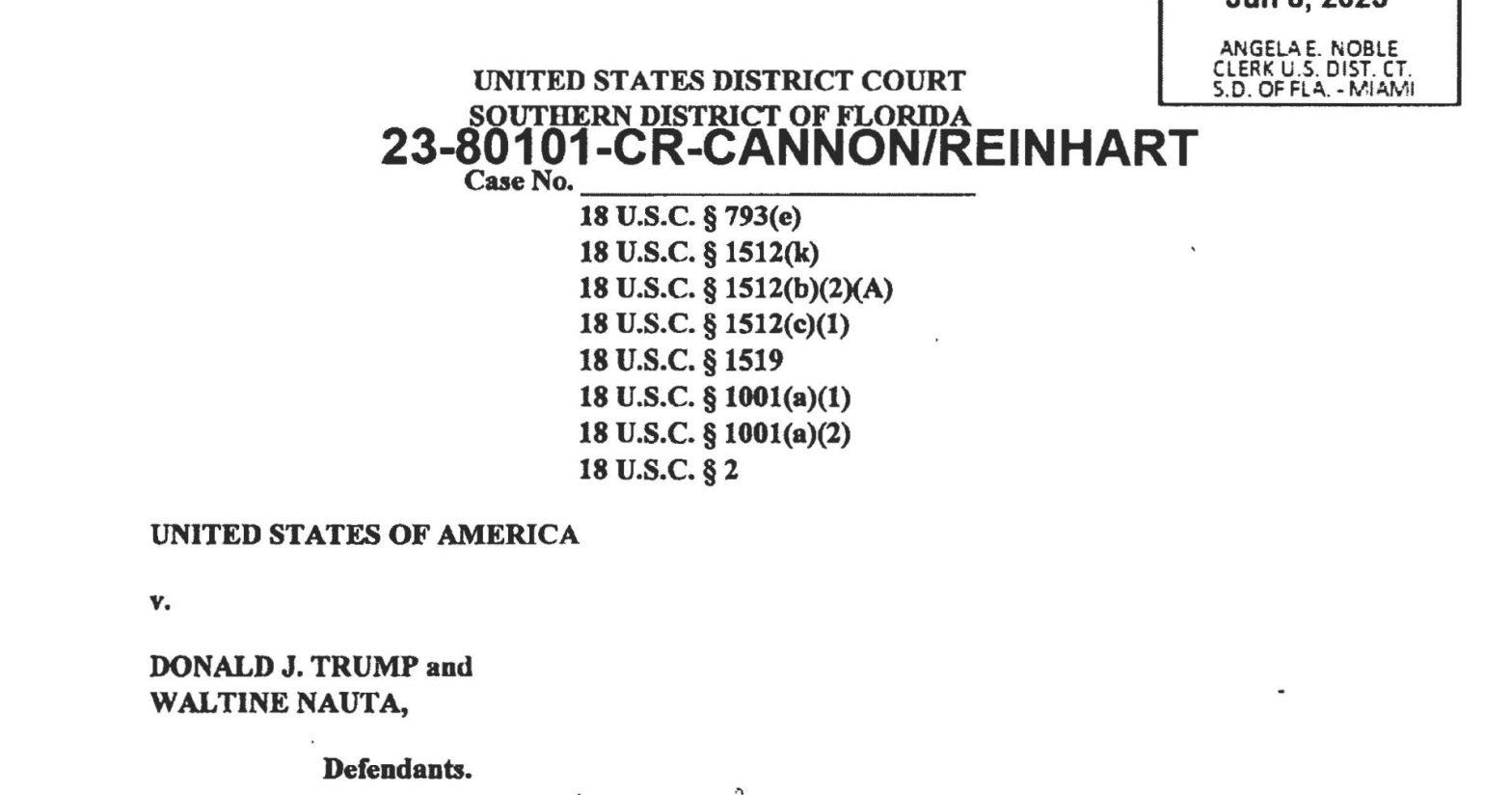
(Jun. 20, 2023) — President Trump and one of his aides have been indicted for alleged federal crimes relating to documents which were the subject of the FBI raid on his Florida home, Mar-a-Lago, on August 8, 2022. This was an unprecedented action by the nation’s analogue to Nazi Germany’s Gestapo. New evidence suggests that the raid was apparently undertaken with the knowledge and assistance of Brandon’s administration, if not Brandon himself.
The indictment sets out in multiple counts a variety of alleged “crimes” committed by President Trump and his aide, Waltine Nauta, taking place between Jan. 20, 2021 (the last day President Trump was in office) and August 8, 2022, the date of the raid.
Against this backdrop, a few interesting facts emerge. Spoiler alert: the following does not address the merits (or deficiencies) of the indictments or speculate on the outcome following pretrial motions, discovery or any trial, now tentatively set to begin August 14, 2023. The likelihood of the trial starting by then is, to understate the matter, remote. Instead, the issue to be examined is whether the indictments constitute election interference.
First, the timing of the indictments is highly suspicious. On Nov. 15, 2022, President Trump announced that he would be a candidate for the GOP nomination for President in the 2024 general election. From that day forward, he was deemed to be a candidate running for election to the presidency.
Federal law – specifically, 18 U.S.C. § 595 – provides that if a “person employed in any administrative position by the United States… uses his official authority for the purpose of interfering with, or affecting, the nomination or the election of any candidate for the office of President..,” that person is subject to a fine and/or one year in prison. These are “slaps on the wrist,” but nonetheless prohibited criminal offenses.
Second, dovetailing into the unfolding evidence that Brandon and his goons at the Justice Department may be coordinating efforts, 18 U.S. C. § 3282 establishes for federal crimes under Title 18 a generally applicable statute of limitations. That limitation period, unless specifically set out in the statute or elsewhere in the U.S. Code, is five (5) years.
Stated otherwise, if a federal crime is alleged as having occurred on January 20, 2021, the last day upon which an action could be commenced would be January 19, 2026. Similarly, if a federal crime is alleged to have occurred on August 8, 2022, the last day a prosecution could be initiated as to that crime would be August 7, 2027. While there are limited exceptions, the general rule is thus that a prosecution for a crime must be initiated not later than five years after it was committed.
This brings us to the third anomaly in the timing of Special Counsel Jack Smith’s indictments against President Trump and Mr. Nauta: with the earliest limitations period expiration date for the alleged crimes being January 19, 2026, why did Special Counsel Smith feel compelled to file his action on June 8, 2023, more than two and a half years early? And as for alleged crimes taking place as recently as August 8, 2022, why was he compelled to file his indictments as to those events nearly five years early?
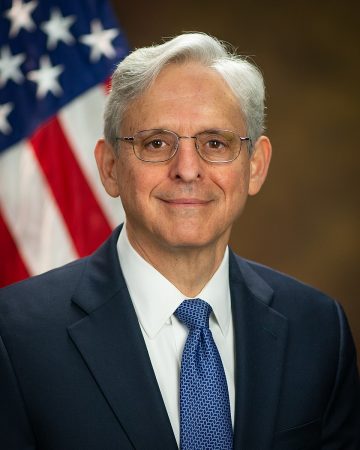
At the risk of going out on a limb…, is there any possibility – even a remote one – that Smith was acting on orders from Attorney General Garland or whoever was the “marionette-master-du-jour” in the Oval Office to file as soon as possible to impede, interfere with, or “affect” the nomination or the election of any candidate – e.g., Donald Trump – for the office of President? And why would that statute not apply to Smith’s June 8, 2023 filing?

Surely no federal official – particularly from the vaunted and oh-so-principled Department of Justice – would stoop that low…, would they? Would they? Surely they knew that no statute of limitation threatened the time-barring of any of the counts of the indictment, so what other reason might they have had for filing so soon? Might it have been to intimidate the Goof to stop hoarding secret and confidential documents himself in his garage? Wait…, wait: could it be that they are trying to get a conviction before the November, 2024 general election? Or perhaps to so harass candidate Trump that he cannot effectively campaign if he wins the GOP nomination? Or maybe even to defeat his nomination altogether?
Apart from questions regarding whether President Trump’s lawyers can prove that Smith’s actions are politically-motivated or rise to the level of a “vindictive” prosecution – given the seeming indifference at the Department of Justice to the thousands of felonies arising from the destruction and BleachBitting of computers and mobile devices (parenthetically, then already under congressional subpoena) by a former Secretary of State, likely containing the same species of “national security” information seized at Mar-a-Lago – why does not the “early” filing of the indictments constitute the precise type of election interference intended by Congress to be prohibited by 18 U.S.C. § 595?
Moreover, would the answer be different if, say, an email or text message between and/or among Brandon, Merrick Garland, Jack Smith and others in the Goofball cabal surfaced confirming that such an “interfering” or “affecting” motivation existed? Not saying one actually exists, of course, but just asking hypothetically if the answer would be different.
I’ll wait.