
by Sharon Rondeau

(May 26, 2023) — On May 3, the Research Group of the non-profit, non-partisan organization Look Ahead America (LAA) published a report revealing discrepancies between Pennsylvania’s county- and state-level 2020 election results which thus far have not been reconciled, explained, nor even widely disseminated to the public.
The report was LAA’s second on the Commonwealth’s 2020 election results, the first having concentrated on ballot and canvassing anomalies following a chaotic, rancorous and disputed presidential election.
The first report, published April 28, 2022, focused on a number of issues including, but not limited to:
- Ballot categorical designations
- “Impossible Ballot Application Dates” and other anomalies
- “Backdated” ballots
- “Disappeared” ballots
- “Fluctuating Return Dates”
- Canvassing (counting) and reporting
- The Department of State (DOS)’s posted procedures and discrepancies between then-Secretary Kathy Boockvar’s public statements and election data published simultaneously by her own department.
As The Post & Email has reported, to compile data in furtherance of its objective of promoting election integrity, LAA makes use of the National Change of Address (NCOA) list published by the U.S. Postal Service; voter rosters from secretaries of state; social media; property records and public databases to identify questionable ballots, focusing on “swing” states where controversies have dominated headlines in recent election cycles and degraded overall public confidence in the electoral process.
Several of LAA’s findings have prompted official investigations into suspected ballot fraud, such as voting in two states or two municipalities within the same state. Other examples include supplying a non-residential address on a voter registration application or claiming to be “indefinitely confined” under questionable or even nonexistent criteria in order to be able to vote by absentee ballot.
LAA’s purpose in producing its second Pennsylvania report was to achieve “increased transparency and thorough explanations for discrepancies past and present with the aim of making sure that they don’t recur in the future” (p. 7), drawing attention to the differences in county and state reported data.
Those differences, the report states on page 3, “were so large that they surpassed the margin of victory in some races, and should have put some races into the margin of automatic recount.”
LAA’s analysis also shows that some counties posted updated results after the state certification deadline of November 23, 2020 and that different vote totals between a county and the state changed the outcome of the race, most often from a Republican to a Democrat.
Background
Against the backdrop of myriad reports of voter disenfranchisement in Pennsylvania and five other “swing” states in a presidential year leading to confusion and dozens of lawsuits, on November 13, 2020, then-Secretary of the Commonwealth Kathy Boockvar declined to implement recounts “in any statewide races, including the presidential election.” Fox43 further reported:
Based on the unofficial returns submitted by all the counties, no statewide candidate was defeated by one-half of one percent or less of the votes cast, according to a Pennsylvania Department of State news release.
That includes the following races: President of the United States, Attorney General, Auditor General and State Treasurer.
The Department of State said 10,000 mail ballots that were cast on or before Nov. 3 were received by counties between 8 p.m. November 3 and 5 p.m. Nov. 6.
Conversely, LAA’s 2022 findings demonstrated that, as a result of “unexplained date changes” (p. 13) and new ballot counts reported well beyond the 2020 certification date, the results of the races for Pennsylvania State Treasurer and President of the United States fell within the .5% margin required by state law to invoke a recount.
Drilling down further, in its “Overview of Results” on page 7, the May 3 report states:
The discrepancies in the state level data surpassed the county certified margins of victory in three close state level races, and show changed outcomes of races. Specifically, these were the 53rd Legislative District, 150th Legislative District, and 152nd Legislative District. All three of these races went from the Republican candidate winning according to the official county records, to the Democrat candidate winning according to the official state records.
In two other races, one held in the 33rd Legislative District and in the 45th Senate District, the differences between the county and state results didn’t affect the overall outcome, but should have placed the results within the margin of recount. The 45th Senate District shrunk an extremely narrow margin of victory from 73 to 69 ballots, whereas the 33rd Legislative District shrunk a margin of victory from 888 to 349 ballots, or 0.27% to 0.10% of the victory margin. Both races should have been automatically recounted. Additionally, no explanation has yet surfaced explaining why over half of the ballots in the original margin of victory were lost in the state version of the election data. The Senate race, won by a Democrat, lost a few ballots but by a smaller amount than any other questionable outcome.
As of this writing, LAA has not received a response to questions (pp. 4-5) posed early last month to Pennsylvania Open Data Officer Jere Matthews regarding the discrepancies, though she replied to LAA Research Director Ian Camacho on April 6 with, “We continue to work with the Department of State and a response will be provided when it is available” (p. 6).
In May 2022, Matthews responded to Camacho’s request for clarification on absentee ballot coding by agreeing to add three descriptors “in the Open Data Portal,” referring to OpenDataPA, a public records repository she helped to implement.
On November 30, 2022, Matthews responded to another communication from Camacho on a similar matter by again stating she had “added this information to the dataset.” “Thank you for the recommendations!” she wrote.
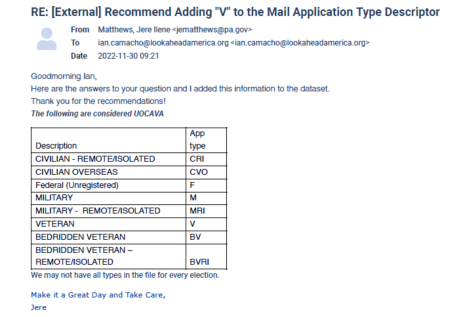
Matthews has worked for the Commonwealth of Pennsylvania for more than two decades, her LinkedIn profile shows, with more than seven years in her current position. In 2018, she was one of three individuals to whom then-Gov. Tom Wolf (D) gave a “Governor’s Award for Excellence” for their implementation of OpenDataPA authorized by Wolf through an executive order which Camacho’s group accessed to acquire the state’s 2020 election data.
Early Inconsistencies
In an October 2020 unprecedented development and without consulting the legislature, the Pennsylvania Supreme Court ruled that mail-in ballots arriving three days beyond November 3, 2020 could be counted. However, an appeal to the U.S. Supreme Court resulted in an order that such late-arriving ballots be “segregated.”
In its 2022 report, LAA pointed out that as of the November 10, 2020 deadline for county election boards to submit their totals to the Department of State and on which the DOS reported more than 50,000 ballots were yet to be counted, Boockvar said that only 10,000 ballots were received between November 4 and 6, 2020.
In a lawsuit in which the Republican Party of Pennsylvania sued Boockvar “in her official capacity,” then-Pennsylvania Attorney General Josh Shapiro, now the Commonwealth’s governor, wrote (p. 13):
The 2020 Election is now over. President-Elect Joseph Biden defeated President Donald Trump by over 80,000 votes in Pennsylvania. Of the approximate 6.9 million votes cast, counties have reported only 9,428 mailed-in ballots that were received during the three-
day extension at issue. The number of challenged ballots is insufficient to change the outcome of the Presidential election (or any other federal election in Pennsylvania)…
History
In Pennsylvania and other states, much of the controversy arising from the 2020 election surrounded the use of mail-in ballots which in fall 2019 the Pennsylvania legislature authorized statewide through its passage of Act 77.
The following year, Act 12 was passed, amending Pennsylvania’s 1937 election code to reflect updates as to mail-in voting procedures, among other changes, and establishing “The Pennsylvania Election Law Advisory Board.”
The state constitution designates the legislative branch as having the authority to make election law, which the Pennsylvania Department of State acknowledged in its own May 14, 2021 report on the 2020 election (p. 4). The Department states it does not verify the accuracy of data entered by the counties into the “SURE” system from which it draws its data (p. 4).
On November 1, 2020, Boockvar issued a directive to all county election boards stating that “officials had until Nov. 12 to verify the identities of the voters who cast mail-in ballots,” which went three days beyond the November 6 deadline set by the state supreme court.
Challenged by the Trump campaign, on November 12, 2020 Judge Mary Hannah Leavitt ruled that Boockvar “did not possess the statutory authority to extend that deadline, thereby invalidating ballots that arrived between November 9 and November 12.”
In January 2022, the mail-in ballot law itself was challenged on constitutional grounds, in part by 11 legislators who had voted in favor of it and with whom Leavitt agreed, but the law was ultimately upheld by the Pennsylvania Supreme Court.
Boockvar resigned approximately eight weeks after the 2020 election as a result of having failed to publicize a constitutional amendment ballot issue unrelated to the presidential election. Despite that, then-Attorney General Shapiro declared the 2020 election as having been “free, fair, and conducted in accordance with the Commonwealth’s laws.”
For his part, Wolf stated that Boockvar’s resignation “has nothing to do with the administration of the 2020 election, which was fair and accurate.”
Is “Accuracy” Subjective?
An example LAA provided of a discrepancy between county and state figures is that of Allegheny County, which reported as “official” election returns for the presidential contest:

The state, however, reported different vote counts in Allegheny County for the same race:
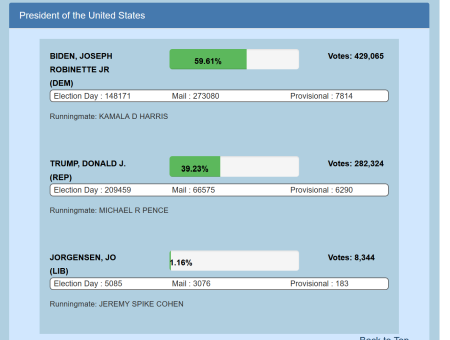
It was Camacho’s view in a recent interview with The Post & Email that the “segregated” ballots designated by U.S. Supreme Court Associate Justice Samuel Alito were nevertheless included in official tallies. “You can see every single case where ballots were counted way past the cutoff date,” he said. “They shouldn’t have been counting them. You can mark it ‘received,’ but you can’t count it. They allowed three days for regular voters, but every single certification was way past the deadline, like a week. In the report you can see everything with the links to verify it. I’m very skeptical of everything, but to me this is the clearest example I see of ballot-stuffing.”
“When we went in to look at this — because we had done a transparency report — I had to go back to Jere Matthews for explanations of what the codes meant, and she finally changed and clarified that,” Camacho said. “So then we knew what the codes meant. But we found the state and the county records didn’t match, which was different from what we had done before when we were looking at official state records, so trying to do mail-in ballots was a waste of time. While transparency is better than it was in 2020 because at least now we know what the mail-in ballots mean, we still don’t know why the numbers are different. If there were a link to a county, a date, an explanation or legal citation, at least we would say, ‘Now there’s transparency.’ In a few cases I actually had to contact the clerk and say, ‘Hey, your numbers aren’t on here’ or ‘It’s partial,’ and they’d say, ‘Whoops!’ and reupload.”
LAA “archived” all of the data it accessed for its May 3 report, Camacho said. “We gave them a month before we published. They’re not being transparent, and they’re not responding, which to me seems like malfeasance on the part of the government. We want to expose these things; we want people to be aware of them because I think people weren’t made completely aware or that there were so many claims out there that it was missed.”
The public can verify the discrepancies for itself, Camacho said, using “official government data,” making it difficult for naysayers to refute.
On Thursday afternoon, The Post & Email contacted Matthews to ask about the discrepancies between the county and state data, referencing LAA’s May 3 report. Just prior to press time early Friday afternoon, we received a response from Dan Egan, Communications Director, PA Office of Administration, who wrote:
Hi Sharon,
Your inquiry about 2020 election data is being referred to the Department of State (cc’d) for a response.
We will update this story upon receipt of any further communication.
I pray daily for these three things relative to elections: Prevention of voter fraud,
exposure of voter fraud, and reversal of voter fraud. I pray this not only for the US but world wide. I encourage everyone to add this quick prayer to your daily prayer list, unless of course you are led to pray more intently.
Two Words, For the weak minded to understand…..Election Fraud…Now eat the words. Live the words, understand the words and the effects of Communist control..Or suicide and save us ammo in the future., IMO
Why doesn’t the data match? Because the people doing the cheating can’t count. They were too busy taking equity courses to learn math.