
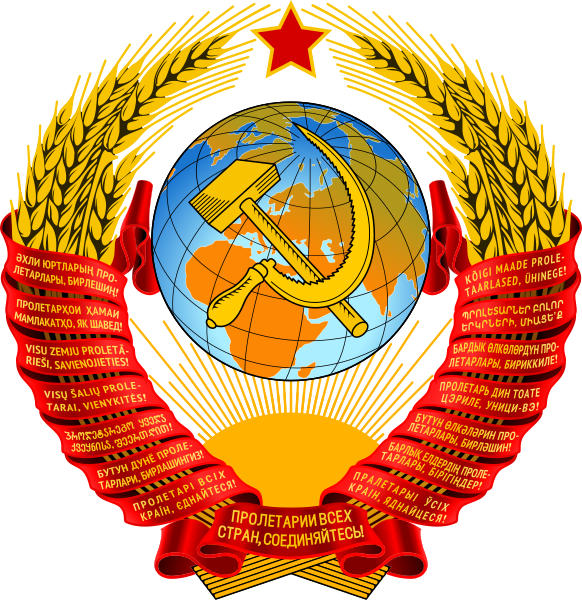
by ProfDave, ©2021

public domain
(Feb. 4, 2021) — For those of us who lived through the Cold War Era, the collapse of the Soviet Union was a great surprise. Even those of us who were committed opponents of despotism, socialism, and/or atheism – who had argued for decades that such a regime was morally and logically wrong – were unprepared for its collapse. Stalin and his successors had built a superpower, an industrial, military, and scientific colossus equal to or exceeding the best that Western democracies could produce – and on the backward ruins of the Russian Empire! While we knew that economically and politically the Eastern bloc was a bad place to live – after all, the Berlin Wall was built to keep East Germans in – we assumed Soviet citizens were used to it and their endurance was unlimited.
Further (forgive me if there is bias here), Marxist theory had considerable appeal among Western intellectuals. It borrowed the Christian democratic value of equality, so frequently unsatisfied in Western societies, and attached it to naturalistic science, the new world-view of the West. It banished superstition and sentimentality and religious myth. This accorded with the post-Christian yearnings of Western academia for a comprehensive secular ideology. Instead of economics being a science of (Creator) given natural principles, or of free but predictable human choices, it became a man-made revolutionary instrument. How could the scientific brain-power of all those central planning technocrats, backed by the full coercive might of the Soviet State and the fervor of the Marxist secular religion – how could it all fail? Was it the hostility of the West (ex Ronald Reagan’s “Star Wars”)? Internal policy failures and mistakes? Or internal contradictions in Communism itself? As you read Duiker and Spielvogel 807-11, ask yourself these questions.
Marxism was born as a Socialist response to early industrialization. It built on the exploitation of the working class by the organizers of industrialization on the one hand and the real suffering and relative jealousy of voiceless masses on the other, in the expectation of class warfare. Where the working classes found a voice in labor unions and the political process, however, “class warfare” became limited to rhetoric (in Europe) and/or forgotten in “the American Dream.” Imperialism and World War I only seemed to fulfill Marxist prophecies – they really had little to do with economics. Revolutionary conditions were only a transient phase of industrialization.
In many ways, the Socialist response to land reform – although tangential to Marxist theory – has had more impact. In Russia, in China, and in Latin America the most common concentrations of wealth and of misery were not in the infant industrial sector, but in the countryside. The initial response to Bolshevism and to Mao was the peasant seizure of land from semi-feudal landowners – the promise of enough land to feed one’s family. In both cases, there were self-governing village institutions providing precedents to bridge the gap. But soil and family are basic human needs. Collectivization was accepted or resisted to the extent that it recognized this.
The Socialist response to colonialism also played a very prominent role in the last half of the 20th century. All the colonial powers were Western, Christian, capitalist, and democratic (all the rest having lost their possessions in the war). Nationalist leaders were caught in a contradiction between the values of their education, the modernization to which they were committed, and the non-western people they wished to lead to independence. Were they black (or brown or yellow) on the outside, but white on the inside? It didn’t really have anything to do with Karl Marx, but the Soviet model offered an alternative to this dilemma: an anti-western, anti-Christian, anti-capitalist, top-down, five-year plan, independent road to independence [Duiker & Spielvogel 713-15].
Finally, Socialism, particularly in its Soviet and Maoist forms, confronted the issues of forced modernization and industrialization. Arguably, the Five-Year Plan did work. This was a top-down, command economy, technocracy that accomplished – or seemed to accomplish – in a short time what market forces had not accomplished in the preceding century (for reasons too numerous to discuss here). The social and political costs were indeed enormous. Short-term gains were impressive, but ninety years after the revolution Russia was still far behind Western Europe in per capita well-being. In China, the jury is still out, but improvement has seemed to come in spite of dogma rather than because of it.
Socialism promised to create a new (classless) society, based on a new Socialist mankind. The citizen of this new order would be comrade-centered, not self-centered, socially motivated, not individually motivated. The new mankind would be egalitarian by conviction, untainted by religion, nationalism, racism, sexism or any other kind of myth. This man-made humanity would be utterly rational, scientific and practical. Each person would be hardworking and unselfish, totally committed to his/her fellow men/women – to the welfare of all. Such people could participate freely and equally in the direction of their own affairs and in the distribution of the fruits of their labors to their fellows without distinction. Sounds great, doesn’t it?
The Soviet system failed – watch for bias here – because it failed to produce the new mankind. Environment and education repressed, but did not replace nationalism, sexism, and even religious faith. The Communist myth was a poor substitute for Orthodox Christianity or even Confucianism as a transcendent moral framework. No way was found in materialism to replace selfishness with the common good. The dictatorship of the proletariat was still a dictatorship, with just about as much inequality, jealousy, and exploitation as the old regime. The repressive state did not wither away. Instead, terror destroyed initiative, even among the technocratic elite, and bred deception, corruption, and mediocrity. In breaking resistance to the will of its director, the Soviet system broke the will of its own people. As the hope of personal (or family) improvement faded further and further into empty promises, the motivation to work with even minimum efficiency failed. Until the 60’s, the Communists were able to hide the relative material and cultural poverty of their own people from themselves, but technological advances in communications began to make this impossible. The Iron Curtain could not hide forever the contrasting conditions of the West. The official modern materialist worker’s paradise was not producing modern material success for its own workers! Spiritual rewards were out of the question. In fact, it was spiritual forces – not just a few dissidents, but large-scale religious resistance – that led the way to general resistance [See Heydt].
Thus the Gorbachev era sought to come to terms with reality too late. The Soviet Union could not afford continued hostility toward the West, let alone a new missile defense arms race. The lid could no longer be kept on the free exchange of ideas, nor on religious expression. The command economy would have to yield to the realities of the market place. A single party system could no longer be imposed by terror and brute force. Once freedom and democracy crept in and the citizens were allowed a voice, it became apparent that the Communist Party did not have their support, the centrifugal forces of language and ethnicity could not be suppressed in one federal union, and the USSR, like the Berlin Wall, came crashing down [Duiker & Spielvogel 807-11].
“Red” China goes on, but not as red as it used to be, as your text points out. The CCP is still in charge, still the dictatorship of the proletariat, but Marxism is giving place to state capitalism and enclaves of free enterprise reminiscent of the old treaty ports. Western ideas and techniques are being adopted in a pragmatic manner. The internet has made the bamboo curtain irremediably porous and there are sporadic relaxations of police-state repression. Will the transition to a free economy and society – possibly the world’s greatest – be peaceful and gradual? Will the Communist elite be able to share power and/or win free elections? Stay tuned for next era’s installment.
—————–
Sources:
Duiker, William L. and Spielvogel, Jackson J. World History, 6th edn., Boston: Wadsworth, 2010
Hargrave, Sidney. Russia: A History, 5th edn. Philadelphia: J.B.Lippincott, 1964
Hesketh, Therese, Lu, Li and Xing, Zhu Wei. “The Effect of China’s One-Child Family Policy after 25 Years,” New England Journal of Medicine, 2005; 353:1171-1176. Retrieved 8/8/11 fromhttp://www.nejm.org/doi/full/10.1056/NEJMhpr051833
Heydt, Barbara von der. Candles behind the Wall. Grand Rapids: Eerdmans,1993.
Hill, Kent R. The Soviet Union on the Brink, Rev edn. Portland, OR: Multnomah Press, 1991.
David W. Heughins (“ProfDave”) is Adjunct Professor of History at Nazarene Bible College. He holds a BA from Eastern Nazarene College and a PhD in history from the University of Minnesota. He is the author of Holiness in 12 Steps (2020). He is a Vietnam veteran and is retired, living with his daughter and three grandchildren in Connecticut.
Comments
One response to “The Failure of the New Socialist Mankind”
TRUMP THROWS IN THE TOWEL AND EMBRACES GOP ESTABLISHMENT
LARRY KLAYMAN ON BATTLING THE LEFT: ‘WE THE PEOPLE ARE NOW ON OUR OWN’
by Larry Klayman
February 1, 2021
https://www.renewamerica.com/columns/klayman/210201