
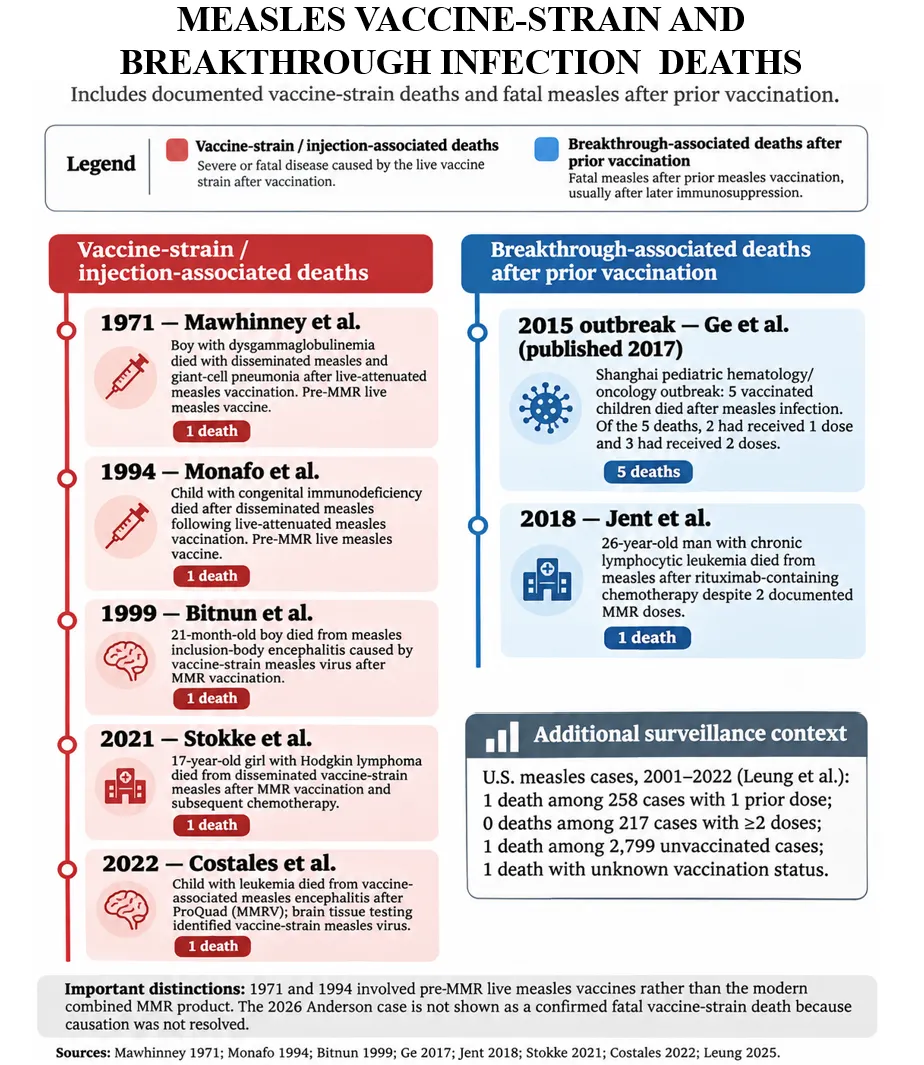
It is essential to know in cases of “measles-related death” if the virus was from injection or infection. Doctors, know your patients’ immune health before risking death via MMR vaccination.
by James Lyons-Weiler, PhD, Popular Rationalism, ©2026
(Nov. 22, 2026) — Fatal vaccine-strain infections, breakthrough measles in the immunosuppressed, and what the FDA and CDC acknowledge about the limits of live-virus vaccination
The Warning Is Already in the FDA-Approved Product Label
Can a vaccine intended to prevent measles cause a fatal measles infection?
For immunocompromised patients, the answer is yes. Physicians have documented deaths caused by the live-attenuated measles virus contained in vaccines, including the measles, mumps, and rubella (MMR) vaccine. These deaths have occurred in patients whose immune systems could not adequately control replication of the attenuated virus, including individuals with congenital immune deficiencies, previously undiagnosed immune disorders, leukemia, lymphoma, and profound immunosuppression following medical treatment.
The Food and Drug Administration (FDA) acknowledges this possibility in the prescribing information for M-M-R II, one of the two combined MMR vaccines currently licensed in the United States. Section 4.2, addressing immunosuppression, prohibits administration to individuals whose diseases or medical treatments have compromised their immune systems. The same section recognizes reports of measles inclusion-body encephalitis, pneumonitis, and death directly resulting from disseminated measles vaccine-virus infection [1].
“A vaccine intended to prevent an infection cannot be assumed safe for every recipient merely because it is effective in the general population. Nor can a record of previous vaccination be assumed to represent current immunity after profound medical immunosuppression.”
This is a substantial admission in a federally approved pharmaceutical product label. Attenuation reduces the pathogenic potential of a virus in a host with an adequately functioning immune system, but attenuation does not eliminate the virus’s capacity to replicate. When the host cannot control replication, a virus intended to elicit protective immunity can instead establish an infection with serious or fatal consequences.
The published medical literature confirms the mechanism. In several fatal cases, investigators identified the vaccine strain within affected tissues, sometimes using genomic sequencing, immunohistochemistry, and pathological examination. These investigations provide stronger causal evidence than the ordinary observation that an illness followed vaccination, because investigators identified the vaccine-derived virus and demonstrated its association with the diseased tissues.
The danger becomes especially important when physicians administer a live-virus vaccine shortly before beginning chemotherapy or when they vaccinate a patient whose immune system has not sufficiently recovered from previous treatment.
A separate problem emerges when someone receives measles vaccination successfully during childhood, develops a malignancy years later, and subsequently loses vaccine-induced protection during chemotherapy. Such a patient may develop severe disease and die after exposure to circulating measles virus despite having received the recommended vaccine doses.
Read the rest here.
Leave a Reply