
“CITIZENS HOLD THE ULTIMATE LEVER OF REFORM”
by Sharon Rondeau

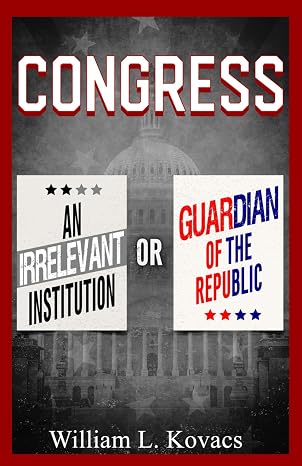
(Oct. 19, 2026) — In “Congress: An Irrelevant Institution or Guardian of the Republic,” author, former Capitol Hill chief counsel and former U.S. Chamber of Commerce senior vice president William L. Kovacs puts forth the specter — based on the historical record — of a feckless and increasingly politicized Congress willingly allowing the presidency to morph into an instrument of authoritarianism, shattering the nation’s constitutional system of checks and balances and placing American freedom in jeopardy.
The book is the third in Kovacs’s trilogy in which he identifies federal government mismanagement and his proposed reforms and was preceded by “Reform the Kakistocracy: Rule by the Least Able or Least Principled Citizens” and “Devolution of Power: Rolling Back the Federal State to Preserve the Republic.”
The Post & Email reviewed the latter volume here.
In the book’s initial two chapters, Kovacs contends that if the president and Congress are of the same political party and uninhibited by the Constitution’s written guardrails for as little as one term, the result could be a tyranny with only the trappings of constitutional order.
Reminiscent to this reviewer of Orwell’s “1984,” the rise of the majority “Opportunity Party” openly supplants Congress’s sworn oath to safeguard the nation’s financial health with the consolidation of power by the executive branch.
An exponentially growing number of presidential executive orders, which Kovacs explains were originally intended to serve as internal agency directives, is an indication that the executive branch is amassing excessive authority and teeters on becoming “a one-person government.”
As Congress continues to eschew its responsibilities, Kovacs further posits, the president expands his dominance by reshaping the courts, imposing tariffs, and potentially defying the 22nd Amendment through an elaborate scheme.
In Chapter 2 Kovacs introduces a fictitious, newly elected “Congressman Jackson” who courageously takes to the floor of the U.S. House of Representatives to tell the public:
“Citizens, Congress has failed you. It is no longer capable of performing its constitutional functions. It can no longer operate as a check on the president. It is up to you to save the nation…”
“Vote out every incumbent” is Jackson’s first directive to the American people. “Elect representatives who will defend Congress as the nation’s primary lawmaking body…”
Throughout the book Kovacs enumerates examples of Congress’s lack of discipline not only by abandoning its role to responsibly oversee the nation’s purse, bit also by failing to enforce its own legislation. Examples include the National Emergencies Act (1976), the International Emergency Economic Powers Act (IEEPA, 1977) and the Information Quality Act (2000) for political reasons.
Because of pressure from lobbyists over the years, Kovacs writes, Congress amended the 1913 “simple” tax code to resemble “a confusing mix of provisions that reward favored activities and penalize others, undermining transparency and fairness.”
Most significant, the author says, Congress has led the U.S. government to a place where it will soon be unable to pay its expenses, particularly its trillions of dollars of debt.
Both major political parties, Kovacs observes, have neglected to curb spending and contributed to the fiscal disaster the nation is facing which will end in collapse if solutions, albeit available to Congress now, are not implemented.
The skyrocketing national debt, Kovacs stresses in Chapter 4, is “an egregious breach of fiduciary duty” on the part of Congress stemming from an “addiction” to awarding “subsidies” to “corporations, universities, agribusiness, hospitals, insurers, nonprofits, and even state governments…”
The courts, Kovacs argues, are not blameless in the crumbling of constitutional order. “In 1984,” he writes on page 66, “the Supreme Court, in Chevron v. NRDC, shifted the balance of power among the three branches of government by instructing federal courts to defer to agency interpretations of ambiguous statutes. The Supreme Court deemed federal agencies ‘the experts’ on interpreting congressional statutes. This decision dramatically expanded executive authority by restricting the courts’ role in interpreting the law and limited Congress’s role to serving as the initial draftsman of legislation.”
As a result, Kovacs writes, “The Administrative State swallowed the Constitution and Congress.” A degree of redemption began to take shape, Kovacs said, in 2022 when the Supreme Court reversed course in two key opinions, West Virginia v. EPA (2022) and Loper Bright Enterprises v. Raimondo (2024).
Kovacs does not simply decry the disintegration of constitutional safeguards, but rather, offers concrete solutions, particularly in Chapter 14, beginning with a directive to Congress to “Distinguish essential from non-essential programs” and withdraw funding for “laws that have not been reauthorized.”
Additional suggestions include a mandate to “Review the Judgment Fund: Congress’s hidden slush fund” about which Kovacs wrote in several articles here, and to “Devolve most federal domestic programs to the states,” discussed in depth in “Devolution of Power.”
“Only by controlling spending and debt can Congress begin to serve once more as a Guardian of the Republic,” Kovacs writes on page 112.
In conclusion, the author reminds us:
Citizens hold the ultimate lever of reform: their vote. Every two years, they can replace the entire House of Representatives. This power allows voters to change the course of government before executive overreach becomes entrenched.
And finally, Kovacs paints another fictitious – but entirely plausible – scenario in which “Joe Nobody” decides to seek office to “serve as a fiduciary to the institution of Congress, a trustee of the Constitution, and a defender of the separation of powers. His campaign theme is simple, yet profound: Preserve the Republic.”
The movement expands, Kovacs muses, as “grassroots campaigns powered by social media and faith in civic renewal…” arise across the country with the result that “for the first time in decades, Congress feels the tremor of accountability…”
Leave a Reply