
What is a Natural Born Citizen of the United States? | by John Greschak

by CDR Charles F. Kerchner, Jr. (Ret), blogging at cdrkerchner, ©2026

(Oct. 12, 2026) — What is a Natural Born Citizen of the United States? | by John Greschak | Copy Provided Courtesy of ProtectOurLiberty.org

Read and get your copy here: http://www.kerchner.com/protectourliberty/naturalborncitizen/What_is_a_Natural_Born_Citizen_of_the_United_States_by_John_Greschak.pdf

# # #

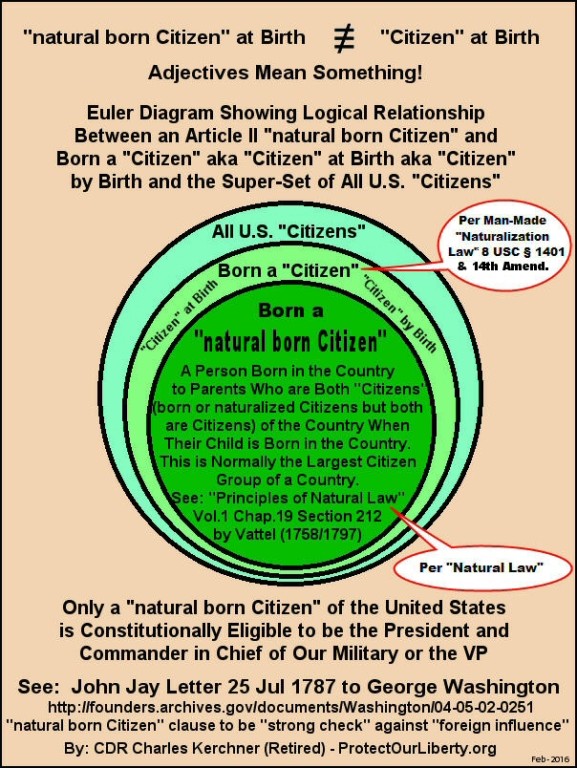
Plus: The truth about the original intent meaning and the source of the “natural born Citizen” term in Article II Section 1 Clause 5 of the U.S. Constitution, the Presidential Eligibility Clause, presented below graphically and logically using a Euler Logic Diagram

My Translation and Analysis of a Key Sentence in Emer de Vattel’s 1758 Treatise on Natural Law in Section 212 -“Des citoyens et naturels” Cited in the Above Euler Logic Diagram: https://cdrkerchner.wordpress.com/2023/04/15/my-translation-of-a-key-sentence-in-emer-de-vattels-1758-treatise-on-natural-law-in-section-212-des-citoyens-et-naturels/

CDR Charles Kerchner, P.E. (Retired)
Author: “Natural Born Citizen”
and “Kerchner v Obama – The Advertorial Campaign“
https://www.kerchner.com/books/catalog.htm
https://cdrkerchner.wordpress.com
https://www.scribd.com/user/52640192/protectourliberty/lists
http://www.protectourliberty.org


Comments

3 responses to “What is a Natural Born Citizen of the United States? | by John Greschak”

  1. Bill Van Allen

    an amicus submission could give Kerchner a concrete way to support access to the OSG records.

    My recommendation would be a focused brief explaining his research interest, the public value of the requested records, and how disclosure would assist informed examination of presidential eligibility. Its usefulness would depend on connecting those points to the FOIA issues before Judge Sannes.

    NDNY Local Rule 7.2 requires leave of court, with the proposed brief and proposed order attached. The brief is limited to 12 double-spaced pages. Ordinarily, the motion must be filed within seven days after the supported party’s principal brief; a later submission requires good cause. The relevant briefing and docket dates would therefore need checking before he files.

    He could support your pursuit of records while retaining his own views about constitutional interpretation and AI assistance.

  2. Bill Van Allen

    Bill, Greschak offers a John Jay–centered interpretation worth studying, but his definition is an argument rather than established law. The Post & Email page would not load; I located his original essay, published December 2, 2008, and updated January 12, 2010. I cannot confirm whether tonight’s posting adds commentary.

    His proposed test requires three things:

    * Birth in the United States.
    * Both parents being U.S. citizens when the child was born.
    * U.S. citizenship maintained continuously from birth.

    He derives this from Jay’s concern about foreign influence, historical usage, and his interpretation of the individual words. He also proposes a constitutional amendment incorporating his definition.

    The strongest research contribution is his examination of the historical documents. He compares Jay’s manuscript and contemporary terminology, and acknowledges that the English Vattel wording “natural-born citizens” appears in the 1797 edition—after the Constitution was drafted. That chronology matters when arguing that the Framers borrowed that particular phrase from Vattel.

    The major legal obstacle is that the Congressional Research Service’s analysis reaches a different conclusion: the prevailing interpretation encompasses citizenship at birth, including U.S. birth subject to jurisdiction regardless of parental citizenship, and qualifying births abroad to citizen parents. CRS is persuasive analysis, not a binding judgment, but any two-citizen-parent argument must address its authorities directly.

    For your developing strategy, my recommendation is to use Greschak as a guide to primary-source research for the John Jay project. I would keep the Sharpe amicus focused on ballot access and voter participation; introducing this presidential-eligibility theory would require a concrete connection to the claims actually filed. His test also differs from your maternal-lineage proposal: it requires two citizen parents, without requiring a U.S.-born mother or grandmother.

  3. Charles Kerchner

    A link to this TP&E article posting has been shared at TheFreeRepublic: One can read additional comments and discussion of this article there at this link: https://freerepublic.com/focus/news/4398908/posts

    CDR Kerchner (Ret)
    http://www.ProtectOurLiberty.org

Leave a Reply

Your email address will not be published. Required fields are marked *

This site uses Akismet to reduce spam. Learn how your comment data is processed.