
Voter verification prevents both disenfranchisement and voter fraud. Alexis de Tocqueville would see it as a positive step.
by James Lyons-Weiler, PhD, Popular Rationalism, ©2026
(Oct. 12, 2026) — Judge Sparkle Sooknanan’s recent ruling identifies some problems with the Justice Department’s methods, but its portrayal of voter verification goes beyond what those findings establish. Popular Rationalism and Alexis de Tocqueville offers a better way to distinguish legitimate enforcement from administrative overreach.
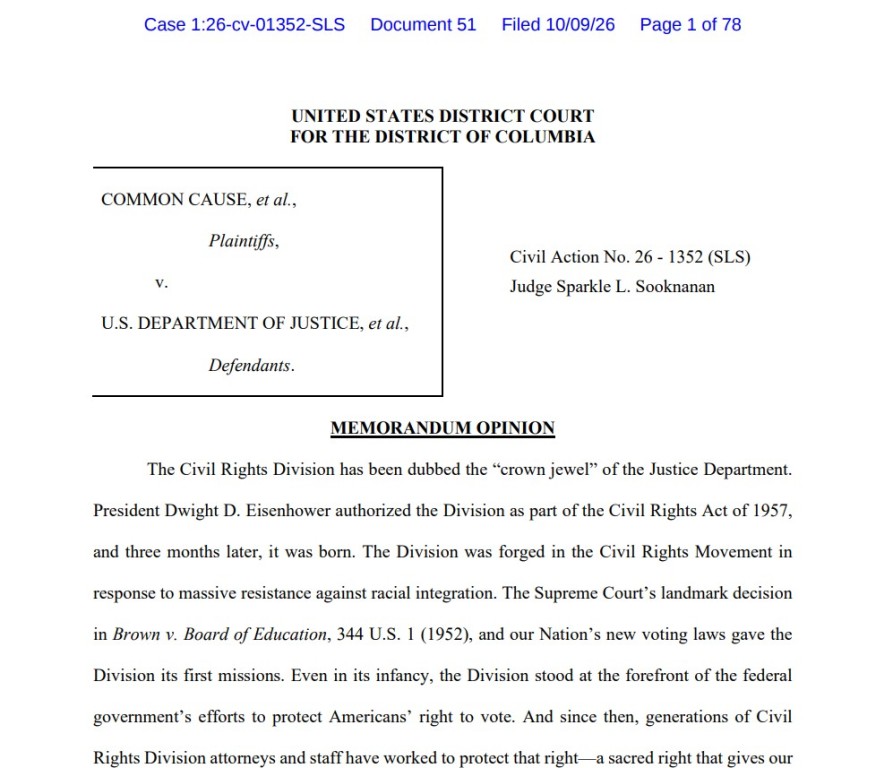
On October 9, U.S. District Judge Sparkle Sooknanan struck down the Justice Department’s Voter List Maintenance Policy in Common Cause v. U.S. Department of Justice. Her opinion describes an effort to obtain statewide voter rolls, compare them with federal citizenship information, and secure the removal of people identified as ineligible. Before reaching the detailed statutory analysis, however, the judge supplies a broader interpretation of the enterprise: “Behind all the window dressing, the challenged policy represents the federal government’s attempt to decide who gets to vote.” That characterization deserves severe scrutiny separate from the legal findings that follow it. (Opinion, p. 2)[1]
Congress itself identified two purposes of the National Voter Registration Act as “to protect the integrity of the electoral process” and “to ensure that accurate and current voter registration rolls are maintained.” These appear alongside the statute’s objectives of increasing registration and participation among eligible citizens. Protecting access and maintaining an accurate electorate belong to the same legislative design. A reading that treats one as the authentic civil-rights mission and the other as inherently suspect fails to represent that design fully. (52 U.S.C. § 20501(b))
The administration cannot turn those purposes into unlimited authority to collect information or direct state officials. But neither should a court turn defects in a particular enforcement program into a suggestion that its underlying objective is alien to the laws upon which it is based. The strongest critique of this ruling begins with that distinction and then examines whether the judge’s statutory reasoning consistently preserves it.
Congress Required Accuracy, Not Simply Access
The Help America Vote Act makes the relationship between participation and verification particularly clear. Under 52 U.S.C. § 21083(a)(4), state systems must make reasonable efforts to remove ineligible registrants while maintaining safeguards against erroneous removal of eligible voters. The two obligations appear together because an accurate voter roll must avoid both kinds of error. Keeping an eligible citizen off the list and retaining an ineligible registration are different failures, but the statute does not instruct officials to recognize only one of them. (52 U.S.C. § 21083(a)(4))
Congress also provided for database comparisons. HAVA requires specified agreements between state election officials and motor-vehicle authorities to check registration information, together with an agreement involving the Social Security Administration. Those provisions concern particular verification arrangements; they do not authorize every subsequent federal citizenship-screening program. They nevertheless establish that intergovernmental data matching can be part of protecting elections rather than evidence, by its nature, of an attempt to subvert them. (HAVA verification provisions).
The judge’s interpretation of the intent of using citizenship as recoverable from a Federal database as well is entirely fiction made to employ the straw man fallacy: Judge Sooknanan injected her (fictional) interpretation based on presumed intent of the data matching and then used that interpretation as evidence that her interpretation was correct.
This represents a textbook case of circular reasoning driven by confirmation bias, often manifesting as a straw man argument and a bootstrap fallacy.
Here is a breakdown of why this happens and the specific fallacies involved:
Read the rest here.
Leave a Reply