
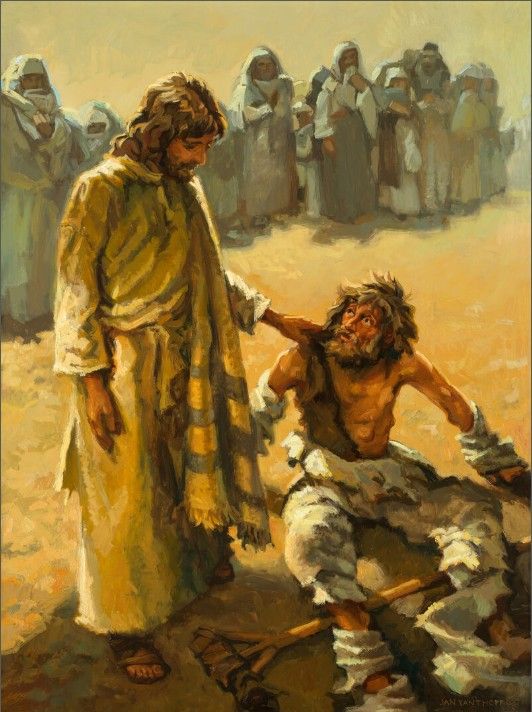
by Dennis Gladden, By Green Pastures, ©2026

(Sep. 9, 2026) — Jesus didn’t have problems until He ran into certain people. I noticed this recently while scanning the gospel of Mark.
Trouble indeed brewed early when a demon interrupted Him teaching in a synagogue, but Jesus commanded, “Be quiet, and come out of him!”
The demon came out.
Later the same day, all kinds of sick and afflicted townspeople gathered around Jesus for relief.
Diseases yielded. More demons fled.
Another time, a storm swamped the boat Jesus was sleeping in. For sure, He and the disciples were going to drown. “Don’t you care that we are perishing?” they shouted above the wind.
Jesus said three words, “Peace, be still!” The howling and heaving stopped.
One after another, disease, devils, and nature submitted to Him—even His enemy of enemies.
The devil dogged Jesus in the desert, tempting Him, until Jesus commanded, “Away with you, Satan!” Snake that he is, Satan slithered off.
It was like the beginning when God said, “Let…” and it came to be.
Time and again, Jesus spoke, and it was.
Until He ran into certain people.
A leper begged Jesus one day to heal him. Jesus consented and said two words, “Be cleansed.”
“Immediately the leprosy left him, and he was cleansed” (Mark 1:42).
The disease obeyed; the man didn’t.
Jesus gave him one assignment. “Say nothing to anyone; but go your way, show yourself to the priest, and offer for your cleansing those things which Moses commanded” (1:44).
Jesus spoke, but this time “however” followed.
“However, he went out and began to proclaim it freely, and to spread the matter, so that Jesus could no longer openly enter the city” (1:45).
There were others like the leper.
Another Sabbath, in another synagogue, another man needed healing. His hand was withered.
Jesus said to him, “Stretch it out.” He obeyed, “and his hand was restored as whole as the other” (Mark 3:5).
Jesus asked the scowling onlookers a question. “Is it lawful on the Sabbath to do good or to do evil, to save life or to kill?”
The question demanded an answer, but they kept silent.
They watched, not to marvel, but to accuse.
They left the synagogue, not to spread the news that the Lord who heals had come, but to plot His destruction.
Jesus had no problems, except with those who didn’t obey.
No surprise, because it had been that way with His Father. God spread out a creation that He pronounced as “very good.” Then Satan came along.
The Accuser scattered doubt. “Has God said?”
For truth, Satan sowed lies. “God didn’t say you couldn’t eat the tree’s fruit. He suggested if you eat. Go ahead. It won’t kill you.”
Satan sweetened sin, and we swallowed it.
Disobedience is the problem. It reared against God in the beginning and rose up against Jesus. Trouble always follows.
When the leper disobeyed, it became harder for people to get to Jesus, who “could no longer openly enter the city, but was outside in deserted places” (Mark 1:45). They still came—because that’s how compelling Jesus is—but it required unnecessary extra effort.
The scribes and Pharisees inspected Jesus, not in adoration but for ammunition, and made trouble for any who would obey Him. “Even among the rulers many believed in Him, but did not confess Him, lest they should be put out of the synagogue” (John 12:42).
As it was in the beginning, so it was in Jesus’ day. And it still is today.
Disobedience breeds trouble.
We encounter versions of the leper—those toward whom God has been gracious who go out proclaiming news Jesus never sanctioned. Mongers of the prosperity gospel come to mind, as do progressives who pamper lifestyles that the Bible says “will not inherit the kingdom of God” (1 Corinthians 6:9–11).
Scholars of the caliber of the Pharisees and scribes dismantle the Bible, denigrate its miracles, ascribe its history to myths, and falsify the red-letter gospels as quotes the writers fabricated.
Just as Jesus foretold, many come in His name, self-anointed ambassadors of “truth” who deceive multitudes.
Paul ran into them, too. Believers in Galatia had received the gospel and were obeying it when teachers with “another gospel” disrupted their faith.
“I am afraid for you,” he wrote. “If anyone preaches any other gospel to you than what you have received, let him be accursed” (Galatians 1:9; 4:11).
This is where this survey of Mark’s gospel lands with me. I don’t want to cause Jesus trouble. Nor do I want to make it hard for others to get to Him.
The leper had a legitimate supplication and counted on Jesus to act. Jesus counted on him to obey.
I also count on Jesus. Can He count on me?
Obedience matters.
It has me asking:
- Are there ways I make it harder for people to reach Jesus?
- Do I think I’m doing Jesus a favor when I obey?
- What impression of the Bible do I give others? Do I read what it says but do what I want?
Prayer: Lord, I often come to You like the leper, asking for Your compassion, and You give it. I rejoice in Your mercy. Help me to control exuberance that would carry me into disobedience. Give me ears to hear, feet to follow, and hands to do what You say. Help me to be a faithful witness and to subdue any action—even well intentioned—that would put distance between You and those You are drawing to Yourself. Amen.
Leave a Reply