

HHS Begins Cutting the COVID EUA Knot. The PREP Act Liability Wall Still Stands. Tell Your Legislators: Tear Down This Wall.
by James Lyons-Weiler, PhD, Popular Rationalism, ©2026
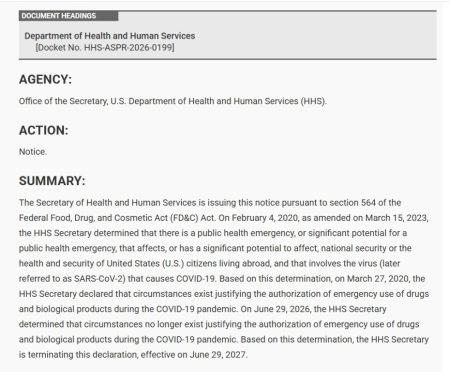
(Jul. 3, 2026) — HHS announced today that Secretary Kennedy signed determinations terminating the COVID-19 EUA declarations for drugs and biological products and for medical devices, because HHS determined that the circumstances justifying those emergency authorities no longer exist. HHS says the drug/biologic declaration ends after a 12-month notice period, while the device declarations end after 180 days.
The Federal Register public-inspection notices give the exact effective dates: June 29, 2027 for COVID-19 drugs and biological products, and December 26, 2026 for the three device declarations covering in vitro diagnostics, personal respiratory protective devices, and other medical devices.
This is an essential first step toward reversing the regulatory capture by Pharma over public health, medicine and our bodies.
The COVID emergency did not merely authorize medical products. It reorganized accountability. Here’s how, and what comes next.
The Public Readiness and Emergency Preparedness Act, the PREP Act, created the liability architecture. The statute granted a covered person immunity from suit and liability under federal and state law for claims of loss caused by, arising out of, relating to, or resulting from administration or use of a covered countermeasure when HHS issues a declaration for that countermeasure. The same statutory section extends that immunity to claims causally related to design, development, clinical testing, manufacture, labeling, distribution, marketing, promotion, sale, purchase, donation, dispensing, prescribing, administration, licensing, or use. That is not ordinary product regulation. That is an extraordinary legal shield.
COVID policy went askew because the federal government placed emergency countermeasures inside that shield, then allowed public agencies, employers, hospitals, universities, schools, pharmacies, and media institutions to behave as though the shielded products had entered civic life under ordinary conditions. They had not. The public encountered campaigns, recommendations, employment pressure, access restrictions, and moral messaging. The manufacturers and administrators operated inside a liability regime that ordinary medical products do not enjoy.
That is the first distortion: the burden moved downward. Manufacturers received insulation. Program planners received insulation. Administrators received insulation. Injured individuals moved into a narrow administrative channel, and they carried the burden they never agreed to carry.
The PREP Act also created the covered-countermeasure compensation process. The statute establishes a fund for eligible individuals with covered injuries directly caused by administration or use of a covered countermeasure, but the process does not replicate ordinary civil litigation. HRSA’s own comparison of the Countermeasures Injury Compensation Program and the National Vaccine Injury Compensation Program states that CICP has a one-year filing deadline, does not pay attorneys’ fees or costs, resolves requests through an administrative process, allows one administrative reconsideration step, and permits no judicial appeal. VICP proceeds through the U.S. Court of Federal Claims, uses Special Masters or judges, and permits judicial appeal.
Read the rest here.