
And an instinct to hide information to suppress rational criticsm of public health programs and policies
by James Lyons-Weiler, PhD, Popular Rationalism, ©2026
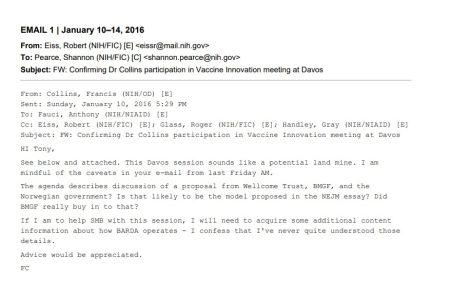
(Jul. 1, 2026) — Francis Collins warned Anthony Fauci that the January 21, 2016 World Economic Forum session titled “Vaccine Innovation for Pandemic Preparedness” looked like a “potential land mine,” according to NIH emails surfaced by Maryanne Demasi and Jeffrey Tucker. The warning was not about a virus. It was about a meeting: a Davos session where the Gates Foundation, Wellcome Trust, Norway, pharmaceutical executives, and U.S. health officials were circling the next model of pandemic preparedness before the world had finished absorbing the lessons of Ebola.
Collins wanted Fauci’s advice because the agenda appeared to involve a proposal for a new vaccine-preparedness partnership. The questions Collins asked were not field-epidemiology questions. They were institutional questions. Was this the model being promoted in the medical literature? Had Gates really bought in? How did BARDA actually work? What position should HHS take? Before the first “Germ Games” email appears, the document already shows the mental operating system: pandemic risk translated immediately into governance, finance, agency turf, philanthropic influence, liability, and platform control.
The later Davos report sharpened the picture. Collins told HHS Secretary Sylvia Burwell that pharmaceutical executives had been blunt. They had spent heavily during Ebola. Their boards had resisted. They could not be expected to do it again for the next outbreak unless governments solved the money and liability questions in advance. They would offer platform capabilities, but they would not surrender commercial intellectual property. Jeremy Farrar then outlined a sketchy nonprofit partnership, with the World Economic Forum serving as interim secretariat.
That is the first buried lesson in the emails: the pandemic-planning class did not begin with transmission. It began with institutions. The outbreak existed as a future trigger for financing, platforms, boards, intellectual property, liability shields, and global coordination. The pathogen had not yet been understood, but the apparatus was already being imagined.
Demasi’s article brought that email trail into public view. The Brownstone companion analysis then connected the international planning culture to the domestic machinery of pandemic governance: the federal plans, emergency-management language, stay-at-home orders, closures, travel restrictions, testing, tracing, countermeasure distribution, and whole-of-government command architecture that later came alive during COVID. Those two reports establish the map. They show the Davos circuitry and the U.S. operational chassis. But the map is not the disease process, and the chassis is not the biology.
The deeper failure exposed by the NIH emails is intellectual before it is institutional. The people preparing for future pandemics understood platforms, finance, liability, command structures, model upgrades, messaging, simulations, and compliance far better than they understood how outbreaks actually become epidemics and pandemics.
That distinction matters because from 2020 through 2022 this same style of model-driven rule helped drive the world toward civic, educational, economic, medical, and constitutional ruin. The catastrophe did not happen because no one had planned. It happened because the planners had mistaken abstraction for comprehension. They treated living societies as programmable systems. They treated models as reality. They treated dissent as a threat to be neutralized. They treated uncertainty as a communications problem. They treated the public as an object of management rather than the sovereign audience to whom science owes the truth.
The surfaced NIH emails therefore deserve a reading deeper than scandal. They show the pre-COVID mindset in formation: outbreaks reduced to scenarios, scenarios reduced to simulations, simulations converted into governance, and governance later imposed on populations as though the assumptions had already been proven. The problem was not preparedness. The problem was superficial comprehension armed with institutional power.
Those two articles therefore establish the map. Demasi shows the elite international circuitry: NIH, WEF, World Bank, Gates, Wellcome, BARDA, WHO, pharmaceutical boards, liability, platforms, simulations, and war-game imagination. Tucker shows the operational chassis: the federal planning documents, the emergency-management vocabulary, the all-of-government cascade, and the civil-liberties machinery waiting to activate again when the next pathogen appears.
I saw incompetence, which is equally scary – if not more.
Read the rest here.