
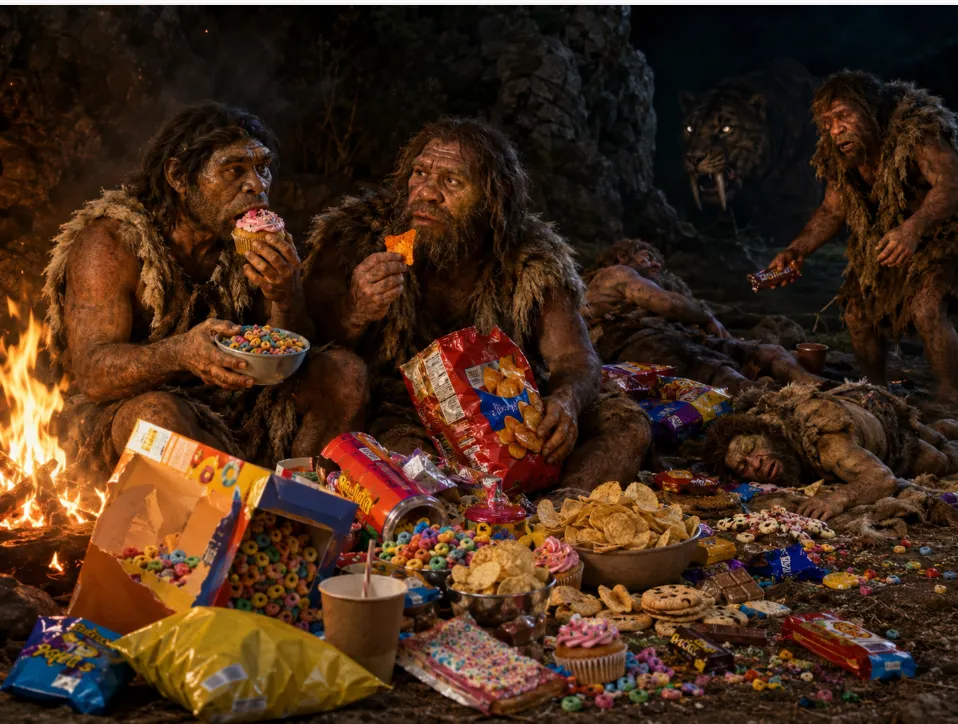
by James Lyons-Weiler, PhD, Popular Rationalism, ©2026

Nearly nothing had low nutrient density. You can put yourself in the ancestral environment by controlling what you allow on your plate and in your mouth.
(Jun. 18, 2026) — A Calorie Is a Calorie: A Useful Fiction
America has achieved a strange biological success. We made calories cheap, portable, shelf-stable, intensely flavored, and available everywhere. Then we built public nutrition around the one number that made that achievement look neutral.
The result should disturb anyone who still thinks the problem is simple arithmetic. By NHANES-based estimates, more than nine in ten Americans fall below the Estimated Average Requirement for vitamin D from foods and beverages. About half fall below the EAR for magnesium. Potassium intake remains below recommended levels across the population, and fiber intake remains so low that one NHANES 2013–2018 analysis found only 7.4% of U.S. adults met the fiber target of 14 grams per 1,000 kilocalories. These are intake estimates, not blood-level diagnoses. The caveat matters. But the direction does not disappear when the caveat is stated.
The same population lives in one of the most calorie-abundant food environments ever constructed.
Hold those two facts together. The standard story begins to crack. This is not a morality play about weak consumers failing to obey correct advice. It is not even, at root, a story about Americans failing to count accurately. It is a story about what the counting system was built to see — and what it was never built to see.
Read on to see how an energy unit became the blind spot at the center of American nutrition affects our perception of “food”.
The calorie was not wrong. It was too narrow.
The calorie is an energy unit. That is its virtue and its limitation.
Historically, it entered nutrition through the attempt to quantify food as potential energy. W.O. Atwater introduced the Calorie to American audiences in 1887 as a practical unit for food energy, and the modern food-label Calorie is equivalent to the kilocalorie: the energy needed to raise one kilogram of water by one degree Celsius. That history matters because the popular critique often becomes sloppy. Atwater was not stupid. The system he helped build was not simply “burn food and pretend humans are furnaces.” Atwater’s work tried to estimate metabolizable energy by accounting for losses.
That is precisely why the deeper error is harder to see.
The calorie does a narrow job. It estimates energy. It does not measure nourishment. It does not measure satiety. It does not measure absorption rate. It does not measure food structure. It does not measure whether the energy arrives with potassium, magnesium, vitamin E, essential fatty acids, intact plant cell walls, water, fiber, polyphenols, or any of the other non-caloric features that make food biologically different from fuel.
“A calorie is a calorie” is true in the limited thermodynamic sense. The first law of thermodynamics has not been repealed. But the slogan smuggles in a second claim: that two foods with the same energy value are nutritionally and metabolically interchangeable. That claim is not physics. It is a category error.
Once you see the calorie as an energy instrument rather than a nourishment instrument, the modern paradox stops being paradoxical. Food has at least two independent properties. Energy density is calories per gram. Nutrient density is nourishment per calorie. Industrial food can maximize the first while stripping the second.
Oil is almost pure energy. Spinach is not. A snack made from refined starch, refined oil, sugar, salt, flavor chemistry, and texture engineering can be extravagant on the first axis and nearly barren on the second. Count only calories and the food becomes a number. Read both axes and it becomes visible again.
The ancestral issue is not nostalgia. It is calibration.
The point is not to romanticize a single Paleolithic menu. There was no single ancestral diet. Human beings ate differently across latitude, season, ecology, and culture. Eaton and Konner made that clear in 1985, and Cordain and colleagues later emphasized that the modern Western diet differs from ancestral dietary patterns across multiple features at once: glycemic load, fatty acid composition, micronutrient density, sodium-to-potassium ratio, and fiber content.
Read the rest here.