by Sharon Rondeau

_(cropped).jpg)
(May 3, 2026) — On today’s “Sunday Morning Futures” with Maria Bartiromo, Treasury Secretary Scott Bessent expounded on the intent of a U.S. campaign against Iran, dubbed “Economic Fury,” to convince the regime to agree to forfeit its nuclear weapons ambitions in order to survive given the weekslong U.S. onslaught against its leadership, military bases and ability to export goods, particularly oil.
On February 28, the U.S. and Israel launched military strikes against Iran, killing its theocratic leader, Ali Khameini, and other high-ranking military and civilian officials, sending the nation into a political tailspin, according to President Donald J. Trump.
On April 13, Trump imposed a “blockade” on the Strait of Hormuz, prohibiting Iran’s ships from transporting exports.
Approximately a month earlier, Iran had closed the Strait, causing oil prices to rise significantly and rekindling economic worries worldwide.
As a result of the blockade, Iran is reportedly losing over $400 million daily, and its storage facilities are full to capacity with oil it is blocked from selling.
On Friday the Treasury Department announced it targeted for “disruption” the activities of three entities facilitating the flow of money to Iran as part of a “shadow banking” operation in accordance with President Trump’s 2020 executive order #13902.
The order states, in part:
I, DONALD J. TRUMP, President of the United States of America, find that Iran continues to be the world’s leading sponsor of terrorism and that Iran has threatened United States military assets and civilians through the use of military force and support to Iranian-backed militia groups. It remains the policy of the United States to deny Iran all paths to a nuclear weapon and intercontinental ballistic missiles, and to counter the totality of Iran’s malign influence in the region. In furtherance of these objectives,
it is the policy of the United States to deny the Iranian government revenues, including revenues derived from the export of products from key sectors of Iran’s economy, that may be used to fund and support its nuclear program, missile development, terrorism and terrorist proxy networks, and malign regional influence.
“Today’s designations further disrupt the Iranian regime’s mechanisms for receiving payments for oil and other commodities, thereby increasing costs and reducing revenue for the regime’s destabilizing activities, and exposing individuals and the methods the Iranian regime uses to bypass sanctions and abuse the international financial system,” the Justice Department wrote on Friday in its press release.
The announcement followed one just days earlier declaring the designation of “35 entities and individuals that oversee Iran’s shadow banking architecture, facilitating the movement of the equivalent of tens of billions of dollars tied to sanctions evasion and Iran’s sponsorship of terrorism. These networks allow Iran’s armed forces—including the Islamic Revolutionary Guard Corps (IRGC)—to access the international financial system to receive payment for illicit oil sales, purchase sensitive components for missiles and other weapons systems, and transfer money to Iran’s terrorist proxies.”
Convinced the economic pressure placed on the regime will be effective in bringing Iran back to the negotiating table after weeks of unproductive talks and canceled meetings, Bessent expressed “optimism” that oil prices will fall after the conflict ends.
“We can see in the futures market that oil prices are already lower three months, six months, nine months out,” he told Bartiromo, “but again, Maria, there are hundreds of oil tankers waiting in the Gulf to come out. The U.S. is only blockading Iranian ships, and we will see…” he said. “I wouldn’t be surprised if we don’t see more of those ships coming out…”
He likened Iran’s current leadership to the “Keystone Cops” and “Baghdad Bob back during the Iraqi War. You had the guy kind-of spouting nonsense while the tanks were driving around behind him, and the Iranians are like this. They’re not tolling the Strait. We think that they’ve gotten less than $1.3 million in tolls, which is a pittance on their previous daily oil revenues.”
“Their oil infrastructure is starting to creak,” he continued. “…They are rapidly filling up storage, and as that happens, they’re going to have to start shutting in wells, which we think could be in the next week.”
Despite higher oil prices since the conflict began, Bartiromo observed, the stock market has continued to rise, a view expressed last week by outgoing Federal Reserve Chairman Jerome Powell, with whom President Trump has an ongoing feud over Powell’s unwillingness to reduce mortgage interest rates over his second term.
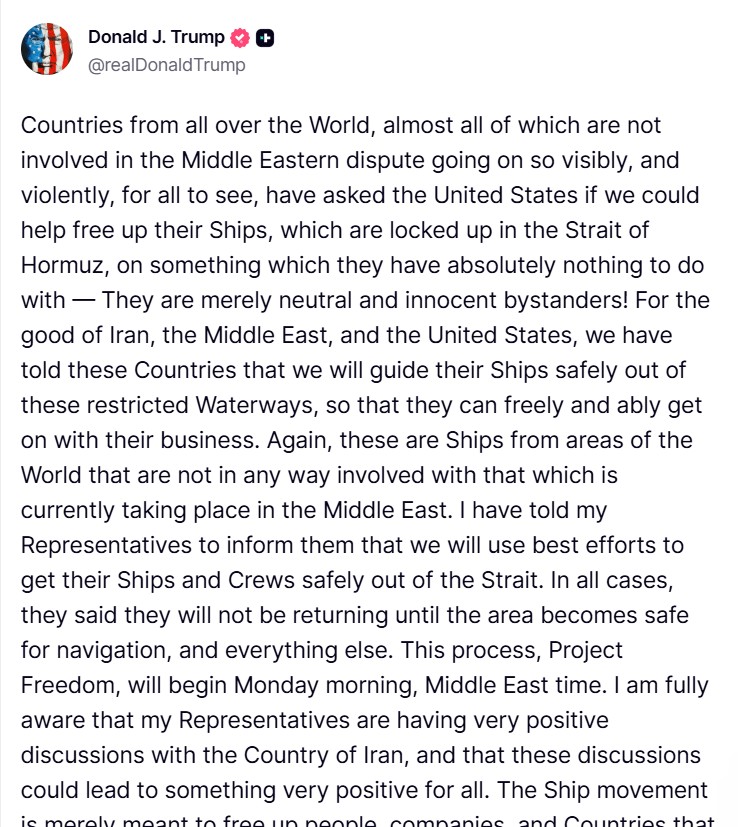
At 4:35 p.m. EDT, Trump announced on Truth Social he will launch a new initiative Monday morning, “Project Freedom” to enable the safe passage of ships from nations not involved in the current Middle-Eastern conflict.
“For the good of Iran, the Middle East, and the United States, we have told these Countries that we will guide their Ships safely out of these restricted Waterways, so that they can freely and ably get on with their business,” Trump wrote. “Again, these are Ships from areas of the World that are not in any way involved with that which is currently taking place in the Middle East. I have told my Representatives to inform them that we will use best efforts to get their Ships and Crews safely out of the Strait…”
He also indicated that talks between the U.S. and Iran could “lead to something very positive for all.”