

by David Shephard, ©2026
(May 1, 2026) — When I was in college, I remember having a discussion in a political science class about the creative drawing, by state legislatures, of majority-minority districts, and the political ramifications of such districts. I am referring to districts where black voters, while a minority in the country, make up a majority of the voters in a given congressional district. We young Republicans at the time appreciated the Democrats’ dilemma, namely that while packing black voters into majority-minority districts did guarantee Democrats a congressional seat, and it no doubt did please their most loyal followers, black voters, such districts also diluted Democrats support in neighboring districts, which ultimately helped Republicans.
Indeed, majority-minority districts had the unintended consequence of making the Republican Party the majority Party in the south, and it helped to eliminate the white southern Democrat – who are now on the endangered species list. Ironically, they are the one, and only, endangered species that the left was never interested in protecting.
Why do we have such districts? Well, it was a liberal reading, in the 1980s, of the Civil Rights Act, specifically, section two of the act, which got us majority-minority districts. It is true that this interpretation has, over the last couple decades, increased the number of black members in Congress substantially, which I think is good, but it also runs counter to the American belief that we should be colorblind. And the other negative consequence, such districts created the idea that people have a right to be represented in Congress by someone from their racial group. They don’t. Your member of Congress represents you from a legal and political standpoint. The congressman’s race and their constituent’s race are irrelevant.
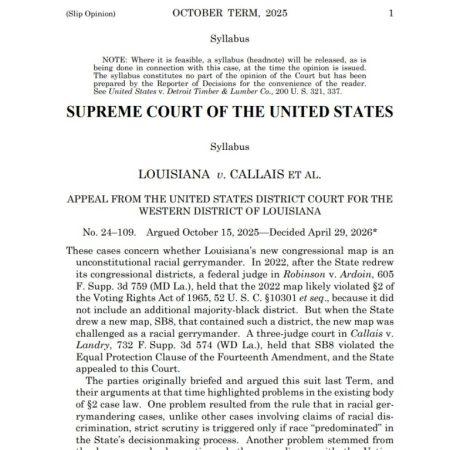
Well, on Wednesday the conservative majority, in Louisiana vs. Callais, gave us a new interpretation, and in my opinion a correct reading of the Voting Rights Act. Despite the handwringing and hyperbole from the media the court didn’t “gut” or overturn any part of the Civil Rights Act. Rather the court did rule that in the absence of clear evidence of racial discrimination, there is no requirement for a state to draw districts based on race. In other words, a state can’t put people into a congressional district based on their race. The likely outcome of the ruling will bring to an end majority-minority districts, and this fact has angered many on the left, specifically the Congressional Black Caucus (CBC), whose members’ districts will most likely be redrawn, beyond all recognition, after 2030.
In every decision there is a winner and a loser, and the loser in this case is the Congressional Black Caucus (CBC). Majority-minority congressional districts are the equivalent of affirmative action for members and would-be members of Congress. But getting rid of these districts will, for many members of the CBC, cut their careers short.
For some context, there are 4 black Republican members of Congress, 5 if you count Senator Tim Scott of South Carolina. All 4 black Republican House members represent majority white districts, and none of them are members of the Congressional Black Caucus. There are 54 Democrat House members of the CBC and most of them are from majority-minority districts.
After the next reapportionment in 2030, this decision, striking down racial gerrymandering, will no doubt cut the size of the CBC. I did a quick perusal of the membership of the CBC, and I doubt many of them could win in a majority or even a plurality white district.
Now partisan gerrymandering is still allowed, so conceivably Democrat legislators could keep the lines for members of the CBC, in their state, and just claim it is partisan and not racial gerrymandering. They could argue that they put so many black voters into those districts, not due to race, but rather due to the fact that they tend to vote for Democrats.
But I have always suspected that Democrats don’t really like racial gerrymandering for the simple fact that it is not the most effective or efficient way to gerrymander. Now the high court has given them an excuse, or cover, to say no to the “civil rights” community: “sorry we can no longer draw majority-minority districts, as much as we would like to.”
When it comes to gerrymandering, Democrats don’t need to pack black voters into one or two districts. In fact, it is probably counterproductive. They have other ways, better ways, to maximize their vote, without packing their most loyal voters into just a couple districts. For example, they can draw in college towns, or wealthy and affluent areas, and swing more than just a couple districts.
I for one think it is good to get rid of racial gerrymandering. It was a relic of the 1960’s. Democrats will now have to earn the votes of black folks. Black politicians will need to get the votes of some white voters, and white politicians will need to get the votes of some black folks. That is what I call democracy.
The left’s claim that majority-minority districts were necessary, because America is a racist country, was a deliberate lie. There are lots of examples of black politicians winning lots of votes from the white electorate. Doug Wilder, a black Democrat, won statewide in Virginia in 1989. Virginia – the former capital of the Confederacy. Obama won nationwide in 2008 and in 2012.
Racial gerrymandering is bad for democracy. Members of the CBC can simply appeal to one race and get elected to Congress. This does nothing to help bring the country together. CBC members like Maxine Waters can fan the flames of racial division and pay no price at the polls.
The Constitution mandates that every 10 years there be a census and a reapportionment of the Congressional districts for the simple reason that all the districts must have the exact same number of people. And toward that end, if I had my way, all districts would be drawn by AI, so the human element would be removed, and the districts would be drawn without regard to race, religion, sex, or partisan affiliation. Now that would go a long way in helping us to form a more perfect union.
Now, I know you may call me a dreamer because of my color-blind, and non-partisan, gerrymandering ideas, but in response I will quote John Lennon, “you may say I’m a dreamer, but I am not the only one.”
David Shephard is a native and very proud Virginian. Raised in Fairfax County, David graduated from George Mason University and majored in Government and Politics. He spent decades in politics, campaign consulting, raising money and lobbying. He is also a longtime conservative blogger writing for numerous blogs. He is also the host of “The Virginia Gentleman Podcast.”
David is the author of Elections Have Consequences, A Cautionary Tale, and his latest book, Norton’s Choice: An Inside Politics Exposé.
Comments
One response to “U.S. Supreme Court Strikes Down Racial Gerrymandering”
My second cousin by the name of Gerald (Gerry) Mandering has this to say on how to standardize Congressional districts throughout the 50 States.
Rough Order of Magnitude.
Voila’: politics vaporized.