

by James Lyons-Weiler, PhD, Popular Rationalism, ©2026

(Mar. 18, 2026) — The United States does not have a patient-demand problem. It has price, coding, middleman, and administrative-waste problems. This article covers all four cost targets — national spending, federal outlays, employer premiums, and household medical bills — and prioritizes the policy levers that lower underlying system prices, cut administrative friction, stop payment gaming, and stop paying for care that does not improve or worsens outcomes.
The Diagnosis: Price, Not Demand
The United States spent $5.3 trillion on health care in 2024 — $15,474 per person and 18.0 percent of GDP.[1] CMS projects that share rising to 20.3 percent of GDP by 2033 if current trajectories hold.[2] That trajectory hits four balance sheets at once: national spending, federal outlays, employer premiums, and household medical bills. Any serious policy response must address all four simultaneously.
The comparative evidence is not ambiguous. Papanicolas, Woskie, and Jha (JAMA, 2018) found that the United States does not use radically more care than peer nations across the board; it pays higher prices for labor, drugs, and services while carrying far heavier administrative overhead.[3]Insurance premiums are not the disease. They are the invoice. That distinction changes the entire policy sequence.
Campaign-finance reform matters. It does not need to come first. Washington already has live instruments: hospital price-transparency enforcement, site-neutral payment authority, Medicare Advantage audit and recovery tools, PBM-reform pathways, antitrust enforcement powers, and a finalized interoperability and prior-authorization rule aimed at reducing administrative burden.[10] The obstacle is not the absence of tools. It is the refusal to deploy them in sequence, with enforcement teeth, before the next election cycle makes them radioactive.
The Ranked Agenda
Cost drivers are not equal. The following six targets are ordered by their measurable fiscal magnitude and the availability of federal instruments to address them. All-payer and global-budget models are addressed separately because they function as containment architecture for concentrated markets rather than as a universal solution.
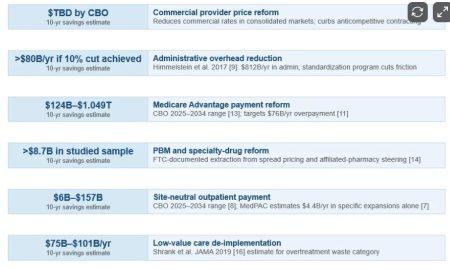
Table 1. Ranked High-Impact Cost Drivers and Estimated Savings Potential in U.S. Healthcare
This table presents the six primary, evidence-backed cost drivers responsible for excess U.S. healthcare spending, ranked by fiscal magnitude and policy tractability. Estimates draw directly from Congressional Budget Office (CBO), Medicare Payment Advisory Commission (MedPAC), Federal Trade Commission (FTC), and peer-reviewed literature. Administrative overhead, Medicare Advantage overpayments, and commercial provider pricing dominate the cost landscape, while PBM extraction, site-of-service distortions, and low-value care represent substantial, measurable, and correctable leakages. The table underscores that the majority of excess spending is concentrated in identifiable, policy-addressable mechanisms rather than diffuse patient demand.
1. Stop Paying for Low-Value Care
The system pays for a substantial volume of care that does not improve patient outcomes. Chalmers and colleagues (JAMA Network Open, 2021) measured overuse across 12 services in Medicare claims and found systematic variation by hospital type, with higher overuse scores in nonteaching and for-profit facilities.[15] The measured services included knee arthroscopy for osteoarthritis, vertebroplasty, inferior vena cava filters, renal stents, spinal fusion for non-specific back pain, EEG for syncope or headache, carotid imaging for syncope, and head imaging for uncomplicated syncope.
Shrank, Rogstad, and Parekh (JAMA, 2019) estimated total annual health-care waste at $760 billion to $935 billion, with overtreatment and low-value care accounting for $75.7 billion to $101.2 billion annually. They projected annual savings of $191 billion to $282 billion from combined waste-reduction interventions.[16] The low-value care category is not the largest slice, but it is among the most clinically actionable — and it produces direct harm in addition to financial waste.
Stopping useless care is not rationing. It is the first condition of ethical cost control.
The de-implementation agenda
Value-based contracts should include explicit low-value-care reduction targets, with bonuses tied to verified performance rather than general process compliance.
HHS should publish and update annually a national de-implementation priority list, drawing on AHRQ evidence reviews, claims-based overuse measurement, and clinical society guidance.
CMS should tie a defined percentage of annual payment updates — applied to relevant services — to verified reductions in targeted low-value utilization, measured using validated claims-based indicators.
Hospital-level overuse scores on priority-list services should be posted publicly alongside readmission rates and other quality measures.
Read the rest here.