
by James Lyons-Weiler, PhD, Popular Rationalism, ©2026

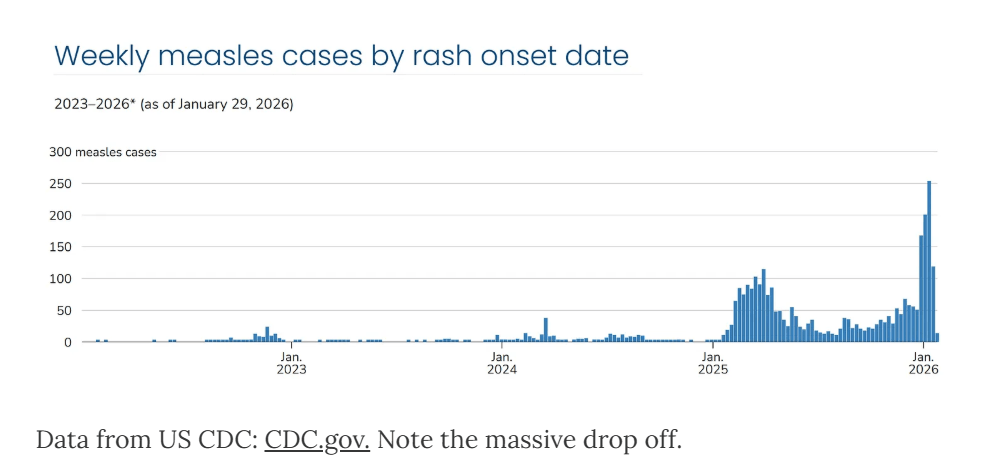
(Feb. 8, 2026) — As of early 2026, a glance at the CDC’s measles rash-onset curve suggests the storm may be passing. The final few bars are low. But whether it is ending takes a bit more time.
To assess whether the measles situation is truly resolving, we must analyze more than the curve. We need to examine how data are collected, how case numbers evolve over time, the biology of immunity and viral dynamics, and how public health policy aligns—or fails to align—with emerging realities. This is the complete analysis.
How Case Counts Work: The Mirage of Right-Censoring
CDC assigns each confirmed measles case to the epidemiological week in which rash onset occurred—not the date of diagnosis or reporting. This means cases always arrive late. If a child develops a rash on Monday, is tested on Thursday, and confirmed the following Tuesday, the case is logged in the past.
Because of this, the most recent 2–3 weeks of data always appear artificially low. This is called right-censoring, and it is intrinsic to all lagged surveillance systems. Early bars are incomplete because they haven’t had time to be filled in. In 2019, for example, week 6 initially showed 12 cases. Three weeks later, that same bar read 36 cases. This phenomenon is so consistent that no responsible epidemiologist draws conclusions from the final bars of a weekly onset curve. And yet, the public does.
During the COVID-19 pandemic, similar artifacts were misread as peaks or troughs. Measles is now falling into the same misinterpretation cycle. Surveillance delay is being mistaken for signal.

Current Numbers and Their Context
As of January 29, 2026, the CDC has confirmed 588 measles cases for the year. Over 90% are part of outbreak chains that began in 2025. That year closed with 2,267 confirmed cases—the most since 1992 and more than eight times the total from 2024. CDC acknowledges these numbers are preliminary.
South Carolina remains at the center of this wave, with 876 outbreak-associated cases as of early February. Public health authorities continue to issue school exclusions, public exposure alerts, and post-exposure prophylaxis advisories. The outbreak cannot be considered over until 42 days—two full incubation periods—have passed since the last infectious exposure. That countdown has not begun.
Read the rest here.