
by Sharon Rondeau
(Jan. 11, 2026) — At 9:06 a.m. EST, “Fox & Friends” co-host Charlie Hurt reported a new figure of 206 deaths resulting from widespread protests in Iran against the Islamic theocracy which has ruled the nation since its 1979 Islamic Revolution.
As of earlier Sunday, the number of deaths was said to be approximately 110; on Saturday, Middle East Eye reported hospitals as having recorded “at least 217 deaths.”
As many as 2,600 protesters have been “detained,” NPR reported Saturday.
In response to protests which began in cities last month but were rapidly augmented at universities and in more rural areas, the Iranian mullahs cut off internet access and more recently, telephone service.
Elon Musk’s Starlink is now providing internet access, Fox & Friends reported.
From Monarchy to Theocracy
In 1979, Ayatollah Khomeini seized control of the country, deposing the monarchy headed by the shah, Mohammad Reza Pahlavi. Renaming it the “Islamic Republic of Iran,” Khomeini identified himself as the “supreme leader” and instituted strict Shia Islamic doctrine on the people.
Women and girls ten years of age and older were forced to wear a hijab or face such punishment ranging from “harassment” to jailing to fines to “flogging.”
Though Khomeini died in 1989, his successor, Ayatollah Ali Khamenei, took an equally hardline stance, promoted “state militarization” and the rise of the Iranian Revolutionary Guard Corps (IRGC) in addition to the army.
In contrast, pre-revolutionary Iran was known for its Westernized society and norms, particularly freedom and education for women.
The last shah, Mohammad Reza Pahlavi, who ruled from 1941 to his displacement in 1979, “initiated major investments in infrastructure, subsidies and land grants for peasant populations, profit sharing for industrial workers, construction of nuclear facilities, nationalization of Iran’s natural resources, and literacy programs which were considered some of the most effective in the world,” Wikipedia reports. “The Shah also instituted economic policy tariffs and preferential loans to Iranian businesses which sought to create an independent Iranian economy. Manufacturing of cars, appliances, and other goods in Iran increased substantially, creating a new industrialist class insulated from threats of foreign competition.”
According to the U.S. Department of Justice, during the 1980s, “Since 1979, the Middle East and the Western world have witnessed a new strain of terrorism associated with Islamic fundamentalism…This campaign has not been a coordinated phenomenon, although Iran has played some role in coordinating it. Most Shiites and even many Sunni have been affected and inspired by the Iranian revolution, and the Islamic crusade has been exported to neighboring Arab countries. Khomeini and the radical mullahs used the Koran to legitimize and promote self-sacrifice among followers and further the campaign against outside forces of suppression. The war against Iraq, the hostage-taking at the U.S. embassy, and the underground terror against the Persian Gulf States have been viewed as Jihads (Holy Wars). Fundamentalist terrorism has had an impact throughout the Middle East, including Kuwait, Bahrain, Iraq, Saudi Arabia, Egypt, Syria, Jordan, and Lebanon. Major extremist groups include Amal, Hizballa, and the Islamic Jihad. The mindset of martyrdom, the sense of injustice to their sect, and the fierce loyalty to religious leaders have shaped the Shia groups into fierce militants. Three factors, each playing off one another, have helped ignite their zeal. These include conflict with foreign ideologies, the Yom Kippur war between Israel and its Arab neighbors, and oil production and prices.”
The theocracy paved for itself a “legacy of terrorism,” the Brookings Institution wrote in January 2019. During Donald Trump’s first term, the State Department classified Iran as “a dangerous regime” which “also is the world’s largest state sponsor of terrorism.”
Iran’s nuclear-enrichment program, which some believed was close to constructing a bomb, received a harsh blow when on June 22, the U.S. military struck three major nuclear sites. At a press conference with Israeli Prime Minister Benjamin Netanyahu on December 29, Trump stated he was told Iran was rebuilding its nuclear arsenal.
“Ready to Help”
The current protests, said by some to be the most intense and widespread in Iran’s history, began on December 28 over spiraling inflation, governmental oppression and corruption, according to Wikipedia.
Trump’s Truth Social timeline Sunday morning expresses support for the protesters as well as for the freedom of Cuba and Venezuela, whose former dictator, Nicolás Maduro, U.S. forces captured in a January 3 surgical extraction to face charges of narco-terrorism lodged in 2020.
On Friday, Trump warned the Iranian regime not to retaliate against protesters with, “You better not start shooting, because we’ll start shooting, too.”
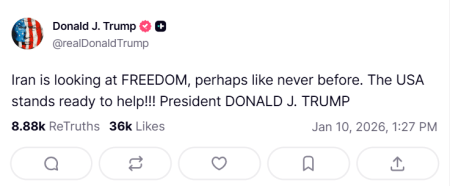
On Saturday afternoon, he wrote, “Iran is looking at FREEDOM, perhaps like never before. The USA stands ready to help!!! President DONALD J. TRUMP.”
Following Hurt’s report on Iran Sunday morning, the co-hosts interviewed American entrepreneur Patrick Bet-David, who was born in Iran prior to the Islamic Revolution and lived there with his parents until age 11, on his observations of current events. He responded that the regime “fears” Trump, and many exiles desire to see the return of the shah in the person of his son. “Everybody wants him to go back and do it,” he said. “He’s supposed to be the savior.”
“When President Trump tells you he’s gonna do something, he does it,” Bet-David continued. “The Iranians remember when he took out Qassem Solemani…”
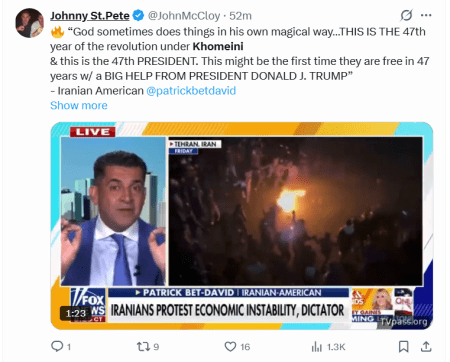
Calling the protesters “courageous,” Bet-David expounded, “You gotta realize, God sometimes does certain things in His own magical way. “This is the 47th year of the Islamic Revolution that happened under Khomeini and this is the 47th President. If the stars are lined up, if God is watching over us, this may be the first year in 47 years that Iran could be free with a big help by the President of the the United States of America, which is President Donald J. Trump.”
Various X accounts, though unverified by this writer, have posted what they say is video of the protesters amid conflagrations and massive street marches.
Footage aired on CBS’s “Face the Nation” Sunday shows “government buildings on fire” and protesters shouting “death to the dictator!” the outlet reported.
On Saturday, a protester climbed the edifice of Iran’s embassy in London, replacing the regime flag with that of the former monarchy bearing a “lion and sun” amid cheers from fellow protesters below.

On Friday Trump said from the White House that “Iran is in trouble” in response to the rising number of protester deaths. “We’ll be hitting them very hard where it hurts, and that doesn’t mean boots on the ground, but it means hitting them very, very hard where it hurts,” he said.
Over the last few days, Pahlavi has encouraged the Iranian people to continue their protests but to “not take side streets that could endanger your lives.”
“Know that you are not alone,” he wrote on X Saturday. “Your compatriots around the world are proudly shouting your voice, and you will surely see images of their numerous and widespread presence on television screens. The world today stands with your national revolution and admires your courage. In particular, President Trump, as the leader of the free world, has closely observed your indescribable bravery and has declared that he is ready to help you. Do not abandon the streets. My heart is with you. I know that I will soon be by your side.”
Today
At 10:19 EST Sunday morning, Pahlavi was Bartiromo’s guest during which he said the current protests have brought “a moment which is defining…This is an opportunity to liberate that nation.”
When Bartiromo asked Pahlavi about his stated plan to become a “transitional leader,” he said as a trained fighter pilot, he possesses the skills to assist in the rebuilding of the country. “People are still fighting despite this crackdown,” he said, and “we are beginning to see more and more defections.”
When asked, Pahlavi provided a message to Trump, stating the Iranian people “believe” Trump’s promise to “have their back.” He called for a “permanent legacy to liberate Iran.”
“This is an opportunity that has presented itself; I plan to return to Iran at the earliest possibility…” he added. “Iranians are prepared to sacrifice not just for themselves,” but “for the whole world,” he said.
He expressed an intent for Iran to have “good relationships with neighbors, including Israel.”
“How long are you expected a transition to take, and what happens then?” Bartiromo continued the interview.
“My job is to lead this transition…” Pahlavi said, and that “under international observation,” he is committed to free and fair elections. As for the length of time a transition might take, he said, “We have to try to do it as quickly as possible” but that it should last “a couple of years.”
Relative to Maduro’s capture and Venezuela’s new future, Pahlavi told Bartiromo, “Every time countries are liberated anywhere in the world, …it’s a message of solidarity across the world.”
When she asked if he would run in a future election, Pahlavi, said, “I’m here to lead” and that he sees himself as a “unifying force” during the transitional period.
Following a segment with HHS Secretary Robert F. Kennedy, Jr. regarding the new CDC dietary recommendations, Bartiromo interviewed Sen. Lindsey Graham, during which Graham urged Trump to “kill” Khamenei.
The topic remained a trend on X through Sunday morning. For his part, Khamenei has claimed the protesters are acting “in order to please the President of the US and make him happy.”
Khamenei has not posted on his X account since Friday.