
by James Lyons-Weiler, PhD, Popular Rationalism, ©2025
(Nov. 25, 2025) — NB: My analysis here does not rest on personal familiarity and long-standing working relationship with Kennedy, but on the evidentiary and methodological standards I have applied to every vaccine-chronic illness study since 2015. This is an important article that deserves your attention and social media shares. -JLW
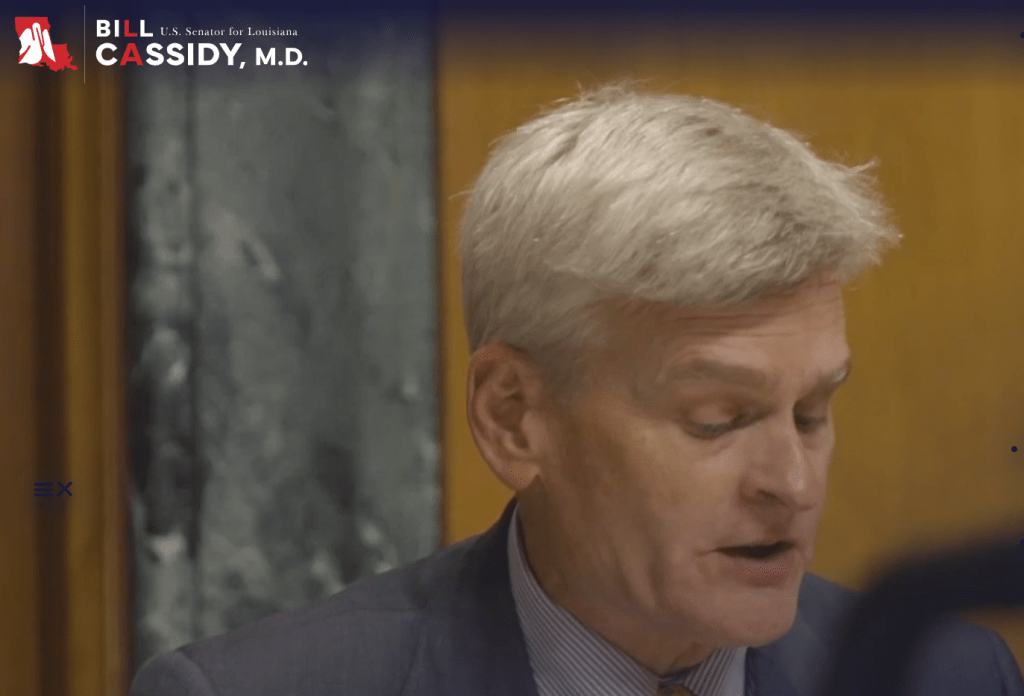
When Senator Bill Cassidy voted to confirm Robert F. Kennedy Jr. as secretary of Health and Human Services, he did not simply exercise the Senate’s “advice and consent” power. He tried to co‑author the job description.
According to Cassidy’s own floor speech and subsequent reporting, he extracted a series of personal promises from Kennedy and treated those assurances as the price of his support: keep the “vaccines do not cause autism” language on the CDC website, preserve existing vaccine advisory structures, protect access to vaccines, seek Cassidy’s input on key hires, and maintain unusually tight coordination with the Senate health committee chair.
That bargain now lies in pieces. The outcome illustrates a deeper problem than one broken deal: a senator tried to hamstring a cabinet‑level health leader at the level of website copy and committee membership, while the country needs a department capable of leading a hard reset on how sick the United States has become.
Cassidy tried to write bad epidemiology into a confirmation vote. Kennedy treated the bargain as a speed bump. The American public ended up with a singular politically mandated distortion of the science presented as a factoid.
The Bargain That Turned Oversight into Co‑Management
Under the Constitution, the Senate holds a clear power: confirm or reject nominees after public scrutiny. It can legislate guardrails, fund or defund programs, and investigate misconduct. It does not hold a formal power to dictate specific sentences on executive‑branch websites or pre‑approve individual staffing decisions inside an agency.
Yet Cassidy, a physician and chair of the Senate Health, Education, Labor and Pensions Committee, publicly framed his vote for Kennedy as contingent on a list of operational concessions. He cited explicit commitments that:
- CDC’s autism page would keep the categorical statement that vaccines do not cause autism. (Cassidy’s claim on the agreement, verbatim: “CDC will not remove statements on their website pointing out that vaccines do not cause autism”)
- The HHS secretary would not create parallel vaccine safety structures outside existing systems. (Verbatim: “(Kennedy) would work within the current vaccine approval and safety monitoring systems, and not establish parallel systems.”
- The secretary would work “unprecedently” (sic) closely with Cassidy himself and seek his input on senior hires. (Verbatim: “He and I will have an unprecedently (sic) close collaborative working relationship … We will meet or speak multiple times a month.” Kennedy had, in testimony, stated that he had already invited Cassidy to his office on numerous occasions, but that Cassidy had never shown up.
That strategy did not operate as neutral institutional design. Cassidy attempted to insert the legislative branch into executive decision streams at a granular level. He tried to convert the Senate’s gatekeeping authority into a continuing veto over phrases, personnel, and advisory bodies.
That move has two predictable properties.
First, it weakens formal law and strengthens informal deals. Handshake assurances leave no enforceable standard when a secretary reverses course.
Second, it defacto places one Senator in a non-existent supervisory position within the Executive Branch as Sec. Kennedy’s supervisor. Secretary Kennedy already has a supervisor provided by the U.S. Constitution. Cassidy’s wishful employment tempts him to overreach and now fight over symbolic language while children still remain at increased risk of neurodevelopmental disorders and autoimmunity based on policies created without science backing them.
Read the rest here.
A perfect example of how the deep state works.