

by James Lyons-Weiler, PhD, Popular Rationalism, ©2025
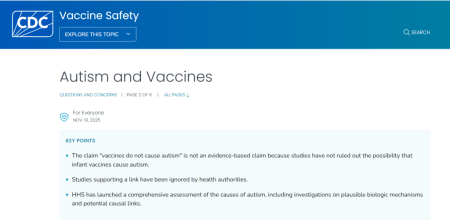
(Nov. 20, 2025) — On November 19, 2025, quietly and without ceremony, the U.S. Centers for Disease Control and Prevention updated its website and rewrote one of the most politically charged sentences in modern American medicine. A sentence that had been treated as gospel—“Vaccines Do Not Cause Autism”—was suddenly recast as something far more fragile. In the CDC’s own words, the slogan “is not an evidence‑based statement” because available studies “have not ruled out the possibility that infant vaccines contribute to the development of autism.”
Yet the headline still sits atop the page. Not because the CDC stands behind it, but because a U.S. Senator demanded it stay. CDC states plainly that the headline remains only due to an agreement with the chair of the Senate HELP Committee. A mandated political slogan now presides over a scientific reversal.
The body of the page reads like a confession. It acknowledges that key infant vaccines—including HepB, DTaP, Hib, PCV13, IPV, rotavirus, and influenza—have never been studied for autism outcomes. It admits that earlier studies used to justify the categorical claim were incapable of ruling out causation. It concedes that mechanistic and associative findings were ignored by health authorities. And it promises, for the first time, an HHS‑led effort to conduct “gold‑standard science” to evaluate whether early‑life vaccination can contribute to autism.
This moment did not arise in a vacuum. It is the final surface rupture of a 25‑year fault line running beneath CDC’s public messaging—a story of suppressed signals, discarded testimony, unpublished findings, internal dissent, FOIA‑released emails, whistleblower documents, and a lawsuit that forced CDC to walk back its own claim once before
The Early Warnings CDC Never Told the Public
In July 1999, the American Academy of Pediatrics and the U.S. Public Health Service issued a joint public statement urging the reduction or elimination of thimerosal in childhood vaccines. The stated reason was “an abundance of caution.” But in internal memos from FDA scientists revealed something more urgent: infants receiving vaccines according to the CDC schedule were exposed to mercury levels far exceeding EPA safety limits.
Behind the scenes, the alarm was palpable; in public, the message was reassurance.
One year later, in June 2000, CDC convened a closed‑door meeting at the Simpsonwood Retreat Center near Atlanta. The meeting brought together CDC officials, vaccine company representatives, and outside consultants to review early analyses from the Vaccine Safety Datalink (VSD). The transcript—obtained via Safeminds by FOIA—shows CDC epidemiologist Thomas Verstraeten presenting a dose‑dependent association between thimerosal exposure and neurodevelopmental disorders, with findings concerning enough that multiple attendees warned of “what this will mean” if made public.
In the months that followed, internal CDC emails—eventually released through persistent FOIA litigation—show Verstraeten repeating the same refrain: “It just won’t go away.” The association persisted despite multiple rounds of analytical restructuring.
But as the signal persisted, the public narrative hardened: vaccines are safe, and no link to autism exists.
2001: The IOM Frames the Outcome Before Reviewing the Evidence
In January 2001, the Institute of Medicine’s Immunization Safety Review Committee met to determine how it would approach vaccines‑and‑autism questions. The committee made two decisions that shaped every subsequent conclusion.
First, the IOM reported they would not review experimental animal data or mechanistic toxicology because the committee did not have “a free weekend” to do so.
Second, as revealed in the same transcript, the chair, Harvard pediatrician Marie McCormick, stated that CDC “wants us to declare” vaccines safe and that the committee was “not ever going to come down that autism is a true side effect.”
Study director Kathleen Stratton added that the predetermined outcome—“inadequate to accept or reject”—was the result “Walt wants,” referring to Walter Orenstein, then head of CDC’s National Immunization Program.
These statements were later entered into the Congressional Record.
The outcome—before any evidence was evaluated—was set.
The Verstraeten Disappearance
In 2002, before CDC’s thimerosal paper was published in Pediatrics, lead author Thomas Verstraeten left CDC to work for GlaxoSmithKline (GSK), a company producing thimerosal‑containing vaccines. The conflict was not disclosed in the paper.
2004: How Testimony and Mechanisms Were Removed
The IOM’s 2004 report on vaccines and autism excluded parental accounts of regression, mechanistic submissions detailing neuroimmune pathways, autism evidence involving vaccines other than the measles, mumps and rubella (MMR) vaccine and the growing literature on thimerosal‑related neurotoxicity.
Although the committee acknowledged that vaccines might trigger autism in a small biologically susceptible subset, it declared such a possibility insufficient to justify further research. It was the line CDC and AAP repeated for years.
At the same moment, statistician C.P. Farrington issued a methodological warning about the self‑controlled case series (SCCS) method—central to CDC’s MMR studies—explaining that SCCS can mask population‑level effects. This concern fell on deaf ears.
Read the rest here.