
by Sharon Rondeau
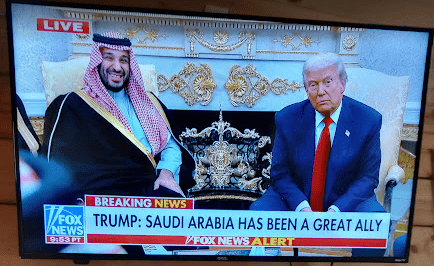
(Nov. 18, 2025) — In an Oval Office meeting with Mohammed bin Salman, Crown Prince of Saudi Arabia early Tuesday afternoon, President Trump announced a Saudi $600 billion investment commitment in the United States while at the same time suggesting it could be increased to $1 trillion.
A few minutes later when Trump asked bin Salman if he wanted to comment, after a second prompt from Trump, bin Salman said the investment will “definitely” increase to $1 trillion.
A total of $21 trillion worldwide has been pledged as investment in the United States, Trump touted, as well as lower gasoline and other prices than during the Biden regime.
The $1 trillion figure was invoked in May when Trump visited the Middle East, signing several significant treaties.
According to the agreement with Saudi Arabia, the kingdom will be purchasing 30 Boeing aircraft, 48 F-35 military planes and other equipment as well as investing in U.S.-based data centers and technology.
The $1 trillion is “national security for us, too,” Trump said in answering a reporter’s question, calling Saudi Arabia “a real ally.”
In contrast to his own administration, Trump said Obama “treated Saudi Arabia very badly” and faulted Biden for “giving a fist-bump” when greeting the nation’s leader on one of his Middle-East trips.
Trump later berated a female ABC News journalist as a “terrible person and terrible reporter” based on what he perceived as her “attitude” while answering her second question.
He said ABC propagates “fake news” and that FCC Commissioner Brendan Carr should consider revoking its broadcast license.
According to the FCC manual, “The Public and Broadcasting”:
In exchange for obtaining a valuable license to operate a broadcast station using the public airwaves, each radio and television licensee is required by law to operate its station in the “public interest, convenience and necessity.” Generally, this means it must air programming that is responsive to the needs and problems of its local community of license. To do this, each non-exempt station licensee must identify the needs and problems and then specifically treat these local matters in the news, public affairs, political and other programming that it airs. As discussed in more detail further in this Manual, each commercial station – and most noncommercial stations – must provide the public with information about how it has met its obligation in a quarterly report. The report contains a listing of the programming the station aired that the licensee believes provided significant treatment of issues facing the community. Each commercial and noncommercial station also must maintain a public inspection file on the FCC’s website https://publicfiles.fcc.gov/ that contains these reports, as well as other materials pertaining to the station’s operations and dealings with the FCC and with the community it is licensed to serve. The public file is an excellent resource to gauge a station’s performance of its obligations as a Commission licensee.